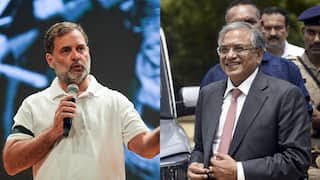
Rahul Gandhi claimed that the 2024 Lok Sabha election and subsequent Assembly polls were “100 per cent” rigged, citing what he described as the disappearance of anti-incumbency and reported objections raised by two Election Commissioners over poll-related decisions.
BY PC Bureau
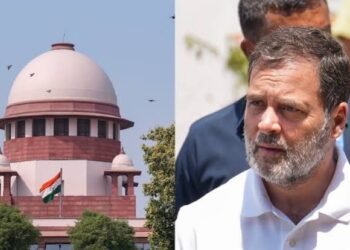
NEW DELHI, September 24: Leader of Opposition in the Lok Sabha Rahul Gandhi on Thursday launxcheda scathing attack on the Election Commission, calling Chief Election Commissioner Gyanesh Kumar a “deshdrohi” and demanding his immediate resignation, while alleging that manipulation of votes has set off a chain reaction in which the legitimacy of laws passed by Parliament and the functioning of constitutional institutions are also put at stake.
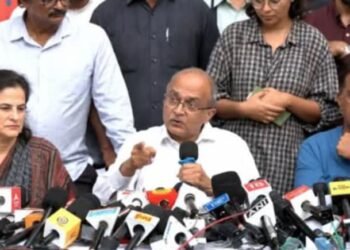
At a press conference in New Delhi, Gandhi said the Congress would not remain silent while, in his words, democracy was being destroyed. He accused the Election Commission of failing in its constitutional responsibility to protect the vote and cited reported objections by Election Commissioners Sukhbir Singh Sandhu and Vivek Joshi to decisions taken in the Commission’s name, including those connected with the Special Intensive Revision (SIR) of electoral rolls. Reports have said the two commissioners recorded objections on at least 14 occasions over a 10-month period; the ECI has described such internal notes and observations as part of its normal decision-making process and maintained that its final decisions were unanimous.
Gandhi’s central argument was that the vote is the foundation of the constitutional system. If the vote is compromised, he argued, the authority derived from that vote is compromised as well. He described the sequence as “vote chori, kanoon chori, sanstha chori”—vote theft leading to law theft and then institutional theft.
“If the vote is stolen and the MPs sitting in Parliament are there based on a stolen vote, then any law they are making is illegal, and any institutional change they make is also illegal,” Gandhi said, according to reports of his remarks.
He went further, alleging that the 2024 Lok Sabha election and subsequent Assembly elections had been rigged, saying there was what he described as “100 per cent certainty” based on evidence he claimed to have presented. Gandhi said he was not making the allegation merely as a political assertion and argued that there was already sufficient information to establish his charge.
A major part of his presentation centred on what he described as the disappearance of anti-incumbency, which he called a fundamental force in Indian democracy.
Gandhi referred to statements by Prime Minister Narendra Modi and Union Home Minister Amit Shah expressing confidence about remaining in power for a long period. He argued that such certainty was unusual in a democratic political system because governments traditionally face anti-incumbency.
“I come from a political family and I have spent more than 50 years in a political family,” Gandhi said, arguing that no political leader operating in a democratic environment could assume that anti-incumbency would simply disappear. He cited former Prime Minister Indira Gandhi, saying that even after the 1971 Bangladesh war and at the height of her popularity, she faced substantial anti-incumbency within a few years.
He then pointed to the electoral histories of Haryana, Maharashtra and Uttar Pradesh, arguing that these states had traditionally swung between political parties. Haryana, he said, had alternated politically for decades; Maharashtra had seen governments change; and Uttar Pradesh had moved between the Samajwadi Party, BSP and other formations. He also referred to Madhya Pradesh and Gujarat, asking why the anti-incumbency pattern appeared to have disappeared in these cases.
“We can understand the popularity of a person, we can understand the performance of a government, but we cannot understand how anti-incumbency disappears,” Gandhi said.
His conclusion was that the explanation lay in what he has repeatedly called “vote chori”.
Gandhi said he and the Congress had been raising questions about electoral processes for some time, but claimed their concerns were ignored. He said the reported objections raised by Sandhu and Joshi had now added another layer to the controversy.
“The two ECs have done a wise thing,” Gandhi said, referring to their reported objections, and urged Gyanesh Kumar to “think seriously” and turn approver, which he described as being in the country’s interest.
He also linked the CEC’s appointment to the controversy. Gandhi said he had submitted a dissent note during the process of selecting Kumar, arguing that the Election Commission should be independent and free from executive control. He alleged that his dissent was “junked”. Under the 2023 law governing appointments, the selection committee comprises the Prime Minister, the Leader of Opposition in the Lok Sabha and a Union Cabinet minister nominated by the Prime Minister.
READ: SIR Deleted Your Name, Gyanesh Kumar’s ECI Asks You to ‘Lie’ on Form 6
Gandhi accused Kumar of attacking the constitutional structure and said the first demand of the Congress was his immediate resignation.
He described the alleged destruction of the vote as an “act against the Indian state and its people” and used the term “deshdrohi” while referring to those he accused of attacking the electoral system. “A person who attacks the vote is a traitor. I’m not saying this lightly,” Gandhi said, according to reports.
Gandhi also widened his allegations beyond the Election Commission, naming Prime Minister Narendra Modi and Home Minister Amit Shah and saying they would be investigated over what he alleged had been done to the country’s democratic system. He described Modi and Shah as being at the “top of the conspiracy”, while saying the details would be revealed.
He characterised the present situation as unprecedented, saying elections were “fundamentally broken”, laws were under question and the independence of institutions was also under threat.
“We are sitting in a place where we have never been,” Gandhi said, arguing that this was the first time in independent India that all three elements—elections, laws and institutions—were simultaneously being questioned.
The Congress leader also framed the controversy as a larger struggle over constitutional democracy, saying his party, which he described as having “fought for freedom”, would not remain silent.
He ended by warning that those responsible would face consequences and said the Opposition would not allow the BJP or the Election Commission under Kumar to “destroy elections”. He again urged Kumar to become an approver, saying doing so would be an act of nationalism.
मैं तीन साल से वोट चोरी का पर्दाफ़ाश करता आ रहा हूँ। अब चुनाव आयुक्त खुद इसे स्वीकार कर सच्चाई उजागर कर रहे हैं।
ज्ञानेश कुमार ने देशद्रोह किया है। वो अभी इस्तीफ़ा दें और approver बन जाएं।
वोट चोरी की साज़िश में नरेंद्र मोदी और अमित शाह की पूरी जांच होगी। pic.twitter.com/l7K0e1fSua
— Rahul Gandhi (@RahulGandhi) September 24, 2026
ECI rejects charge of divided decision-making
The Election Commission has rejected the suggestion that the reported internal notes amount to a breakdown in the Commission’s decision-making. It has said written notes, technical inputs and internal scrutiny are normal mechanisms within the institution and are intended to ensure legal compliance and protect voters’ rights. The Commission has maintained that its final decisions, including those relating to SIR, were unanimous and had legal backing.
BJP hits back
The BJP dismissed Gandhi’s attack as politically motivated. BJP spokesperson Pradeep Bhandari described the briefing as a “damp squib” and accused Gandhi of being unable to secure public support through democratic means. He said voters had already placed the “Gandhi-Vadra family” in the Opposition.
The political confrontation comes amid heightened scrutiny of the Election Commission following reports of repeated objections by two Election Commissioners over decisions concerning electoral-roll processes. The controversy has also intensified the Opposition’s demands for action against Kumar, including calls for his removal and a probe into the allegations.
Gandhi’s allegations remain political claims and have not been established as facts by a court or other independent adjudicating authority. The ECI has rejected the broader allegations and maintained that its decisions are legally backed and unanimously taken.