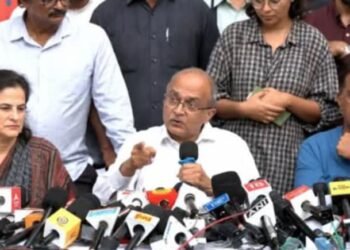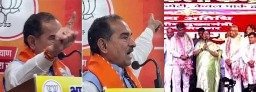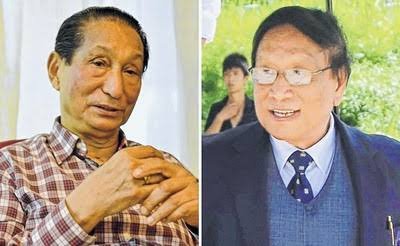
The Nagaland Tribes Council has expanded the controversy into a wider challenge to the current Naga peace process, questioning the exclusion of other Naga political groups from consultations with the NSCN (I-M).
BY PC Bureau
September 24: A full-scale revolt is brewing in Nagaland against the NSCN (I-M), with influential organisations of the Ao community, including the apex Ao Senden, leading a widening backlash against verbal attacks on veteran Naga leader and former chief minister and governor Dr S.C. Jamir. Student organisations, the Nagaland Pradesh Congress Committee (NPCC) and the Nagaland Tribes Council (NTC) have joined the protest, demanding that the remarks against the 95-year-old leader be withdrawn and calling for an open debate on the future of the Naga political settlement.
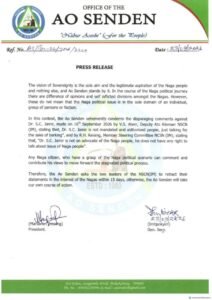
The backlash follows remarks reportedly made by NSCN (I-M) deputy ato kilonser V.S. Atem and steering committee member R.H. Raising on September 16. The Ao Senden said it had taken strong exception to what it described as “disparaging remarks” against Jamir.
According to the Senden, Atem said Jamir was “not mandated and authorized” by the Naga people and was “just talking for the sake of barking”. Raising was quoted as saying that Jamir was “not an advocate of the Naga people” and had “no right to talk about the issue of Naga people”.
The Ao Senden, led by president Marsanen Imsong and general secretary Imtipokyim, has given Atem and Raising 15 days to retract the remarks, saying that failure to do so would leave the organisation with “no option but to pursue its own course of action”.
The Senden also rejected any suggestion that the Naga political issue could be treated as the exclusive preserve of one organisation or faction. It reiterated that sovereignty remained the “sole aim and legitimate aspiration” of the Naga people and said every Naga with an understanding of the political situation had the right to express an opinion and contribute to finding a way forward.
The Ao Students’ Conference (AKM) echoed that position, saying disagreements over Jamir’s views should be settled through democratic debate rather than attempts to silence him. AKM president Lanulemba Longchar and general secretary Aomayang Longkumer said Jamir’s views could be questioned and scrutinised, but doing so should not amount to denying him the right to speak.
The student body argued that if every Naga has the freedom to express an opinion, every Naga must also have the freedom to challenge that opinion. Disputed statements, it said, should be answered with facts and reasoned arguments rather than attempts to silence the speaker. No individual or organisation, it added, should claim exclusive ownership over discussion of the Naga people’s political future.
The Ongpangkong Students’ Conference (OKM) also came out in support of Jamir. Its president Tongpangmangyang Kichu and general secretary Sungkumjang Kichu said they were “deeply disturbed” by the allegations against the veteran leader and described the reported remarks by the NSCN (I-M) as “uncalled-for and unacceptable”. They said Jamir’s comments represented his personal views and should not be interpreted as an attempt to cause harm.
OKM warned that a prolonged war of words could further weaken Naga unity. It endorsed the positions taken by the Ao Senden and AKM, called for a timely and honourable political settlement and said it would remain vigilant.
NPCC president and Lok Sabha MP S. Supongmeren Jamir, meanwhile, said every Naga citizen and leader had the right to speak on the search for a political solution. The Naga struggle, he said, was a continuous process, and while statements by legislators and other leaders could reflect personal perspectives, that did not take away their right to participate in the political discourse.
Supongmeren also criticised the proposed compulsion of Vande Mataram, saying it would be “totally against the ethic of Christianity” and arguing that a secular Union government should not make it mandatory. On the deaths in Tuensang allegedly linked to illicit liquor, he said the Nagaland Liquor Total Prohibition Act should be reviewed and rectified if necessary, arguing that laws should ultimately serve to protect lives.
The Nagaland Tribes Council has taken the dispute beyond the question of the remarks, questioning the structure of the ongoing political dialogue itself. NTC president C. Pankathung Lotha and general secretary C. Onen Walling said details of a recent consultative meeting between the NSCN (I-M) and the State government had not been made public, but described reported references to Jamir as “nobody”, “no mandated person”, “no advocate” and an “old man in hurry” as “illogical, unpalatable and unacceptable”.
READ: SIR Deleted Your Name, Gyanesh Kumar’s ECI Asks You to ‘Lie’ on Form 6
The NTC referred to what it said were four attempts on Jamir’s life and warned that such language could deepen existing divisions. It also questioned the NSCN (I-M)’s present position on the political settlement, referring to the August 3, 2015 Framework Agreement with the Government of India, signed after years of ceasefire and negotiations, as well as the separate agreement signed by six other Naga groups on November 17, 2017.
The council further questioned the State government’s decision to hold the consultative meeting with the NSCN (I-M) while excluding the six other Naga National Political Groups, arguing that the oppositionless BJP-NPF government, as a facilitator, should engage all stakeholders. It described the approach as a “divide and rule” strategy.
On the reported “old man in hurry” remark attributed by the NTC to State government adviser Achumbemo Kikon, the council said the issue should not be allowed to become a major political controversy and suggested that Kikon apologise if he had made the remark personally.
The NTC also raised historical questions concerning Tangkhul participation in the Naga movement, the 1975 Shillong Accord and subsequent NSCN alignments, while questioning what it described as inconsistencies between the NSCN (I-M)’s 1997 ceasefire, the 2015 Framework Agreement and its present position.
The council appealed to Nagas to reject further division and instead focus on peace, unity and development. It called for a political settlement before the next Assembly election, expected in February-March 2028, saying Nagas had endured decades of conflict and nearly three decades of ceasefire without a final settlement.