While the administration has approved withdrawal of cases against 20 people booked in connection with last year’s violence, the inquiry report remains a central demand of Wangchuk and the Ladakh leadershi
BY PC Bureau
September 24: Ladakh Police on Thursday disputed claims surrounding climate activist Sonam Wangchuk’s latest protest programme, saying the September 23 padyatra and the prayer meeting held a day later drew substantially fewer people than organisers had projected, while rejecting allegations that security personnel prevented residents from attending the gathering.
The police statement came as Ladakh observed the first anniversary of the September 24, 2025 violence in Leh, in which four people were killed during protests demanding greater political safeguards for the Union Territory.
Wangchuk and the Leh Apex Body (LAB) had revived the agitation ahead of the anniversary, with the activist seeking the early publication of the judicial inquiry report into last year’s violence, justice and compensation for those killed and injured, and renewed movement on Ladakh’s long-standing demands for statehood and constitutional safeguards, including Sixth Schedule protection.
AMIT SHAH MUST RESIGN…
Today Ladakh commemorated the first anniversary of indiscriminate firing with AK 47 on unarmed youth that lead to the killing of 4+1, injury to 80+ & FIRs against 80+.
All without any firing order. Even after one year, the report of the Judicial Inquiry… pic.twitter.com/kvqFay4Aov— Sonam Wangchuk (@Wangchuk66) September 24, 2026
Police: Padyatra never exceeded 70
According to Ladakh Police, the LAB had obtained permission for a 20-kilometre padyatra from Kharu village to Leh Market on September 23. Authorities said they deployed security, traffic and crowd-management personnel because organisers had projected a large procession.
The police, however, said the march ultimately involved no more than about 70 participants.
Wangchuk and his supporters began the walk from Kharu but stopped after approximately four kilometres at Stakna, according to the police account. The participants then travelled by vehicle to Sindhu Ghat before continuing on foot to NDS Memorial Park.
The march had initially been conceived on a larger scale. Wangchuk had told claimed before the event that the padyatra was intended to remind the Centre of its commitments to Ladakh and to commemorate those killed, injured or jailed during the movement for constitutional safeguards and restoration of democratic rights. The original plans were subsequently scaled down amid changing weather conditions.
Police deny blocking prayer gathering
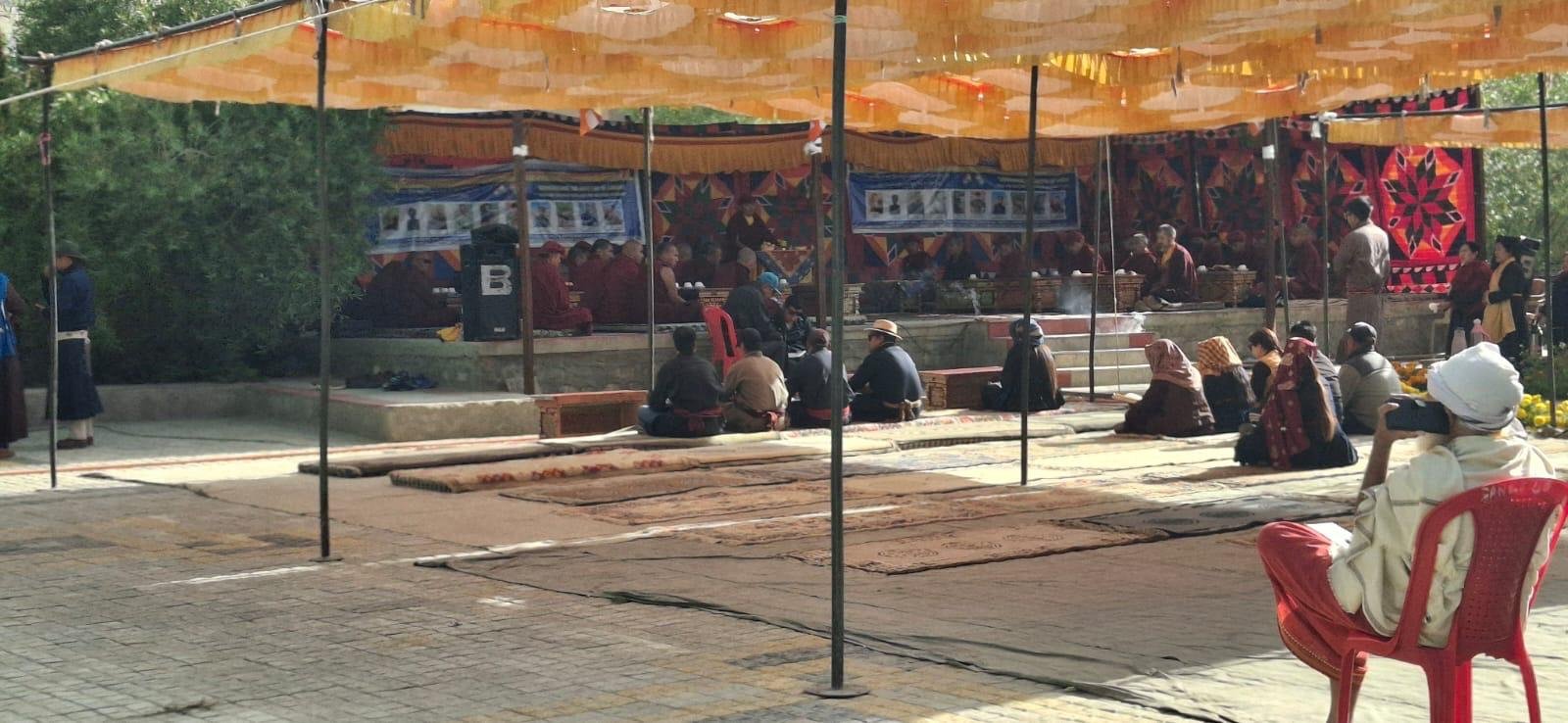
On September 24, the Ladakh Buddhist Association held a public meeting at NDS Stadium, which has a reported capacity of around 10,000. The administration had permitted a prayer gathering between 10 am and noon.
Police said fewer than 800 people attended.
Among those who addressed the gathering were Wangchuk, LAB leader Chering Dorjay Lakrook, Ladakh MP Mohammed Haneefa Jan, former MP Thupstan Chhewang, Asghar Karbalai and Sajjad Kargili.
During the meeting, leaders alleged that police barricades had prevented residents from reaching the venue.
Ladakh Police rejected the allegation, saying no individual had been stopped from proceeding to the venue or attending the programme. Any barricades or police deployments elsewhere in Leh, it said, were part of routine traffic and crowd-management arrangements because organisers had anticipated a large gathering.
The police described allegations that residents had been prevented from attending as “totally false, baseless, and misleading”, while reiterating that lawful and peaceful assemblies would be permitted subject to public-safety requirements.
What Wangchuk had said before the padyatra
The police account comes against the backdrop of increasingly sharp statements by Wangchuk in the days before the march.
Announcing the September 23 programme, Wangchuk had said the march was not simply a commemoration of the four people killed in the 2025 violence. He described it as part of the continuing struggle for Ladakh’s land, environment, culture and democratic rights.
He demanded that the judicial inquiry into the September 24, 2025 violence be made public, arguing that the report should establish why the firing took place, whether there was an order to open fire and who was responsible. He also questioned how the violence began and raised allegations concerning the use of automatic weapons against protesters.
READ: SIR Deleted Your Name, Gyanesh Kumar’s ECI Asks You to ‘Lie’ on Form 6
Wangchuk also criticised the compensation announced for victims, saying the amounts were inadequate. He said that families of those killed had been offered ₹15 lakh, while compensation for permanently disabled victims ranged from ₹1 lakh to ₹3 lakh, which he said was insufficient.
The activist also accused the Centre of failing to make substantive progress in negotiations with Ladakh’s representatives. After the September 9 meeting between the Union Home Ministry and representatives of the Leh Apex Body and Kargil Democratic Alliance, Wangchuk said the talks had produced no new substantive proposal.
“Chai was nice, but nothing has moved forward,” he said.. He said the delegation had presented a list of issues it regarded as non-negotiable, including greater authority for an elected UT-level leadership over the bureaucracy and law and order, as well as assurances against major decisions affecting land and governance before an elected structure was established.
He also accused the government of calling meetings only when an agitation was announced, arguing that the September meeting appeared designed to delay the planned padyatra.
The larger Ladakh movement
The current confrontation is the latest phase of an agitation that gained momentum after Ladakh became a separate Union Territory without a legislature in 2019 following the reorganisation of the former state of Jammu and Kashmir.
While the creation of a Union Territory had long been sought by sections of Ladakh’s political leadership, concerns subsequently grew over the absence of an elected legislature and over control of land, employment, natural resources and local administration.
The Leh Apex Body and Kargil Democratic Alliance subsequently emerged as the principal civil-society platforms negotiating with the Centre.
Their demands have included statehood for Ladakh, inclusion under the Sixth Schedule, greater safeguards for land and employment, stronger political representation and greater local control over development and natural resources. The movement has also sought separate parliamentary representation for Leh and Kargil and stronger democratic control over administration.
Wangchuk became one of the most prominent public faces of that movement.
In March 2024, he undertook a 21-day hunger strike to press for constitutional safeguards and protection of Ladakh’s environment and resources. Later that year, he joined the LAB-KDA-backed Delhi Chalo padyatra, a roughly 1,000-kilometre march from Ladakh to Delhi.
The marchers were detained near the Delhi border on September 30, 2024, as they attempted to enter the capital. Wangchuk and the other participants were subsequently released and allowed to proceed to Rajghat on October 2.
The 2024 march had brought together demands for statehood, Sixth Schedule protection, stronger political representation, safeguards for land and employment and greater local control over natural resources.