Copenhagen and Prague airports, Hungary’s airspace and Ireland’s national broadcaster RTÉ were among the latest targets across Europe. At least 14 flights were disrupted on Thursday.
BY PC Bureau
November 6: Airports, airlines and media organisations across Europe have been hit by a wave of bomb threats, triggering evacuations, security searches and flight disruptions. The threats, which have so far proved false, have raised concerns about a possible coordinated campaign aimed at creating panic and testing European security systems.
On Friday, fresh warnings prompted security checks at several airports and forced Ireland’s national broadcaster RTÉ to evacuate its offices. Other media organisations, including Sky, also reported receiving similar threats.
The incidents come amid growing concerns over hybrid attacks targeting European countries. Some officials and security analysts have previously pointed to possible Russian links in such operations, but no perpetrator has been identified in the latest cases.
Airports and media organisations in Europe targeted
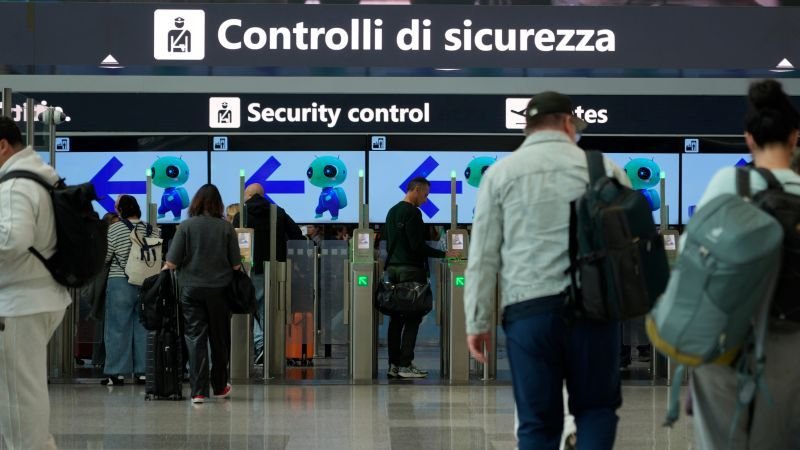
The threats initially focused on airports and airlines in Europe. On Friday, police in Denmark and the Czech Republic reported fresh warnings involving Copenhagen and Prague airports. Hungary’s defence minister said fighter jets escorted three aircraft in Hungarian airspace following threat reports that morning.
A KLM flight from Prague to Amsterdam was searched after landing, but no explosives were found. The incident followed disruption to at least 14 flights on Thursday.
The threats later spread to media organisations, particularly in Ireland. RTÉ received an email claiming that an operative had planted a bomb inside its building, which would detonate within 45 minutes. The message also threatened attacks on “airplanes, cruise ships, subway stations and trains” across Europe.
READ: ECI Gives Left-Out Electors Another Chance During Ongoing SIR
🚨🇪🇺🇮🇪 BREAKING:
BOMB THREATS in Ireland this AM were reportedly accompanied by an email sent out to media orgs, including RTE, Newstalk, and the Irish Independent:
“Hello. I am Mikhail Andropov, one of the leaders of the group responsible for the bomb threats against airplanes in Europe over the past week.
European authorities have once again shown that they are incompetent fools who are incapable of doing anything to stop us.
We experimented with multithreading, and we succeeded in causing widespread panic, as well as forcing European authorities to spend a fortune on all these procedures.
But this is only the beginning. What happened this week is just a small part of what awaits Europe in the near future.
Right now, we’re preparing a new wave of attacks. Right now, we’re recruiting residents of your countries who are actively cooperating with us.
We’ve also gained access to compromised devices, servers, and accounts belonging to residents of Europe, as well as those outside its borders—which will allow us to use this against you.
Very soon, we will be blowing up your airplanes, cruise ships, subway stations, and trains. In the meantime, I recommend taking a vacation by plane while you still have the chance.
We want the whole world to know about us, which is why one of our operatives has planted an explosive device in your building. It will detonate in 45 minutes. The clock is ticking.”
Source: Live 95 (Ireland) / Writer: Michael
https://t.co/dmwc4Zrluk— Mario Nawfal (@MarioNawfal) November 6, 2026
How were the threats delivered?
Most of the warnings appear to have been sent by email.
Prague’s Václav Havel Airport said it received an anonymous message claiming that bombs had been placed on four flights. Czech police confirmed that similar emails had been sent to other European airports.
In Italy, an email from a group calling itself “The Male State” was sent to a logistics company linked to Rome’s Fiumicino Airport. The message falsely claimed that explosive devices had been placed on two incoming flights from Helsinki and Dublin. The airport confirmed that the threat had been received.
The Male State originated in Russia in 2016 as a misogynistic movement and later supported Russia’s war in Ukraine. A Russian court designated it an extremist organisation in 2021.
Airport security experts say European airports have established procedures for responding to bomb threats and regularly conduct emergency drills. Every threat is treated seriously, even when it ultimately proves to be a hoax.
Who is behind the threats?
No individual, organisation or country has been formally identified as responsible. The European Union has said it is too early to draw conclusions about the source of the incidents.
Some security analysts and government officials suspect the threats could be part of a wider campaign of hybrid attacks or coordinated intimidation.
Eric Schouten of aviation security group Dyami pointed to the possibility of Russian state-linked saboteurs, noting that several of the affected countries support Ukraine.
Germany’s Foreign Ministry referred to Russia’s invasion of Ukraine, saying European security was “being tested far beyond the Ukrainian frontline”. It cited the bomb threats alongside cyberattacks on supermarket refrigeration systems and drone incursions.
Spain’s foreign minister described the incidents as a likely “attempt at hybrid aggression and a form of psychological warfare”. Britain’s transport minister called the threats a “malicious hoax”.
Irish officials, meanwhile, said they had yet to establish whether the threats against media organisations originated from an individual or were part of a coordinated operation.
Disruption without explosives
All the threats reported so far have proved false. No explosive devices have been found.
The disruption to air travel has nevertheless been significant. At least 14 flights were affected on Thursday, including an Aer Lingus service diverted to France and two other flights diverted to Sofia, Bulgaria. Several additional flights were disrupted earlier in the week.
Security analysts say such threats can serve purposes beyond causing immediate disruption. They may also be intended to spread public anxiety, impose economic costs and test the response capabilities of airlines, airports and security agencies.
The incidents have coincided with other reported disruptions across Europe, including cyberattacks on supermarket refrigeration systems in several countries, adding to concerns about a broader pattern of attacks on civilian infrastructure.