With Section 31 of the Representation of the People Act warning of punishment for knowingly false declarations, deleted voters face questions over whether Form 6 provides a proper route for restoration of their earlier enrolment.
By Navin Upadhyay
NEW DELHI, September 24: What happens to a voter whose name was already on the electoral roll but disappears during the Election Commission’s Special Intensive Revision? In Delhi, the answer currently appears to be: apply afresh through Form 6—but first declare that you are seeking inclusion in the electoral roll “for the first time”.
That wording has triggered a legal challenge and is now raising a broader question: can a voter who says he was already registered truthfully make a declaration meant for someone entering the electoral roll for the first time?
The Election Commission’s Form 6 states: “I am applying for inclusion in Electoral Roll for the first time and my name is not included in any Assembly Constituency/Parliamentary Constituency.” The declaration is followed by a warning that a statement or declaration which is knowingly false, or which the applicant does not believe to be true, is punishable under Section 31 of the Representation of the People Act, 1950, with imprisonment of up to one year, a fine, or both.
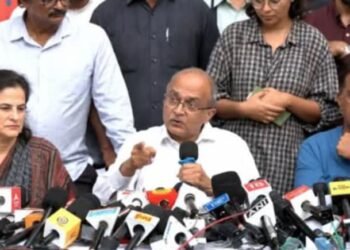
The issue is not hypothetical. Former Principal Director-General of the Directorate of Revenue Intelligence D.P. Dash says he recently found his name missing from the electoral roll in Odisha during the SIR exercise. He said he was advised to use Form 6 to seek inclusion but refused because he had already been a registered voter and did not want to declare that he was applying for inclusion for the first time.
Dash said he raised the issue with the Booth Level Officer, who told him that an objection could not be uploaded on that ground and that the available route required Form 6. Dash subsequently submitted a written complaint and asked the BLO to upload it.
READ: Ladakh Violence: LG Withdraws Cases Against 20 Accused
“This is ridiculous. The EC is compelling you to lie on affidavit,” Dash said.
The controversy has already reached the Delhi High Court. A petition filed by Delhi Pradesh Congress Committee president Devender Yadav and another petitioner challenged the “first-time applicant” declaration in Form 6 insofar as it applies to voters whose names had previously appeared on electoral rolls but were deleted during the pre-SIR exercise or the ongoing SIR. The petitioners argued that such voters could be forced into making a declaration inconsistent with their electoral history and could potentially face the consequences of Section 31. The High Court did not examine the merits at that stage and directed the petitioners to pursue the matter as a public interest litigation.
The Election Commission’s own Delhi SIR instructions make the issue more consequential. The Chief Electoral Officer’s website tells electors whose names are not found in the draft roll that they may file Form 6 during the claims-and-objections period, along with the declaration form and supporting documents. It separately describes Form 6 as the application for enrolment of a new elector.
That creates the central problem. A genuinely new voter and a previously enrolled voter whose name has disappeared are not necessarily the same category. Yet the same Form 6 declaration asks both to affirm that the application is being made “for the first time”.
The distinction is important because Section 31 does not make every inaccurate statement an automatic criminal offence; it specifically refers to a statement or declaration that is false and which the person knows or believes to be false, or does not believe to be true. But that is precisely why the wording of the form matters. A voter who believes he was already enrolled may reasonably question whether he can sign a declaration saying the application is being made for the first time.
The Election Commission has other forms for other electoral situations. Its Delhi website identifies Form 8 for shifting residence, correction of existing entries and related changes, while Form 7 is used for objections to inclusion or for seeking deletion. But for a person who says, “My name was already there and has now disappeared,” the SIR instructions specifically point to Form 6 as the route for inclusion after the draft roll is published.
That is what makes the controversy larger than a technical dispute over a form.
The voter’s position is simple: “I was already registered.”
The Form 6 declaration says: “I am applying for inclusion for the first time.”
And immediately after that declaration, the form warns of punishment for a knowingly false statement.
The question now before the electoral machinery—and potentially the courts—is whether a procedure designed to restore the electoral status of a previously enrolled voter can require that voter to make a declaration intended for a first-time enrolment.
For voters affected by SIR, that is not merely a question of paperwork. It is a question of whether the route provided to get back onto the electoral roll accurately reflects the status they are seeking to establish in the first place.