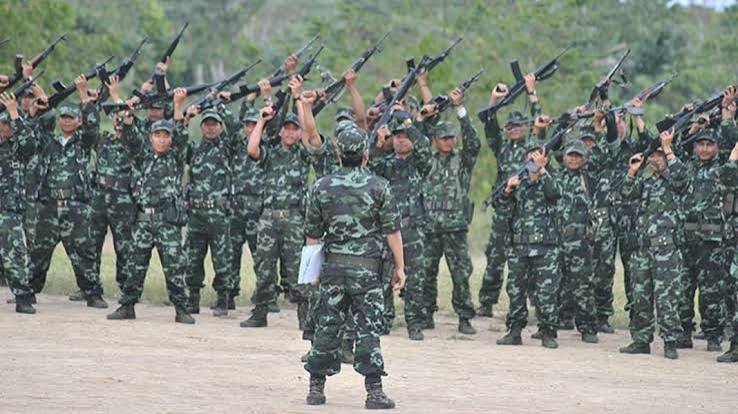
Local reports described the four as Eastern Zone Village Volunteers linked to Mount Ararat Camp. The identity of the attackers, their affiliation and the precise circumstances of the shooting remain unconfirmed.
BY PC Bureau
September 24: Manipur’s fragile hill districts witnessed a fresh spate of violence on Wednesday night and Thursday, with four persons reportedly linked to the NSCN (I-M)’s Eastern Flank shot dead in Kamjong, while 41 Naga homes and several community churches were reportedly set ablaze in the Makui area of Kangpokpi.
The incidents, reported from two districts with a history of inter-community tensions and armed-group activity, have triggered fresh allegations between Naga and Kuki groups. While local accounts have attributed the attacks to rival armed formations, the identities of the perpetrators and the circumstances of the violence have not been independently established.
In Pilong, Kamjong district, four persons described by local Tangkhul reports as Eastern Zone Village Volunteers (EZ-VVs) associated with the NSCN (I-M) were reportedly shot dead on Thursday.
The deceased were identified as Phami Jajo, Ningthem Zingsui, Betterson Jajo and Vareishim Jajo, while Akhan Kaping of Hunphun was reported to have survived the attack.
A local Tangkhul account said the four were associated with the Mount Ararat Camp and the Somdra Tract Burma Refugee Tangkhul NSCN (I-M) grouping. It said the camp leadership subsequently conveyed information about the incident to the organisation’s PRO.
The precise circumstances remain unclear. Local reports have referred to the involvement of other armed persons, but there is no independent confirmation identifying the attackers or establishing their organisational affiliation.
READ: Rahul Gandhi Calls CEC Gyanesh Kumar ‘traitor’, Alleges 2024 Polls Were ‘100% Rigged’
41 Naga Houses Destroyed
In a separate development in Kangpokpi district, 41 Naga houses were reportedly burnt in three settlements around Makui, along with several community churches, during violence that continued for nearly 12 hours.
The affected settlements were Makui Chamriupui, Makui Thanamba and Makui Thebram. According to media reports, 17 houses were destroyed in Makui Chamriupui, eight in Makui Thanamba and 16 in Makui Thebram.
Reports said the arson began at around 2.30 pm on September 23 and continued until approximately 2.30 am on September 24.
Displaced residents alleged that armed Kuki groups were responsible for the destruction. The allegation could not be independently verified.
The violence forced residents to leave their homes and move towards the larger Makui village centre, where displaced families reportedly sought shelter.
The latest incidents add another layer to a conflict that has increasingly seen Naga-Kuki tensions intersect with the activities of multiple armed organisations.
Kuki-Zo organisations have repeatedly accused NSCN (I-M) and allied groups of involvement in attacks on Kuki civilians and settlements in the hill districts. Naga organisations and NSCN (I-M), in turn, have rejected allegations of a campaign against Kukis and accused Kuki armed groups of attacks on Naga areas.
The competing narratives have become particularly difficult to verify because attackers in several incidents have been described by police or local authorities only as unidentified armed men.
For the moment, the two latest episodes remain surrounded by unanswered questions: who carried out the attacks, which armed groups were involved, whether existing ceasefire or peace arrangements were violated, and why security forces were unable to prevent the reported destruction of civilian homes.