

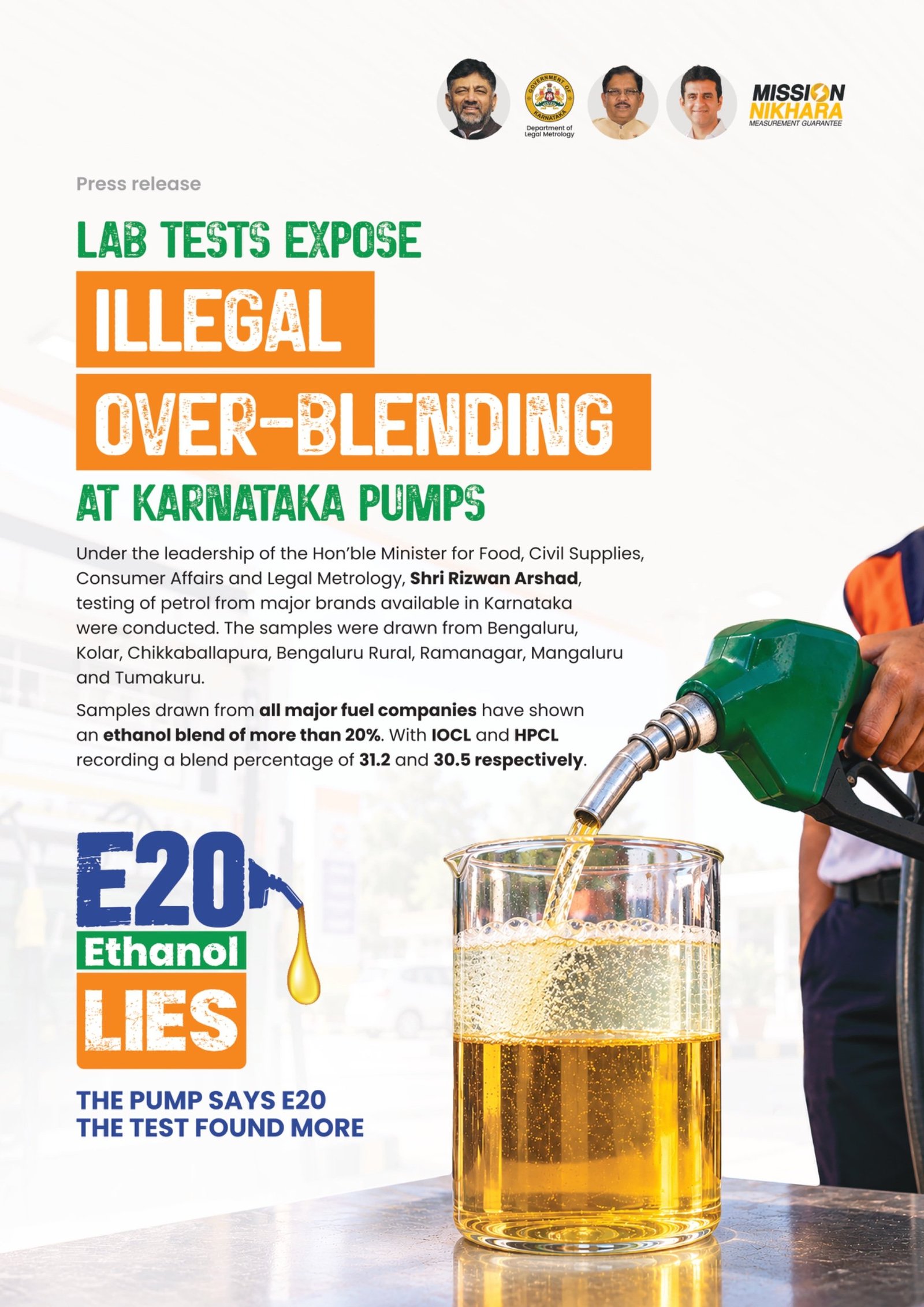
Independent laboratory tests commissioned by Karnataka found that 11 of 14 detailed petrol samples contained more than 20% ethanol. Indian Oil recorded the highest concentration at 31.2%, followed by HPCL at 30.5%, according to the state government.
PC Bureau
Bengaluru, November 6, 2026: Independent laboratory tests commissioned by the Karnataka government have found ethanol concentrations of up to 31.2% in petrol sold by major oil companies, well above the 20% blend targeted under the Centre’s E20 programme.
Food, Civil Supplies and Consumer Affairs Minister Rizwan Arshad released the findings on Friday, saying samples from Indian Oil Corporation Limited (IOCL) recorded the highest ethanol content at 31.2%, followed by Hindustan Petroleum Corporation Limited (HPCL) at 30.5%. Samples collected from Bharat Petroleum Corporation Limited (BPCL), Nayara Energy and Shell outlets also showed levels exceeding 20%.
The state government said four out of five petrol pumps surveyed were selling fuel with ethanol content above the E20 level. It accused oil marketing companies of failing to provide adequate information to consumers and demanded that the Centre investigate the findings and take corrective action.
Addressed a press conference today and shared laboratory findings exposing excessive ethanol blending in petrol supplied across Karnataka. Tests conducted at NABL-accredited and ISO-certified laboratories found ethanol levels exceeding 20%, with certain IOCL and HPCL samples recording 31.2% and 30.5%, respectively.
Under the leadership of Hon’ble Chief Minister Shri D.K. Shivakumar, we demand transparency from the Union Government, strict action against over-blending, compensation for affected consumers and mandatory disclosure of ethanol content at fuel stations. Consumers deserve quality fuel and transparency for every rupee they pay.
#PressConference #Ethanol #E20
— Rizwan Arshad (@ArshadRizwan) November 6, 2026
Laboratory Tests Find Ethanol Levels Above 30%
The Department of Food, Civil Supplies and Consumer Affairs, along with the Legal Metrology Department, collected 63 petrol samples from outlets operated by IOCL, HPCL, BPCL, Nayara Energy, Shell and Mangalore Refinery and Petrochemicals Limited (MRPL).
The samples were collected across seven districts: Bengaluru Urban, Bengaluru Rural, Kolar, Chikkaballapura, Ramanagara, Dakshina Kannada and Tumakuru.
The samples were initially sent to the in-house laboratories of IOCL and BPCL. Arshad said the reports from these laboratories did not disclose the ethanol content, despite it being one of the prescribed testing parameters.
He questioned the lack of disclosure, saying it raised serious concerns about transparency and the information being provided to consumers.
The samples were subsequently examined at the Shriram Research Institute in Bengaluru, an NABL-accredited and ISO-certified laboratory. The institute used gas chromatography to measure ethanol concentrations.
Of the 14 samples for which detailed results were released, 11 recorded ethanol levels above 20%. The concentrations ranged from 13.5% to 31.2%.
The reported results included:
- IOCL: 31.2% and 20.8%
- HPCL: 30.5%, 27% and 22.4%
- BPCL: 26.5% (Speed), 24.2%, 22.6% and 19.9%
- Nayara Energy: 26.1% and 20.6%
- Shell: 25.5% and 13.5%
- MRPL: 19.2%
Three samples recorded ethanol concentrations at or below 20%: BPCL at 19.9%, MRPL at 19.2% and Shell at 13.5%.
The government also pointed to variations in ethanol content among samples from the same company. It said the findings had been brought to the attention of the Union government.
Government Flags Potential Costs to Motorists
Arshad argued that higher ethanol concentrations could impose additional costs on vehicle owners through reduced fuel efficiency and increased maintenance requirements.
He said 99% of India’s more than 35 crore vehicles were not designed to operate on petrol containing more than 20% ethanol. Vehicles sold after April 2023, he added, were certified for E20 compatibility. The withdrawal of lower-blend petrol from nearly one lakh fuel stations had also left consumers with limited alternatives.
The minister raised concerns about the compatibility of existing fuel-dispensing infrastructure, much of which was designed for lower ethanol blends.
Higher ethanol content can affect mileage and, depending on vehicle compatibility and component specifications, accelerate the deterioration of rubber and plastic parts in fuel systems, including hoses, seals and gaskets.
The Karnataka government estimated that reduced fuel efficiency alone could cost consumers around Rs 62,000 crore annually. Its calculation was based on annual petrol consumption of approximately 6,200 crore litres and an assumed average price of Rs 100 per litre, with a projected 10% loss in mileage.
Adding estimated vehicle repair and maintenance expenses of around Rs 39,000 crore, the government put the potential annual burden on consumers at nearly Rs 1.01 lakh crore.
These are state government estimates and have not been independently verified.
Arshad said the testing exercise was initiated following complaints from motorists about declining mileage and rising vehicle maintenance costs.
He also referred to separate inspections by the Legal Metrology Department, which reportedly found calibration and short-delivery irregularities at several petrol pumps. Those findings relate to fuel measurement and are separate from the ethanol-blending investigation.
Karnataka Seeks Compensation Fund and Mandatory Disclosure
The minister called on the Union government to investigate the laboratory findings and penalise oil marketing companies if violations are established.
Among the demands are mandatory disclosure of the exact ethanol percentage at every petrol station and the availability of different fuel blends, including E10 and E20, so that consumers can make informed choices.
Karnataka has also proposed an E20 Spoilage Fund to compensate vehicle owners for damage allegedly caused by unsuitable ethanol blends. Under the proposal, claims would be processed within a fixed timeframe, with damage certified by authorised vehicle service centres.
Arshad said the state would continue testing retail petrol and could initiate action under the Motor Spirit and High Speed Diesel (Regulation of Supply and Distribution and Prevention of Malpractices) Order, 2005.
He described the alleged over-blending as a breach of public trust, arguing that oil companies and other industry stakeholders should not be allowed to pass the potential costs of the ethanol programme on to motorists.
READ: India Staves Off Global Doom as Sensex, Nifty Stage Huge Rally
E20 Programme Faces Fresh Political Scrutiny
The findings come amid growing political criticism of the Centre’s ethanol-blending programme.
The E20 initiative is part of the government’s effort to reduce dependence on imported crude oil, lower emissions and create a larger market for domestically produced ethanol, much of it derived from sugarcane and grains.
The programme has faced questions over vehicle compatibility, fuel efficiency and the pace of its nationwide implementation. Congress leader Rahul Gandhi has also criticised aspects of the rollout.
The Centre has defended ethanol blending as an important component of India’s energy-security strategy. It has also discussed higher blends, including E85, for vehicles specifically designed to use them.
As of Friday, the Union Ministry of Petroleum and Natural Gas and the major oil marketing companies had not issued detailed public responses to Karnataka’s findings.
The state government said it would forward the laboratory reports to the Centre and continue its testing programme. It described Karnataka as the first state to independently test and publicly disclose ethanol concentrations in retail petrol on this scale.
The findings have brought the debate over ethanol blending into sharper focus, raising questions about fuel standards, testing transparency, vehicle compatibility and consumer protection. The response from the Centre and the oil companies will be crucial in determining whether the Karnataka investigation leads to a wider review of the E20 programme.