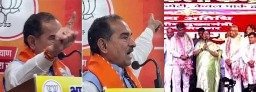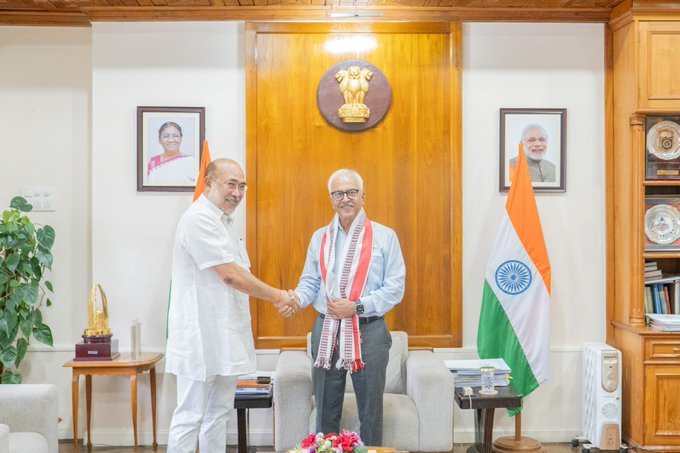
Former Manipur CM N. Biren Singh’s decision to meet Governor Ajay Kumar Bhalla with a fresh security formula has triggered political questions, particularly over why he approached the Governor rather than Chief Minister Yumnam Khemchand Singh.
BY PC Bureau
September 24: Former Manipur chief minister N. Biren Singh’s decision to take his latest security proposal directly to Governor Ajay Kumar Bhalla, rather than to Chief Minister Yumnam Khemchand Singh, has set tongues wagging in political circles in Imphal, even as the substance of his proposal raises questions over the scope of his proposed crackdown on armed groups.
Singh met Governor Bhalla at Lok Bhavan on Thursday and proposed that cadres covered by Suspension of Operations (SoO) agreements and other peace arrangements be confined to their designated camps for two to three months, with their weapons securely deposited and subjected to periodic checks.
He also proposed a simultaneous statewide security operation to identify armed groups operating outside existing arrangements, recover unauthorised weapons and take action against those involved in violence.
The unusual political optics of the meeting have attracted attention because Governors are more commonly approached by opposition leaders or political delegations seeking intervention in matters concerning a state government.
That has prompted speculation in political circles over whether Singh is attempting to bypass the Khemchand Singh government in taking his security formula directly to the Governor and, through him, to the Centre.
There is no evidence that Singh intended the meeting as an attempt to undermine the Chief Minister. But the political optics are difficult to miss, particularly at a time when questions over the handling of Manipur’s continuing ethnic conflict remain politically sensitive.
Called on Hon’ble Governor Shri Ajay Kumar Bhalla Ji today and discussed some of the core issues concerning peace and security in Manipur. During the meeting, I stressed four key points:
1. Cadres under SoO and other peace arrangements, should be properly verified, along with… pic.twitter.com/YJyjvJV3wl
— N. Biren Singh (@NBirenSingh) September 24, 2026
Singh’s proposed solution
Singh has argued that the first step should be a physical verification of cadres covered by the various SoO and peace arrangements. Those verified cadres, he said, should remain inside designated camps for two to three months, with their weapons deposited securely.
He proposed that security forces use the same period to conduct operations across the state against armed groups operating outside existing arrangements and recover unauthorised weapons.
Singh put the number of Kuki cadres covered by SoO arrangements at about 2,180. He estimated that the Pambei-led United National Liberation Front (UNLF) has around 1,400 cadres, while the Zeliangrong United Front has around 300 cadres under peace-related arrangements.
“I believe the above suggestions will help in addressing the present conflict situation and the issue of illegal immigrants in the state,” Singh said after meeting the Governor.
He added that Bhalla had assured him that the matter would be raised with central leaders.
Singh also linked the proposal to the resettlement of internally displaced persons, reconstruction and rehabilitation, and his continuing demand for an update of the National Register of Citizens (NRC).
According to Singh’s assessment, violence in the hill districts since February has claimed 58 lives and resulted in the burning of 40 to 50 villages.
READ: Manipur: Four Shot Dead in Kamjong, 41 Naga Homes Burnt in Kangpokpi
But what about NSCN (I-M) and Arambai Tenggol?
The central question arising from Singh’s proposal is whether a “statewide” security operation will actually encompass all armed organisations accused of involvement in the conflict, or whether the principal emphasis will remain on Kuki-Zo groups covered by the SoO framework.
Singh specifically identifies the Kuki SoO structure and other peace arrangements. But his proposal is mum on NSCN (I-M) and Arambai Tenggol..
Kuki-Zo organisations have repeatedly accused NSCN (I-M) and allied formations of involvement in attacks on Kuki villages and civilians. NSCN (I-M), however, has denied allegations of conducting a campaign against the Kuki population and has made counter-allegations against Kuki armed groups.
The question becomes equally relevant when Arambai Tenggol, the prominent Meitei organisation in the Valley, is brought into the picture. The organisation has faced allegations from Kuki groups over its role in the conflict, while individuals associated with it have faced arrests in cases involving alleged unlawful activities.
But Chief Minister Yumnam Khemchand Singh told the Manipur Assembly on September 7 that Arambai Tenggol and village volunteer groups in the hills and Valley had not been declared banned organisations, and that police action was based on alleged individual criminal conduct rather than membership of the groups.
That position is significant in assessing Biren Singh’s proposed statewide operation. If cadres covered by SoO arrangements are to be physically verified, confined to designated camps and their weapons secured for two to three months, what comparable mechanism, if any, would apply to NSCN (I-M), Arambai Tenggol and other armed or militant formations operating outside the SoO framework?