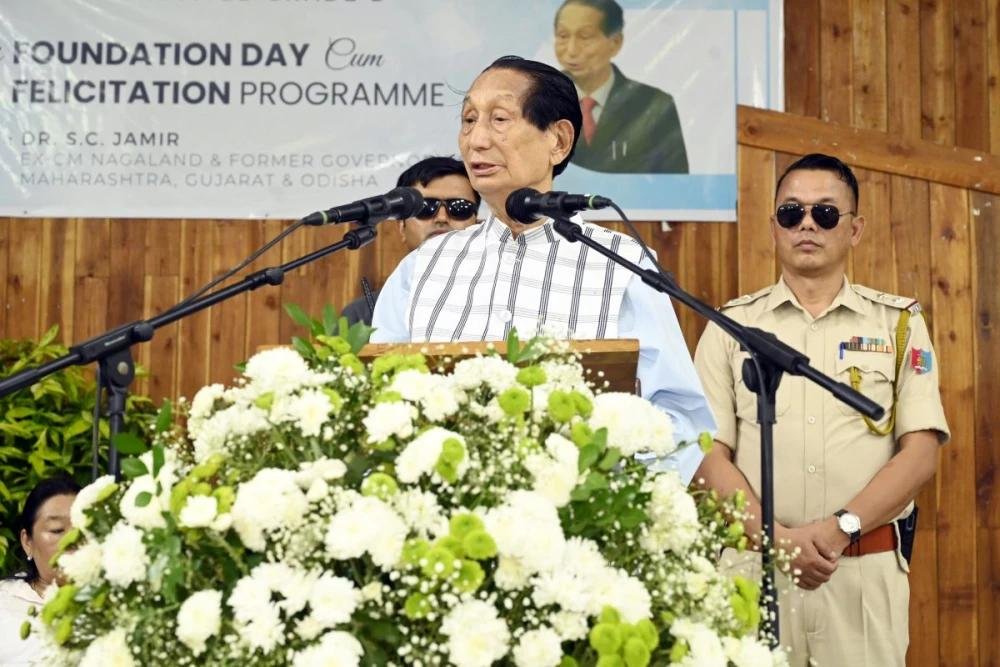
“Who are you? Where were you? What have you done?” Ungma Senso Mongdang asks NSCN (I-M) leaders, invoking the village’s own history and sacrifices in the Naga political movement while defending Jamir’s political standing.
BY PC Bureau
Septmber 25: In a sharp reprimand to the NSCN (I-M) leadership, the native village of former Nagaland chief minister and governor Dr S.C. Jamir has questioned the authority of its leaders to challenge his right to speak on the Naga political issue, calling his critics “outsiders” and asking: “Who are you? Where were you? What have you done?”
The intervention by the Ungma Senso Mongdang, the apex organisation of Ungma village, comes amid mounting reactions in Nagaland to remarks by senior NSCN (I-M) leaders V.S. Atem and R.H. Raising, who reportedly questioned Jamir’s mandate to speak on the Naga political issue.
The village’s response is significant because it shifts the controversy from a confrontation between the NSCN (I-M) and a former chief minister to a broader question of who has the right to speak on the Naga political future and who can question the political standing of Nagaland’s own leaders.
The Ungma Senso said Atem and Raising had no authority to describe Jamir as having “no mandate”, “no right” or no standing to speak on the Naga political issue.
It questioned the locus standi of the two leaders, describing them as not being Nagas from Nagaland, and defended Jamir as a bona fide indigenous citizen and “true son of the soil” of Ungma.
The message from Jamir’s village was blunt: those who had not shared the history and sacrifices of the people of Nagaland could not dictate who among Nagaland’s own citizens had the right to speak.
‘Who are you? Where were you?’
The Ungma Senso invoked the village’s own place in the Naga political movement while responding to the NSCN (I-M) leaders.
It recalled that the Second Naga People’s Convention was held at Ungma from May 21 to 23, 1958, and said generations of people from the village had made sacrifices for the Naga cause.
It also referred to the meeting organised by the Forum for Naga Reconciliation at Ungma on August 23, 2025, which brought together representatives of different Naga factions and civil society organisations.
Against that historical backdrop, the Senso questioned Atem and Raising: “Where were you? What have you done?”
The village organisation said Nagas of Nagaland must question the authority of those seeking to dictate terms to them, “much less” challenge the standing of a leader such as Jamir, who had served Nagaland and the Naga people for decades.
READ: On Leh Violence Anniversary, Wangchuk’s Padyatra Finds Few Takers
Bigger than Jamir
The reaction comes as the controversy over Jamir begins to acquire a wider political dimension.
The Ao Senden, the apex organisation of the Ao community, has already demanded that Atem and Raising retract their remarks within 15 days and has expressed solidarity with Jamir.
The interventions suggest that the dispute is no longer confined to whether Jamir should be entitled to express his views.
Instead, tribal and village organisations are questioning whether any faction or armed organisation can claim exclusive authority over the Naga political discourse.
The Ungma Senso was categorical that the Naga political issue was not the private property of any individual, faction or armed group.
It said no “self-appointed leader or spokesperson” could silence or discredit a bona fide citizen of Nagaland.
Defending Jamir’s political record
The Senso also defended Jamir’s public record, saying he was not merely a former chief minister but a statesman whose contributions to Nagaland, constitutional safeguards for Naga interests and the State’s political history were matters of record.
It maintained that his decades of public service gave him the experience to express his views on the Naga political issue and that his freedom of speech could not be curtailed by what it described as an outside element.
The organisation said dismissing Jamir’s mandate was not merely an insult to him personally but an affront to the people of Nagaland, particularly the people of Ungma.
‘Naga issue belongs to the Nagas’
The confrontation also touches a much larger and long-running question surrounding the Naga political process.
The NSCN (I-M) has been a principal participant in negotiations with the Government of India and has maintained a central role in the political struggle.
But Nagaland’s political and social landscape extends far beyond any one organisation. Tribal bodies, village organisations, churches, student organisations, civil society groups, elected representatives and different Naga political formations have all participated in the debate over the Naga political future.
The Ungma Senso’s intervention reflects that wider constituency.
Its argument is that the Naga political issue belongs to the Naga people as a whole and that no faction can determine who among them is entitled to speak.
Non-cooperation warning
The Senso went beyond criticism and announced that the people of Ungma would not cooperate, engage with or honour the leadership of any organisation, group, faction or formation associated with Atem and Raising.
It warned that attempts to undermine, disrespect or intimidate Naga leaders from Nagaland by what it described as outsiders would meet resistance from the people.
The organisation also expressed solidarity with the Ao Senden’s September 23 ultimatum and appreciated other civil society organisations for extending support.
It appealed to Naga organisations and citizens to remain united against what it called “divisive and opportunistic politics”.
The Senso further criticised Nagaland MLA Achumbemo Kikon over his remarks concerning Jamir, accusing him of relying on what it described as “half-baked history” and seeking political mileage.
For now, the immediate target of the controversy remains the remarks against S.C. Jamir.
But the response from Ungma — backed by the wider reaction from Naga civil society — has turned the episode into a larger assertion of Nagaland’s ownership of its political discourse.
The village’s message to the NSCN (I-M) leadership could hardly have been more direct: before questioning the mandate of a son of Nagaland, explain your own mandate to speak for Nagaland.