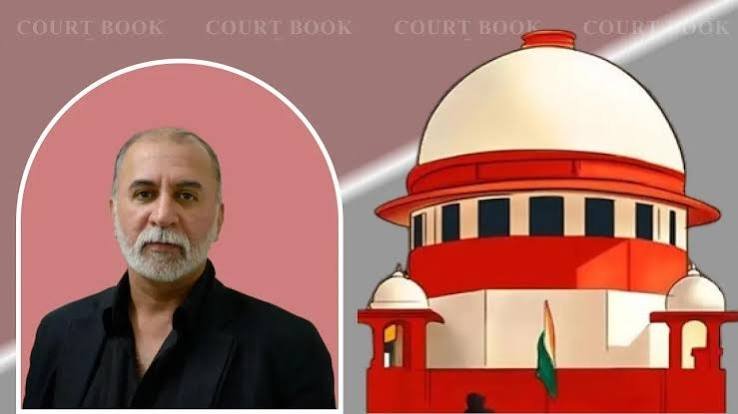
The Supreme Court has refused to suspend former Tehelka editor Tarun Tejpal’s 10-year prison sentence in the 2013 Goa rape case, finding no grounds to grant relief.
BY PC Bureau
November 6: The Supreme Court on Friday declined to suspend the 10-year rigorous imprisonment sentence imposed on former Tehelka editor-in-chief Tarun Tejpal in the 2013 rape case involving a junior colleague at a luxury hotel in Goa.
A bench of Justices MM Sundresh and Prasanna B Varale, after examining the evidence, including Tejpal’s emails and messages, found no prima facie grounds to suspend the sentence and rejected his application.
Tejpal has challenged the Bombay High Court judgment that overturned his acquittal by a trial court in 2021. The Goa government has filed a separate appeal seeking enhancement of his sentence to life imprisonment.
Tejpal’s Arguments
Senior Advocate Kapil Sibal, appearing for Tejpal, questioned the prosecution’s account of the incident, particularly its claim that Tejpal knelt inside an elevator, pressed the buttons to keep the doors shut and committed oral penetration.
Sibal argued that technical evidence showed the elevator doors opened at every floor during the alleged incident, which lasted 2 minutes and 9 seconds. He said the High Court had failed to adequately consider this evidence.
“During those 2 minutes and 9 seconds, the lift door opened twice at the ground floor. Her case was that it did not open and that she would have run out had it opened,” Sibal told the bench.
He further submitted that CCTV footage, which could have established whether the doors opened, had been destroyed. Referring to the testimony of the Grand Hyatt hotel manager and Mitsubishi personnel, Sibal said the elevator doors opened automatically at every floor and could not be kept shut by pressing buttons. He argued that this undermined a central part of the prosecution’s account.
Sibal also questioned the investigation, alleging that the investigating officer had viewed CCTV footage contradicting the victim’s account but made no attempt to seize it.
He referred to the victim’s meeting with Nikhil Agarwal immediately after she left the elevator. Sibal said the meeting was mentioned in an email but omitted from the subsequent complaint, and that the investigating officer had not contacted Agarwal.
Agarwal, who testified as a defence witness, reportedly said that the victim was smiling and appeared excited when she met him. According to his testimony, she said, “I have some gossip to tell, guess whom I have been flirting with?” and later identified the person as “TT”.
Emphasising that the case involved the reversal of an acquittal, Sibal argued that suspension of sentence was ordinarily warranted in such circumstances.
Senior Advocate Siddharth Agarwal, also appearing for Tejpal, argued that the victim had given six different accounts of the incident before the FIR was registered on November 22, nearly two weeks after the alleged incident.
He submitted that none of those accounts mentioned rape or oral penetration. According to him, the versions progressed from flirting to an attempted kiss and then a kiss, but did not contain the allegation that ultimately formed the basis of the conviction.
Agarwal also pointed out that Tejpal had remained on bail throughout the trial and had not misused the liberty granted to him.
READ: Abhishek Banerjee Launches All-Out Attack on SC Over TMC’s Bengal Loss
Goa Government Opposes Suspension
Solicitor General Tushar Mehta, appearing for the Goa government, dismissed the defence arguments as irrelevant to the central issue.
He emphasised that Tejpal owned the magazine where the woman worked and that she was a friend of his daughter. Mehta also referred to statements from colleagues who said they had seen the woman crying profusely after the incident.
He drew the bench’s attention to a message Tejpal allegedly sent her at 1:30 am the following night. The message contained a single word: “Fingertips”.
“Imagine a person sending that message to a girl of his daughter’s age. What does that message implicate? It can have only the meaning the High Court found,” Mehta submitted.
The Solicitor General also relied on an apology email Tejpal sent after the woman raised the matter with Shoma Chaudhary, the magazine’s then editor.
Arguing that the email undermined the defence’s focus on the elevator doors, Mehta referred to Tejpal’s statement that “It was in the frivolous and laughing mode that the encounter took place”. He also highlighted Tejpal’s claim that he had not realised the encounter was non-consensual until his daughter confronted him.
After hearing both sides, the Supreme Court refused to suspend Tejpal’s sentence. The appeal challenging the conviction remains pending.