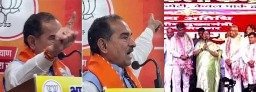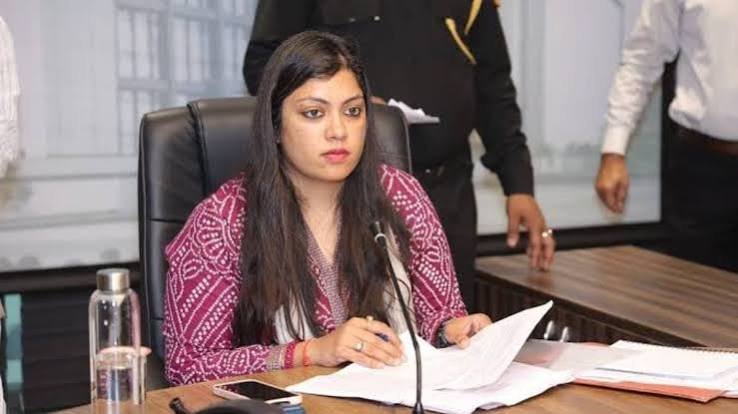
The controversy follows the Allahabad High Court’s order quashing student Akriti Chaudhary’s NSA detention and directing ₹5 lakh compensation, portions of which the Supreme Court subsequently stayed.
BY PC Bureau
NEW DELHI/ September 25 — The Supreme Court hearing involving Noida District Magistrate Medha Roopam, daughter of Chief Election Commissioner Gyanesh Kumar, has triggered an unusual chain of questions — over the bench before which her plea was listed, the muting of the court’s audio during the proceedings and the immediate stay of adverse findings and compensation ordered against her by the Allahabad High Court.
The controversy has now widened after the Lawyers Association for Constitution questioned the listing before Chief Justice of India Surya Kant, while CJP spokesperson Saurav Das has raised a series of additional questions about the role of Justice Satish Chandra Sharma, who was on the bench hearing Roopam’s plea.
At the centre of the controversy is a basic procedural question: why was Roopam’s plea heard by the Sharma-Kotiswar Singh bench when, according to LiveLaw, that bench did not have the roster for preventive-detention matters under the roster effective from July 13, 2026? LiveLaw also reported that other matters arising from the same Noida workers’ protest were pending before a bench led by Justice B.V. Nagarathna.
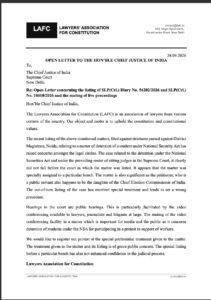
The Lawyers Association for Constitution has separately written to CJI Surya Kant questioning what it describes as an out-of-turn or specially assigned listing. The lawyers’ body has argued that such listing before a particular bench, coupled with the subsequent handling of the hearing, sets a troubling precedent for confidence in the judicial process.
The second unusual element was the muting of the audio feed.
On September 23, the bench comprising Justice Satish Chandra Sharma and Justice N. Kotiswar Singh heard Solicitor General Tushar Mehta and senior advocate Mukul Rohatgi before the audio of the video-conferencing proceedings was muted and media access was blocked. LiveLaw reported that reporters could no longer follow the proceedings after that point.
READ: On Leh Violence Anniversary, Wangchuk’s Padyatra Finds Few Takers
The matter concerned Roopam’s challenge to the September 2 Allahabad High Court judgment that had quashed Delhi University student Akriti Chaudhary’s detention under the National Security Act in connection with the Noida workers’ protest and ordered ₹5 lakh compensation.
The High Court had directed that the compensation be recovered from the salaries of Roopam and other officials involved in the detention process. The ruling had also made strong observations against the manner in which the NSA had been invoked.
The Supreme Court subsequently granted interim relief to Roopam. But there is an important clarification: on September 24, the Court revised its order and made clear that it had stayed only the High Court’s strictures and the compensation/costs portions of the judgment — not the High Court’s quashing of Chaudhary’s detention itself.
Saurav Das widens the questions
In a post on X, Saurav Das linked the Roopam hearing to the larger controversy surrounding Gyanesh Kumar and the Supreme Court.
Das alleged that Roopam’s case had been listed before Justice Sharma “out of turn” and contrary to the roster, and questioned why it had not gone before the Nagarathna-led bench. He also described the muting of the audio during the hearing as highly unusual and questioned the immediate stay of the High Court’s adverse observations and compensation order.
🚨IMPORTANT NEWS🚨
Since Chief Election Commissioner Gyanesh Kumar is in the news, I have some very important but sad news to share about a Supreme Court judge.
Supreme Court judge Justice Satish Chandra Sharma. Just two months away from retirement.
If you remember, the… pic.twitter.com/h6YRgYs14F
— Saurav Das (@SauravDassss) September 24, 2026
These claims overlap partly with the independent reporting by LiveLaw, which has specifically raised questions over the roster applicable to the case.
Das then raised a separate issue involving Justice Sharma: he pointed to a Supreme Court judgment on the constitutional challenge to the 2023 law governing appointments of election commissioners, in which Justice Sharma was part of the bench and issued a dissenting opinion, resulting in a split verdict.
That case is separate from the Medha Roopam litigation. Justice Sharma’s dissent, by itself, does not establish any connection between his judicial position in the election-commissioner case and the Roopam matter.
Das nevertheless argues that the coincidence of the two cases involving the CEC and Justice Sharma warrants public scrutiny.
Allegations about judge’s son
The Madhya Pradesh High Court’s website records that Justice Sharma’s son, who enrolled in 2017, is the standing counsel for the Election Commission of India. He is also the standing counsel for the Central Board of Direct Taxes and the Income Tax Department. His younger son,…
— Prashant Bhushan (@pbhushan1) September 25, 2026
Das has also made a further allegation concerning Justice Sharma’s family. He claimed that the judge’s son holds several government-counsel panels, including assignments involving the Income Tax Department, GST, Customs and Excise and the Madhya Pradesh government.
This allegation has not been independently established by the sources reviewed for this report. Das said he was withholding the name of the judge’s son and asked whether a judge could be perceived as impartial in politically sensitive cases when a family member represents government departments.
Justice Sharma’s official Supreme Court profile records that he himself previously served as Additional Central Government Counsel and later as Senior Panel Counsel for the Government of India before his elevation to the Supreme Court. That professional history is a matter of public record, but it does not establish any impropriety in his hearing of the Roopam case.
The election commissioner connection
Das also invoked the separate constitutional challenge concerning the 2023 law governing the appointment of election commissioners.
That litigation concerns the composition of the selection mechanism for Election Commissioners. Justice Sharma was part of the bench that heard the challenge and dissented, producing a split verdict that requires consideration by a larger bench.
The case is particularly sensitive because of its connection with the institutional position occupied by Gyanesh Kumar. But the judicial proceedings in that case are legally distinct from Roopam’s appeal against the Allahabad High Court judgment.
Likewise, allegations made by Das about the Election Commission, the appointment process or alleged “stealing” of votes are political claims and are not established facts for purposes of this report.