The September 5 gazette notification deferring Manipur census exercise gives no specific reason, security assessment or fresh date for resuming the exercise, leaving the political circumstances surrounding the decision to speak for themselves.
BY Navin Upadhyay
September 6, 2026: The Centre’s decision to defer the Census 2027 house-listing exercise in Manipur comes barely six months before the State goes to the polls. That timing, and the absence of any clear reason in the gazette, makes the decision difficult to view merely as an administrative postponement.
The political circumstances surrounding it point to a more consequential explanation.
For months, Meitei civil-society organisations, with support from sections of the Naga community, have demanded that a National Register of Citizens be completed before the Census. Their argument is that counting the population without first determining citizenship could legitimise the presence of alleged illegal immigrants, particularly people they associate with the Kuki-Zo community and migration from Myanmar. They have also linked the demand to future questions of delimitation, political representation and control over land.
The Manipur Assembly has reiterated its earlier resolutions seeking an NRC before the Census. Protests disrupted enumerator training, while the High Court recorded a Central undertaking that the September house-listing exercise would not begin.
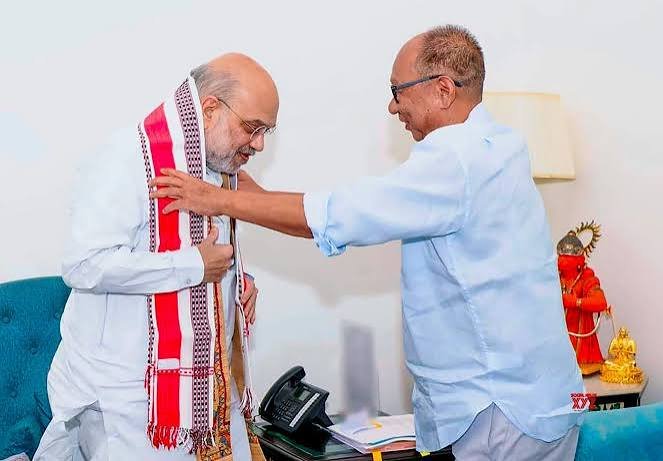
Then came the meeting chaired by Union Home Minister Amit Shah with the Governor and Chief Minister. Soon afterwards, the State government said the deferment respected the “feelings and aspirations of the people.”
That phrase may be politically more revealing than the gazette itself.
The Centre did not announce an NRC. It did not accept the demand as a legal precondition for the Census. But it stopped the Census exercise that the principal campaigners against the existing sequence wanted stopped.
That is the political fact at the centre of the controversy.
Who benefits from the pause?
The answer becomes more obvious when the calendar is considered.
Manipur’s 60-member Assembly election is due in February-March 2027. The BJP is going into that election after suffering a major setback in the 2024 Lok Sabha polls, when it lost both of the State’s parliamentary seats — Inner Manipur and Outer Manipur — to the Congress.
The party therefore faces a difficult political task: rebuilding its support base amid an unresolved ethnic conflict and deep divisions between the Meitei-majority valley and the Kuki-Zo-inhabited hills.
The NRC issue fits directly into that political landscape.
Questions of migration, citizenship and “who belongs” have enormous mobilising potential. In Manipur, they are no longer abstract questions of population administration. They intersect with the ethnic conflict, competing territorial claims and anxieties over political representation.
A Census conducted before the citizenship question is politically settled would produce a population snapshot that could become ammunition for competing communities.
Deferring it avoids that immediate confrontation.
More importantly, “till further declaration” keeps the question alive.
A fixed postponement would merely move the Census. An open-ended postponement leaves the political question unresolved and therefore available for continued mobilisation.
READ: Manipur: No Precedent for Statewide Census Deferral in India
READ: NRC, Delimitation and Manipur: An Analysis of Competing Claims
The political asymmetry
The deferment also creates an obvious asymmetry.
The Meitei groups that demanded an NRC before the Census have effectively achieved the immediate objective they were seeking: the house-listing exercise has been stopped.
The Kuki-Zo community, which has strongly opposed any process that could portray its members as outsiders or illegal immigrants, has received no equivalent assurance.
There is no new date for the Census in Manipur.
There is no publicly notified protocol explaining how displaced people living in relief camps will be counted.
There is no guarantee that a future Census will take place before the Assembly election.
And there is no NRC notification either.
The result is therefore not a settlement. It is a political pause that leaves one side’s central demand alive while postponing the exercise that the other side wants conducted.
The SIR comparison
The political argument is strengthened by what happened only months earlier.
During the Special Intensive Revision of electoral rolls, Booth Level Officers went from house to house across Manipur between 30 May and 28 June 2026. Officials reported receiving 19.34 lakh forms from around 20.93 lakh electors.
SIR is not a Census. It is an electoral exercise under the Election Commission, while Census house-listing is the first stage of the national population and housing count.
But the comparison raises an uncomfortable question.
If officials could conduct a State-wide door-to-door electoral verification exercise in May and June, why did a similar house-to-house Census exercise become impossible in September?
If the answer is security, the Government has not said so in the gazette.
If the answer is displacement, the Government has not explained why a Census protocol for displaced persons could not be devised.
If the answer is the NRC demand, the Government has not made the NRC a formal legal prerequisite.
The only official explanation is therefore the deferment itself.
Everything else has come from the politics surrounding it.
The Kuki-Zo factor
The political consequences are particularly significant for the Kuki-Zo legislators.
Ten Kuki-Zo MLAs were elected in 2022. Following the death of Thanlon MLA Vungzagin Valte, nine remain.
Community organisations have sought to pressure them to stay away from the Assembly until their demand for a separate administration is addressed. During the recent Assembly session, two returned to Imphal physically for the first time since the 2023 violence; others participated virtually or stayed away.
A Deputy Chief Minister from the community remains part of the Government, while several of the nine Kuki-Zo MLAs are BJP legislators.
That creates a politically delicate situation for the Centre.
The Government needs the Assembly to function, needs its Kuki-Zo legislators inside the political system, and at the same time faces powerful community organisations that reject the present political arrangement.
In such a situation, conceding the immediate demand for a Census pause can help reduce pressure without conceding the larger demand for separate administration.
The politics of the NRC demand
The BJP’s wider political vocabulary makes the NRC demand especially potent.
Across India, questions of illegal immigration and citizenship have been used as powerful political mobilisation issues, most prominently in Assam and in the debate surrounding the Citizenship Amendment Act.
In Manipur, the same politics acquires an additional ethnic dimension because the question of migration from Myanmar has become intertwined with the conflict between Meitei and Kuki-Zo communities.
An NRC before the Census would therefore not simply be a bureaucratic exercise. It would determine, or at least publicly contest, who is considered part of the population being counted.
The Centre has not agreed to conduct an NRC before the Census.
But by deferring the Census instead of firmly rejecting the demand, it has allowed the issue to remain politically potent.
And with an election approaching, that may be precisely the point.
Why the timing matters
The most striking feature of the September 5 gazette is not simply that Manipur has been excluded.
It is that the exclusion is open-ended.
The notification says the Census will continue everywhere except Manipur “till further declaration”. There is no date by which the State will return to the exercise.
That creates a window extending potentially into the election period.
A Census before the election could generate politically sensitive population data at a time when every community is intensely concerned about numbers, representation and territorial rights.
A Census after the election postpones that confrontation.
The political advantage of such uncertainty is obvious even if the Government’s intention was entirely administrative.
The legal question follows the politics
The Centre has invoked Sections 3 and 17A of the Census Act, 1948, and Rules 6A and 6D of the Census Rules, 1990, in amending the notification.
But the Act does not expressly say that once a Census has been notified for the whole country, the Government may subsequently defer it indefinitely in one particular State.
Section 3 empowers the Centre to declare its intention to conduct a Census in the “whole or any part” of the territories covered by the Act. That provides the Government with considerable flexibility.
The question, however, is whether that general power also authorises the post-notification, State-specific suspension now imposed on Manipur.
That is a question a court could ultimately be asked to decide.
But even before the legal question is settled, there is a political one that cannot be avoided:
Why Manipur, why now, and why without a date for the Census to resume?
The answer will determine whether this is remembered as a temporary administrative accommodation necessitated by an extraordinary situation — or as a politically timed decision taken in the run-up to an election.
For now, the gazette leaves the reasons unstated.
The politics surrounding it does not.