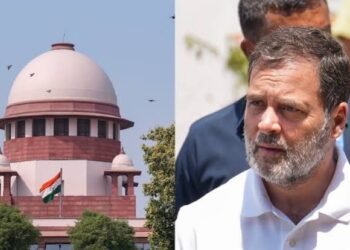
Police are investigators, not judges. The Bhavnagar incident raises a disturbing question: if an accused can be publicly tied up, beaten and humiliated before trial, who will protect the constitutional safeguards against police brutality? Will the Supreme Court set an example by punishing these policemen?
BY Navin Upadhyay
September 6, 2026: Will the Supreme Court wake up to yet another instance of alleged police brutality in which an accused man appears to have been publicly beaten, humiliated and treated as guilty before a court has even heard his case?
That is the question being raised after videos from Gujarat’s Bhavnagar went viral, showing a 20-year-old homeless murder accused allegedly tied with ropes and repeatedly beaten by police officers during what they described as a crime-scene reconstruction.
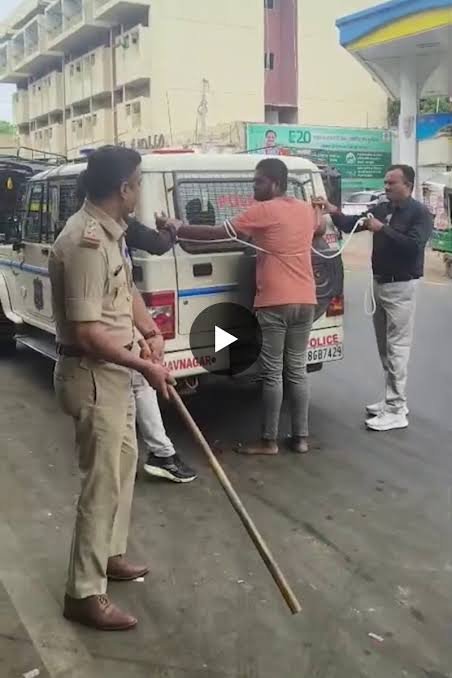
The footage shows Faizal alias Khatki Rafiq Lakhani being restrained and taken to different spots around the GSRTC bus stand. Officers are seen striking him with batons while he is held against a patrol vehicle, pillars and walls. At several points, he appears to be forced to kneel or lie down as members of the public watch.
Reports based on the footage have put the number of blows at more than 100 in roughly 10 minutes.
Whatever the allegations against Lakhani, the images raise a fundamental question: When did crime-scene reconstruction become an occasion for police to publicly punish an accused?
Mohd Faizal recently came out of jail.
A Hindu girl, Kajal, was brutally beaten to death with sticks in broad daylight at Bhavnagar bus stand.
The accused, Faizan, was paraded through the streets of Bhavnagar today.
When Kajal’s brother came to save her, Faizan also brutally… https://t.co/fCRUDIW7mS
— News Algebra (@NewsAlgebraIND) September 5, 2026
Lakhani was arrested on September 4 by Nilambaug police in connection with the death of 40-year-old Kajal, a homeless woman with whom he had reportedly lived near the same bus stand.
According to the police, Lakhani confronted Kajal and a mutual acquaintance, Ravi alias Boda Rajendra Gohel, on September 3, accusing them of having an affair while he was in prison in another case. Police said he assaulted the two and that the incident was captured on CCTV. Kajal was taken to Sir Takhtasinhji General Hospital, where she was declared dead later that night.
The following day, police brought Lakhani back to the alleged crime scene.
What followed, however, has become a separate controversy.
Instead of simply reconstructing the sequence of events, officers were filmed tying the accused with ropes and repeatedly beating him in front of bystanders.
Nilambaug police inspector D.P. Unadkat subsequently defended the action, describing Lakhani as a “notorious person” and saying the beating was intended to demonstrate that crimes against women would be taken seriously.
“We beat him to set an example,” he was quoted as saying.
That statement may be more troubling than the footage itself.
Police officers are investigators, not judges. They do not have the authority to impose punishment because they believe an accused deserves it.
🚨 BREAKING: Faisal alias Khatki Lakhani, accused in the brutal murder of Kajal Baraiya at Bhavnagar ST Depot, was taken to the spot for crime-scene reconstruction by Gujarat Police and Serviced properly.
The reconstruction was carried out at the ST Depot as part of the…
— Megh Updates 🚨™ (@MeghUpdates) September 5, 2026
Social media outrage
The videos have provoked widespread outrage on social media, with users questioning how a man who has not been convicted could be tied up and beaten in public by those entrusted with enforcing the law.
Several reactions described the episode as “mob justice by the police”, while others questioned the very idea of using physical violence as part of a crime-scene reconstruction.
The public nature of the assault has added to the anger. The accused was not merely allegedly assaulted in custody; he was displayed, restrained and beaten in a crowded public place.
Social-media users have also questioned the police argument that the assault was intended to “set an example”. Critics say deterrence cannot become a justification for physical punishment outside the judicial process.
The incident has also revived concerns about whether homeless and economically vulnerable accused persons are particularly exposed to such treatment.
Some users have demanded disciplinary and criminal action against the officers involved, while others have called for an independent inquiry rather than allowing the police force itself to determine whether the conduct seen in the videos was justified.
Has the law been forgotten?
The Supreme Court has repeatedly stressed that an arrested person does not lose his fundamental rights.
Its landmark D.K. Basu judgment laid down safeguards against custodial torture and abuse and made clear that people in police custody remain protected by the Constitution.
The principle is simple: arrest is not conviction, accusation is not guilt, and police custody is not a substitute for judicial punishment.
READ: Manipur Census Pause: Politics Behind the Centre’s Decision
A crime-scene reconstruction may be a legitimate investigative exercise. But nothing about the exercise gives police officers the authority to physically punish the person being questioned or taken to the scene.
That is precisely why the Bhavnagar footage is so disturbing.
If an accused is guilty, the prosecution must prove the case in court. If convicted, the court can impose the appropriate punishment.
But the police cannot decide that a suspect should be beaten “to set an example”.
Will the Supreme Court step in?
The larger question is whether yet another video of alleged police excess will disappear into the news cycle without triggering meaningful institutional accountability.
India has laws, constitutional safeguards and Supreme Court directives intended to prevent custodial violence. Yet incidents of police assault continue to surface, often accompanied by explanations that the victim was a “notorious criminal”, a habitual offender or someone who deserved to be taught a lesson.
That is precisely the logic the rule of law is supposed to prevent.
The allegations against Lakhani must be investigated independently and fairly. If he is responsible for Kajal’s death, he must face trial and, if convicted, punishment under law.
But that process cannot legitimise what appears in the videos.
The two issues must remain separate: one concerns an alleged murder; the other concerns the conduct of the police.
The Bhavnagar footage therefore presents the Supreme Court, the Gujarat authorities and the wider criminal-justice system with a disturbing question:
If police officers can tie up an accused, beat him repeatedly in public and then describe the assault as an “example” for others, what remains of the distinction between investigation and punishment?
And perhaps the more uncomfortable question is this:
How many such videos must emerge before the constitutional promise against custodial brutality becomes something more than a principle repeated in judgments?