While Census exercises have previously been disrupted in Assam and Jammu and Kashmir because of unrest, there is no clear precedent for an entire state being formally excluded–like Manipur– from a Census before house-listing begins and without a new date.
BY Navin Upadhyay
NEW DELHI, September 5, 2026: The Centre has formally deferred the house-listing operation for the 2027 Census in Manipur, but the move appears to have no clear precedent in independent India where an entire state’s Census exercise was formally kept in abeyance before the enumeration process began and until further orders.
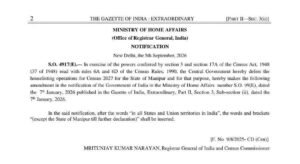
The Office of the Registrar General, India, issued a notification on September 5 under Sections 3 and 17A of the Census Act, 1948, read with Rules 6A and 6D of the Census Rules, 1990. It amended the January 7 notification for Census 2027 by inserting the words “except the State of Manipur till further declaration” after the reference to house-listing operations in all States and Union territories.
The notification means that, unlike the rest of the country, Manipur has no operative date for the start of its house-listing exercise. The Centre has not announced when the exercise will resume.
The decision came after the Manipur High Court on August 31 directed that the Census house-listing exercise be kept in abeyance until October 12. The court was hearing petitions seeking, among other things, an update of the National Register of Citizens (NRC) before the Census. The Centre subsequently deferred the exercise in the state.
Why the distinction matters
The Census of India has faced major disruptions in the past, but those cases are not identical to what has now happened in Manipur.
The 1981 Census could not be conducted in Assam because of the disturbed conditions during the Assam agitation. Similarly, the 1991 Census could not be held in Jammu and Kashmir because of militancy. Those states therefore lacked Census enumeration for the scheduled year, with population figures subsequently worked out through alternative methods.
Those examples are often cited as precedents for Census disruption caused by conflict. But they are different from a formal notification issued before the Census operation in a state has commenced, expressly excluding that state from the national exercise “till further declaration.”
There have also been instances when Census work in particular areas was postponed or conducted at different times because of natural disasters, weather and accessibility. Such local or regional postponements, however, do not amount to a comparable state-wide deferment of the entire Census operation.
That distinction makes the Manipur notification significant.
READ: NRC, Delimitation and Manipur: An Analysis of Competing Claims
Census caught in Manipur’s demographic dispute
The deferment has emerged amid a highly charged debate over migration, citizenship and demographic change in Manipur.
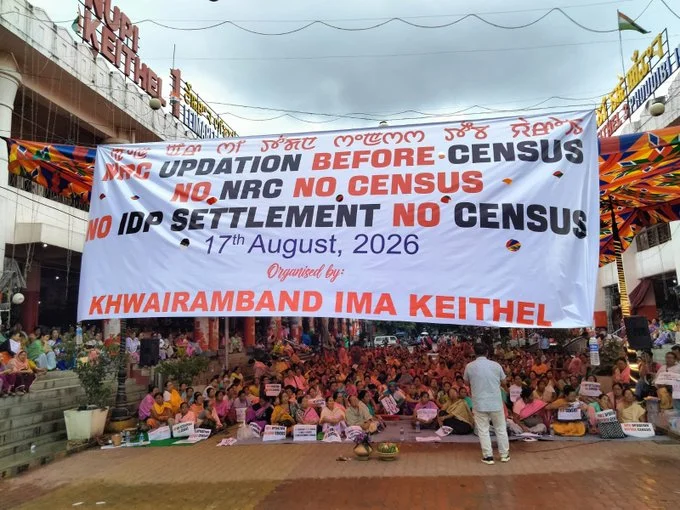
Civil society organisations, particularly in the Imphal Valley, have demanded an update of the NRC before the Census. Their argument is that the population exercise should first establish who qualifies as a citizen and distinguish citizens from alleged illegal immigrants.
Kuki-Zo groups have opposed the demand, arguing that an NRC-first approach could affect displaced people and deepen existing ethnic divisions. The Census itself has therefore become entangled in the political conflict that has divided the state since May 2023.
The Manipur Assembly on September 2 passed its third resolution urging the Centre to update the NRC before conducting the Census.
The timing has added another layer to the controversy. The house-listing phase had been scheduled to begin in Manipur on September 1, making the August 31 intervention and subsequent Central deferment an immediate halt to an exercise that was about to start.
A decision with wider implications
The Census is not merely a headcount. Its data informs government planning and resource allocation and, after the relevant constitutional and statutory processes, can have consequences for political representation and delimitation.
That makes the Manipur decision more consequential than an ordinary administrative postponement.
At the same time, the Centre’s notification does not say that an NRC will be conducted before the Census. It only defers the house-listing operation in Manipur until further declaration. Reports on the government’s decision indicate that it followed concerns and demands raised in the state, but the formal notification itself does not prescribe an NRC as a condition for restarting the Census.
For now, the legal position is therefore straightforward: Census 2027 house-listing operations have been formally excluded in Manipur until further declaration.
The historical comparison requires greater caution. Assam in 1981 and Jammu and Kashmir in 1991 demonstrate that Census enumeration has previously failed to take place in states because of extraordinary circumstances. But a formally notified, state-wide deferment of the Census exercise before its scheduled commencement, with no fresh date and the state expressly excluded “till further declaration,” is not matched by those cases.
Manipur has thus entered an unusual constitutional and administrative situation: a national Census is moving ahead according to its scheduled framework, while one state has been formally placed outside the exercise pending a future decision by the Centre.