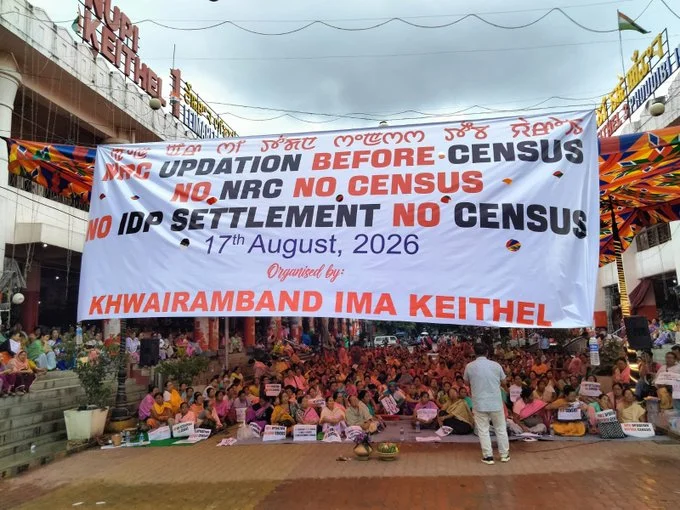
In this article, Benjamin Mate, Chairman of the Kuki Organisation for Human Rights Trust, examines the Meitei and Naga demand for an NRC in Manipur against the backdrop of the state’s long-running delimitation dispute
By Benjamin Mate
Drawing on my limited social and political experience, I offer the following assessment of the Meitei and Naga demand for a National Register of Citizens (NRC) in Manipur, and its connection to the long-running dispute over Delimitation.
The Meitei community has consistently been apprehensive about any delimitation of Manipur’s Assembly constituencies. This anxiety dates back to the first delimitation exercise in Manipur in 1972, based on the 1971 census. During that exercise, the Meitei were able to manipulate the census by including tribal villages along the foothills of the Imphal, Thoubal, and Bishnupur districts within the valley’s population count. As a result, the Meitei secured 40 of the 60 Assembly seats allotted to Manipur, even though the population ratio between the general (non-tribal) and tribal communities was approximately 55:45.
The Delimitation Act 2003 and the Contested 2001 Census
When Parliament enacted the Delimitation Act, 2003, to increase the number of parliamentary and Assembly seats reserved for Scheduled Tribes and Scheduled Castes without increasing the existing State Assembly seats, the Delimitation Commission’s working paper, based on 2001 census data, indicated that the tribal communities of Manipur stood to gain five additional Assembly seats, to be adjusted from the 40 seats held by the Meitei.
This prospect alarmed the Meitei, who moved to stall the delimitation exercise. Since the Delimitation Commission is a constitutional body established under a special constitutional provision, its determinations could not be challenged directly in court. Instead, the then Congress-led Manipur Government, together with the All Political Parties of Manipur (whose leadership was largely Meitei or Meitei-influenced) and the Lawyers’ Guild, Manipur, approached the Gauhati High Court’s Imphal Bench, challenging the census figures for three Naga-dominated subdivisions—Mao, Maram, and Purul-Paomata—and seeking a recount.
READ: Opinion: Few May Mourn Nemcha Kipgen’s Exit as Manipur Dy CM
Having obtained relief from the court, the State Government’s attempt to conduct a recount in these subdivisions was boycotted by the Naga community of Senapati District. In response, the authorities arbitrarily deleted more than ninety thousand Naga residents from the population count, purportedly to bring the district’s decadal growth rate in line with state and national averages. This deletion reduced the tribal communities’ anticipated gain from five Assembly seats to just three.
To eliminate even these remaining three seats, a further petition was filed in the Gauhati High Court seeking a recount in nine additional tribal subdivisions, and requesting that the delimitation exercise be stayed pending final publication of the 2001 census figures for Manipur. This petition succeeded, and the exercise was stalled in Manipur even as the Delimitation Commission completed its work in more than twenty-five other Indian states.
The Tribal Response and the Supreme Court Case
The matter came to the attention of tribal Civil Society Organisations (CSOs) only in 2006. The tribal leaders convened a meeting in Imphal and resolved to contest the issue both inside and outside the courtroom, nominating me to serve as the petitioner on behalf of all tribal CSOs of Manipur.
The case was lost in the Manipur High Court, where the presiding judges were Meitei. We then approached the Supreme Court and, in July 2007, obtained a stay of the Manipur High Court’s order. The late Senior Advocate Soli J. Sorabji represented us in the Supreme Court.
Following our victory, the Manipur Government convened a special one-day Assembly session in August 2007 and passed a resolution denouncing the Supreme Court’s stay order, which itself was an unconstitutional act. The All Political Parties of Manipur then lobbied the Central Government in Delhi, resulting in a Presidential Ordinance deferring the delimitation exercise in Manipur, Assam, Nagaland, and Arunachal Pradesh. The Parliament subsequently gave effect to this through the Representation of the People (Amendment) Act, 2008.
It bears noting that in Assam, Nagaland, and Arunachal Pradesh, the underlying disputes concerned the redrawing of constituency boundaries, not the reallocation of seats between Scheduled Tribe/Scheduled Caste and general categories. In Manipur, by contrast, the dispute was squarely between the tribal and general (Meitei) communities, and in this instance, the State and Central Governments acted in concert to deny the tribal communities of Manipur the constitutional entitlement guaranteed to them under the Delimitation Act, 2003.
A Comparative Case: Assam
It is also worth noting that Assam faced a comparable delimitation dispute, where the 2001 census indicated that the Muslim community stood to gain three additional Assembly seats. This was fiercely opposed by the All Assam Students’ Union (AASU) and the state’s political parties at the time. However, once the BJP came to power in Assam, the state government proceeded to complete the delimitation exercise, to the satisfaction of the majority community.
The Present NRC Demand in Manipur
In the present context, the Meitei have promoted a narrative branding the Kuki-Zo community as illegal immigrants and refugees. The evident aim is to depress the recorded Kuki-Zo population figures, in the same manner previously employed against the Naga, since the seat reallocation under the Delimitation Act, 2003, remains pending and the Kuki-Zo community is going to gain more Assembly seats.
The demand for an NRC before the census appears similarly designed to undermine the delimitation exercise expected to follow the 2026 census, which will trigger a pan-India redrawing of parliamentary and Assembly constituencies. Both the Meitei and the Naga are, in my assessment, well aware that their demand for an NRC exceeds constitutional bounds and cannot realistically be guaranteed by the Government. Nonetheless, they recognise that raising this demand creates leverage to negotiate for a greater allocation of Assembly seats at the expense of the Kuki-Zo community, following the precedent set in Assam.
(The Author is Chariman of the Kuki Organisation for Human Rights Trust)