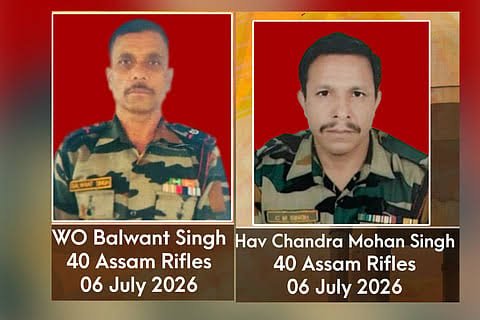
Four suspects arrested after the ambush have been granted bail, raising questions over the investigation, the charges invoked and whether the actual perpetrators have been identified.
BY PC Bureau
Two months after a deadly ambush on an Assam Rifles convoy in Manipur’s Ukhrul district on July 6 claimed the lives of two personnel, the investigation has yet to yield a breakthrough and remains with the Manipur Police. Unlike similar cases in the past that were promptly handed over to the National Investigation Agency (NIA), the Ukhrul ambush is still being investigated by the State police.
The July 6 attack near Nungshang Kong along National Highway 202 killed 40 Assam Rifles personnel Warrant Officer Balwant Singh and Havildar Chandra Mohan Singh. The convoy was returning to the unit’s headquarters at Shangshak when suspected militants ambushed it at around 1.30 pm. Security forces subsequently launched search and area-domination operations in the surrounding areas.
The attack involved heavy firing and, according to reports from the area, multiple explosions. The prolonged exchange of fire sent villagers and farmers in the vicinity fleeing for safety. No insurgent group publicly claimed responsibility. The NSCN-IM was accused to have plotted the ambust, but it denied any involvement and also rejected suggestions that a breakaway “Eastern Flank” faction was part of its organisation.
The initial response was swift. Security forces mounted intelligence-based operations in neighbouring areas of Ukhrul and Kamjong districts to identify and track those suspected of involvement in the ambush.
On July 14, three people were detained during operations in TM Kasom, Litan and Sikibung areas, according to police. Around the same time, the Tangkhul Naga Long (TNL), the apex body representing the Tangkhul Naga community, alleged that four residents of Sharkaphung village had been picked up during the security operation.
READ: Will Supreme Court Wake Up to Bhavnagar Police Brutality?
The four were identified as Wungphayo Kasar, A.S. Ninglum, Yaoreingam Lungleng and Vareiyo Lungleng. The TNL described them as villagers and demanded their immediate release, warning that their continued detention could trigger unrest. The organisation later alleged that the four had been falsely implicated and imposed a temporary blanket ban on security operations in Tangkhul villages.
The arrests became a contentious part of the investigation because the accused were presented by community organisations as ordinary villagers rather than insurgents involved in the ambush. At the same time, security agencies maintained that the detentions were part of an intelligence-based operation aimed at identifying those responsible for the July 6 attack.
The larger question now is what progress has been made in identifying the actual attackers.
Unlike some other recent cases involving attacks on security forces in the Northeast, there has been no NIA investigation into the Ukhrul ambush. That has raised questions about whether the July 6 attack is being treated primarily as a local law-and-order case or as a wider national-security offence requiring a central investigation.
What is increasingly difficult to ignore, however, is the lack of a breakthrough. No group has claimed responsibility, the identities of the attackers have not been officially established, and the circumstances surrounding the ambush remain contested.
The July 6 attack also occurred against a particularly sensitive backdrop. Ukhrul and neighbouring Kamjong have experienced continuing security concerns amid the wider ethnic conflict in Manipur and tensions involving Naga and Kuki communities. Any investigation that relies heavily on village-level detentions without establishing a clear evidentiary trail risks deepening mistrust between local communities and security agencies.
For the families of the two Assam Rifles personnel killed in the ambush, the central issue is straightforward: who planned and carried out the attack, and when will they be brought to justice?
Two months later, those questions remain unanswered in the public domain.
The government has repeatedly stressed the need to restore peace and security in Manipur. But restoring confidence also requires credible investigations into attacks on security personnel, particularly when two serving members of the Assam Rifles were killed in an ambush on a major highway.
The question, therefore, is not merely why the NIA has not been brought into the case. It is whether the existing investigation has the resources, evidence and institutional capacity to identify the attackers and establish their wider network.
Until that happens, the July 6 ambush remains another unresolved episode in Manipur’s long-running cycle of violence—two dead personnel, four arrested suspects, competing claims over their involvement, and no publicly established answer to the most important question: who carried out the attack?