



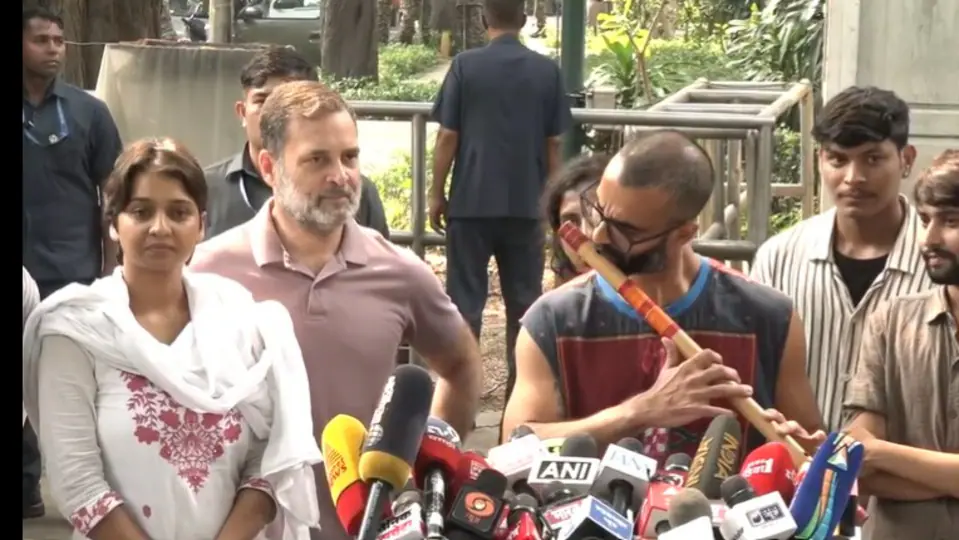
Rahul Gandhi’s earlier criticism of police action against students has not fully answered questions about his response to Dipke’s detention and Bora’s overnight custody.
BY PC Bureau
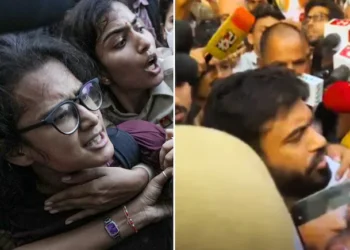
New Delhi, October 17, 2026: Cockroach Janta Party (CJP) founder Abhijeet Dipke remained under preventive arrest, All India Students’ Association (AISA) president Neha Bora spent the night in detention before being released, and hundreds of students were reportedly detained as Delhi Police deployed a massive security force to prevent the CJP’s ‘Lehra Do Tiranga’ march.
As the crackdown intensified on October 16, one question began circulating in political circles: where was Rahul Gandhi?
The Congress leader and Leader of the Opposition in the Lok Sabha has repeatedly argued that protests against the Special Intensive Revision (SIR) of electoral rolls are part of a common democratic struggle. But if all anti-SIR protests are one, why was there no immediate public statement from him specifically condemning Dipke’s detention, questioning Bora’s overnight custody or expressing solidarity with the students detained during the police operation?
Why did the Congress leadership appear restrained while opposition leaders Mamata Banerjee, Arvind Kejriwal and M.K. Stalin publicly criticised the action? And why was there no conspicuous show of solidarity from the Congress’s student wing at the Tiranga march?
These questions go beyond political optics. They concern the opposition’s ability to build a united movement against alleged electoral irregularities without allowing party rivalries to undermine it.
Mamata, Kejriwal and Stalin speak out; Rahul Silent
Three prominent opposition leaders publicly condemned the detention of Dipke and Bora.
Trinamool Congress chief Mamata Banerjee described Dipke’s detention as part of an “undeclared Emergency”. Referring also to the earlier detention of CJP leaders Ashutosh Ranka and Saurav Das, she expressed solidarity with the young protesters.
“Your Didi stands firmly with you,” she declared.
DMK president M.K. Stalin demanded answers about the whereabouts of the two organisers.
“Where is @abhijeet_dipke? Where is @neha_aisa?” he asked, describing the failure to disclose their whereabouts as “blatantly illegal and deeply inhumane” and demanding their immediate release.
AAP chief Arvind Kejriwal described the police action as “sheer dictatorship” and questioned whether waving the national flag had become a crime.
By Saturday morning, Rahul Gandhi had not issued a comparable public statement specifically addressing the detention of Dipke and Bora, according to the information available at the time.
The contrast was notable because Congress has sought to position itself at the forefront of the national campaign against alleged electoral manipulation.
The danger of treating a student movement as a rival
The more uncomfortable question concerns Congress’s relationship with independent student-led campaigns.
Rahul Gandhi has been among the prominent national politicians raising concerns about alleged vote chori, or vote theft. Yet repeated press conferences did not, by themselves, produce the kind of mass mobilisation that campaigners sought.
Reports published by The Indian Express subsequently brought fresh attention to allegations concerning electoral rolls and the conduct of the Election Commission. The episode illustrated how an issue raised by a political leader can acquire wider public traction through subsequent reporting and activism.
A similar question arises over paper leaks and the education system.
Rahul Gandhi has repeatedly raised allegations of examination paper leaks. Dipke and his associates, meanwhile, sought to translate student grievances into street mobilisation. Their campaign attracted attention beyond conventional party politics, giving young people a platform to express broader dissatisfaction.
The student movement also faced a crackdown on July 20, according to accounts of the protests. Critics have questioned why Rahul Gandhi did not visit the protesting students to express solidarity, particularly when some were fasting.
The larger point is that political leaders cannot expect to claim ownership of public anger simply because they raised an issue first.
A movement may begin with an issue highlighted by a national leader, but its leadership and constituency can evolve independently. Students who organise their own protests may not see themselves as an extension of any political party.
If Congress treats such mobilisation primarily as a competing political enterprise, it risks alienating the very young people it hopes to attract.
If the protests are one, solidarity cannot be selective
Rahul Gandhi’s argument that anti-SIR protests are one raises a straightforward question of political consistency.
If the campaign is a common democratic struggle, should the opposition not defend protesters regardless of which organisation mobilises them?
Should Gandhi not demand clarity about Dipke’s detention and the grounds for preventive action? Should he not question the circumstances in which Bora was held overnight? And should he not stand alongside opposition leaders who have condemned the crackdown?
The same questions apply to the Congress’s student wing. If the party believes the SIR controversy threatens democratic rights, why was there no conspicuous show of solidarity from its student activists at the Tiranga march?
There may be organisational, logistical or tactical explanations. The absence of a visible Congress contingent does not establish a deliberate decision to undermine the CJP, just as the absence of an immediate statement does not establish support for the police action.
Nevertheless, perceptions matter in politics.
For a movement that claims to transcend party boundaries, solidarity cannot be confined to demonstrations organised by political allies. It must also extend to activists whose independence or political ambitions may make established parties uncomfortable.
🚨 BREAKING : AISA President Neha Bora has been RELEASED.🇮🇳✊️ https://t.co/3Ni5icF8Qm
— Priya Purohit (@Priyaa_Purohit) October 17, 2026
READ: Mamata, Kejriwal, Stalin Condemn Dipke, Neha Detention; Rahul Gandhi Remain Silent
Has Rahul Gandhi miscalculated?
One possible interpretation of Congress’s restrained response is that the party does not want the CJP to emerge as an independent political force capable of attracting students who might otherwise gravitate towards the opposition. This remains speculation rather than an established account of Congress’s strategy.
If such a calculation is being made, however, it could prove counterproductive.
A student who sees an activist detained may not ask which opposition party stands to gain from the incident. The student may instead ask whether anyone with political power is prepared to defend the right to protest.
If the answer appears to be no, the outcome may not be a migration of student activists into Congress. It could instead be wider disillusionment with the political system.
Young people who feel ignored by the government and unsupported by the established opposition may withdraw from organised politics or continue their activism outside party structures.
Either outcome would challenge the assumption that a weakening independent student movement automatically benefits Congress.
India’s youth cannot be treated as a political constituency that will remain available indefinitely, waiting for an established party to provide leadership. Trust must be earned through consistent action.
The youth will not wait forever
The CJP crackdown has given Rahul Gandhi an opportunity to clarify what he means when he says all anti-SIR protests are one.
If Rahul Gandhi wants students and young activists to believe their struggle is part of a shared democratic movement, he must demonstrate solidarity when it carries a political cost. A clear statement demanding transparency about the legal grounds for detention and supporting the right to peaceful protest would be a meaningful step.
Silence risks feeding the impression that opposition unity ends where party calculations begin.
There is no guarantee that a more active Congress intervention would revive the student movement, just as a restrained response does not mean the movement will collapse. Protests rise and fall for many reasons, and the students involved retain their own agency.
But if young protesters conclude that neither the government nor the established opposition is prepared to stand with them when they face the consequences of dissent, the damage could extend far beyond a single march.
Rahul Gandhi may have helped bring electoral irregularities into the national debate. He cannot assume that students who take those concerns to the streets will automatically follow his leadership.
If all anti-SIR protests are one, the test is not whether opposition leaders share a slogan. It is whether they stand together when protesters are detained and demonstrations are blocked.
The question confronting Rahul Gandhi is simple: can he build a broad democratic movement that accommodates independent student activism, or will the gap between his call for unity and the opposition’s actions continue to raise doubts about that commitment?
The answer will matter not only for the anti-SIR campaign but also for the relationship between established opposition parties and a new generation of politically active young Indians.



Comments 1