Congress leader Rahul Gandhi has condemned alleged police brutality against student protesters, but his cautious engagement with the CJP has raised questions about the opposition’s response to the crackdown on young demonstrators.
BY PC Bureau
October 17: Congress leader and Leader of the Opposition Rahul Gandhi has slammed Delhi Police over alleged brutality against student protesters, particularly young women, during demonstrations demanding Chief Election Commissioner Gyanesh Kumar’s resignation over alleged irregularities in the Special Intensive Revision (SIR) of electoral rolls. But he remain consipicious by his silence on the ARREST AND SUBSEQUENT RELEASE OF aBHJIT dIPEK AND CRACKDOWN ON cjp lEHRAY tIRANGA mARCH ON oCTOBER 16.
In statements and social media posts in mid-October 2026, Gandhi accused Delhi Police of failing to act adequately on complaints of alleged assaults against students, including Athira from Kerala and Ritu from Rajasthan. He said he had spoken to Kerala Home Minister Ramesh Chennithala and Rajasthan Congress leaders about the cases, and referred to the registration of a Zero FIR in Kerala. He also vowed to pursue legal remedies against officers allegedly involved.
Describing the alleged conduct as “brutality by Amit Shah’s Delhi Police”, Gandhi invoked the 1930 Dharasana Satyagraha, arguing that police violence could injure protesters but would not break their resolve. Students have alleged that they were beaten, dragged and humiliated during detention, including being assaulted on private parts. These allegations require investigation and should not be treated as established findings.
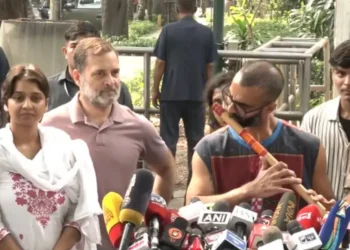
Gandhi also met affected students at 10 Janpath, presenting their accounts as part of a wider concern about the use of fear and humiliation to discourage democratic protest. His response has been personal and forceful, placing the experiences of young protesters, particularly women, at the centre of his criticism of the Modi government.
यौन उत्पीड़न, कपड़े खींचना और निजी अंगों पर हमला – लोकतंत्र के लिए आवाज़ उठाने वाली छात्राओं और महिलाओं के साथ दिल्ली पुलिस की बर्बरता शर्मनाक हदें पार कर रही है।
यह सब आवाज़ों को दबाने की उस साजिश का हिस्सा है, जिसमें इतना डरा दो, इतना अपमानित करो कि कोई दोबारा सवाल उठाने की हिम्मत ही न करे।
मोदी-शाह जानते हैं कि जिस दिन सत्ता हाथ से गई, उस दिन उनकी मनमानी की कहानी खत्म। उनका यही डर पुलिस तक पहुँचता है और हिंसा बनकर देश के युवाओं और महिलाओं पर टूट रहा है।
— Rahul Gandhi (@RahulGandhi) October 17, 2026
CJP: Shared cause, but limited political embrace by Rahul Gandhi
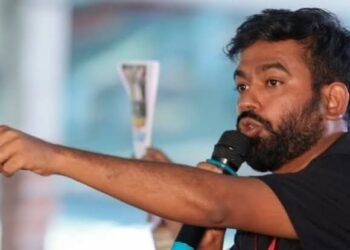
CJP, the youth-led group founded by Abhijeet Dipke, has organised protests over a range of issues, including examination paper leaks, education and alleged electoral-roll irregularities. Its leaders have faced repeated police action. CJP co-convenors Saurav Das and Ashutosh Ranka were sent to Tihar Jail in a separate case related to their alleged entry into the de-notified Jantar Mantar protest site, while Dipke was detained again ahead of the planned ‘Lehra Do Tiranga’ march at Connaught Place.
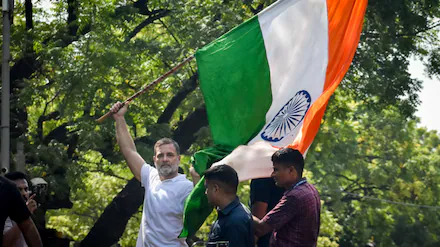
Gandhi’s public support for CJP has been less direct than his response to the allegations made by the students he met. On October 14, he posted in support of the principle involved in the detention of young protesters, writing: “Waving the Tricolour at Jantar Mantar in a peaceful protest is not a crime. Jailing youth for it is an act of cowardice… Different banners, one cause.”
The post was widely interpreted as a show of solidarity with the CJP-led agitation, although Gandhi did not explicitly name the organisation or its leaders. Dipke welcomed the statement, but it did not amount to a formal political alignment or a joint campaign.
Congress subsequently explored inviting Dipke to an INDIA bloc high tea, suggesting some outreach amid the anti-CEC protests. Yet the relationship between the established opposition party and the independent youth group has remained less clearly defined than their overlapping demands might suggest.
READ: Analysis: If All Anti-SIR Protests Are One, Where Is Rahul Gandhi?
A history of distance and competing political space
For months, Congress and CJP pursued parallel campaigns over electoral accountability and other public issues. While their concerns sometimes overlapped, they generally operated through separate platforms, with Congress running its own protests rather than fully integrating itself into CJP’s mobilisation.
CJP leaders have at times criticised what they regard as the reluctance of the established liberal opposition to support their agitation consistently. Congress circles, meanwhile, have viewed the group with caution, amid questions about its political positioning and its ability to attract young protesters outside conventional party structures. Such tensions are relevant to understanding why expressions of solidarity have not necessarily translated into organisational cooperation.
Gandhi has been more explicit and personal in his criticism of police conduct in the cases involving Athira and Ritu. His response to CJP-related detentions, by contrast, has focused more on the general principle of the right to peaceful protest than on the organisation or its leadership.