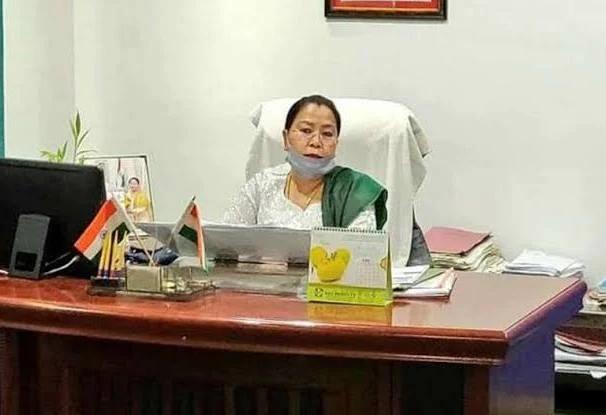
The unanswered question is whether Nemcha Kipgen return to Imphal would deliver tangible gains for the Kuki-Zo community or merely create an impression of normalcy without a political settlement.
BY Navin Upadhyay
Let down by their MLAs, weakened by internal divisions and, critics allege, manipulated by armed groups operating under the Suspension of Operations (SoO) arrangement with the Centre, Kuki-Zo civil society organisations in Manipur Kangpokpi district appear ready to make a decisive departure from the community’s avowed political position. By opening the door for Deputy Chief Minister Nemcha Kipgen to begin discharging her official duties regularly from Imphal, they risk conceding ground on a question that has defined the Kuki-Zo struggle for the past 42 months.
For a community that has shunned Imphal since May 3, 2023, and demanded a separate Union Territory with its own Assembly, this could prove a consequential retreat—one that critics may see as driving a final nail into the movement’s political resolve.
The next step could be the dismantling of the buffer zones, which Kuki-Zo CSOs have consistently maintained were sacrosanct. Thereafter, SoO groups could, as critics allege they did during the last Assembly elections, align themselves with the state government to influence Kuki-Zo voters and help BJP candidates secure victories in their strongholds in 2027 polls. Who cares for the community’s long-standing demands for justice and a separate Union Territory when its leaders are themselves compromised?
Supporters of Nemcha Kipgen could argue that her regular presence in Imphal and an effort to bury the hatchet might help the Kuki-Zo community strengthen its political position amid its ongoing tensions with the Nagas. However, such a strategy raises a fundamental question: would a rapprochement not risk compromising the Kuki-Zo community’s demands for justice, security and a separate administration?
For all these months and years, Kuki-Zo civilians have avoided Imphal even when they needed urgent medical treatment, had to catch flights or wanted to attend schools and colleges. More than 250 people from the community have been killed, while horrific incidents of sexual violence—including the public parading of Kuki-Zo women—have left deep and lasting scars. Families fled their homes, leaving behind property and possessions that were looted, destroyed or seized.
Against this history of suffering, fear and displacement, the appeal for Kipgen to work regularly from Imphal carries implications far beyond the routine functioning of a minister’s office. It raises a question the Kuki-Zo political leadership can no longer avoid: if the community’s elected representatives and civil society organisations are now prepared to embrace political normalisation with Imphal, what has changed—and what has become of the demand for justice and a separate administration?
READ: Analysis: If All Anti-SIR Protests Are One, Where Is Rahul Gandhi?
Three years of separation—and sacrifice
The scale of the rupture since May 3, 2023, cannot be understood merely through the geography of the conflict.
Kuki-Zo families were forced to flee areas where they feared for their lives. Many left homes and belongings behind, while others lost access to livelihoods, education and familiar social networks. Displacement brought uncertainty over housing, employment, schooling and the future of children who had already experienced trauma.
These experiences helped turn physical separation into a wider political reality. The refusal or reluctance to travel to Imphal came to reflect not only immediate security concerns but also a profound loss of confidence in the state’s ability to guarantee equal protection.
The Kuki-Zo demand for a separate administration must be understood in that context. For its supporters, the demand is not simply an exercise in territorial politics. It is presented as a response to the breakdown of trust and the belief that the existing administrative structure cannot adequately protect the community.
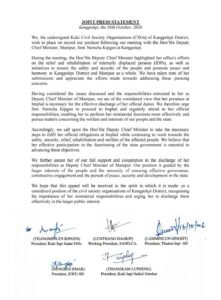
The joint statement issued on Friday followed a meeting with Kipgen. It was signed by representatives of the Kuki Inpi Sadar Hills, Sadar Hills Chiefs’ Association (SAHILCA), Thadou Inpi-Sadar Hills, Kuki Women Union-Sadar Hills and Kuki Inpi Saikul Gamkai.
The organisations acknowledged Kipgen’s efforts concerning relief and rehabilitation for internally displaced persons, public safety and initiatives to promote peace. They nevertheless argued that her responsibilities as Deputy Chief Minister required her to be present in Imphal and participate regularly in the functioning of the state government.
They offered their support and cooperation, describing their appeal as guided by the wider interests of the people and the need for effective governance.
On the face of it, their argument is straightforward: a senior minister cannot perform all her responsibilities effectively if she remains away from the seat of government.
But the statement leaves a larger question unanswered. What has changed since May 2023 that would make regular political engagement in Imphal acceptable—or beneficial—to a community whose members continue to face displacement and security concerns?
Have the underlying fears been adequately addressed? Are displaced families able to return safely? Have outstanding grievances been investigated? Is there a credible political process addressing the demand for a separate administration?
The organisations may believe that Kipgen’s presence in Imphal would help resolve these issues. If so, they owe the community an explanation of how. In an era of virtual meetings and digital governance, why can she not continue discharging much of her official work remotely, as she has done until now? Documents requiring her signature can be sent between Kangpokpi and Imphal, barely 40 kilometres apart, without necessarily requiring her physical presence in the state capital every day. If official business can be conducted through digital communication and the movement of files, what has suddenly changed to make her regular physical presence in Imphal indispensable?
This is not an argument that a Deputy Chief Minister should remain indefinitely away from the seat of government. It is a question of necessity, timing and political purpose. Why should a community whose members have avoided Imphal for 42 months because of deep-seated security fears accept this shift without being told what concrete benefits it will bring? Will Kipgen’s return secure meaningful progress on justice, the rehabilitation of displaced families, their safety and the demand for a separate Union Territory with its own Assembly? Or will it merely create the appearance that normalisation is under way?
The circumstances surrounding the CSOs’ appeal also invite questions about the possible influence of armed organisations on Kuki-Zo civil society bodies. Given the reported association of Kipgen’s husband, S. T. Thangboi Kipgen, with the Kuki National Front (KNF), speculation may arise over whether he played any role in persuading the organisations to ask her to begin regularly attending official duties in Imphal.
It is well known that CSOs in Manipur are often at the beck and call of armed groups. The extent to which this influence may have shaped the latest appeal, however, remains an open question. The signatory organisations need to explain whether their decision emerged from independent deliberations and what political or security assurances underpin their call.
The political symbolism of Kipgen return
Kipgen’s position is particularly sensitive because her entry into the BJP-led government was opposed by the Kuki-Zo Council, which had resisted participation in a state government without progress towards the community’s demand for a separate administrative arrangement.
When the government was formed in February 2026, Kipgen became Deputy Chief Minister alongside Naga People’s Front leader Losii Dikho. She took her oath virtually from Manipur Bhawan in New Delhi rather than travelling to Imphal for the ceremony.
Her decision to join the government had already exposed differences between electoral politics and the collective position advocated by sections of the Kuki-Zo leadership.
Regular attendance in Imphal would add another dimension to that debate. A virtual oath-taking ceremony allowed Kipgen to assume office without making the journey to the capital. Regularly working from Imphal would represent a more visible and sustained form of engagement.
That would not, by itself, mean that she had abandoned the demand for a separate administration. But it could weaken the symbolic separation that has come to define the conflict, particularly if her return were portrayed by the government as evidence that normal political relations had been restored.
For a movement built around the argument that existing arrangements no longer provide adequate security and political confidence, such symbolism matters more that aything else.n