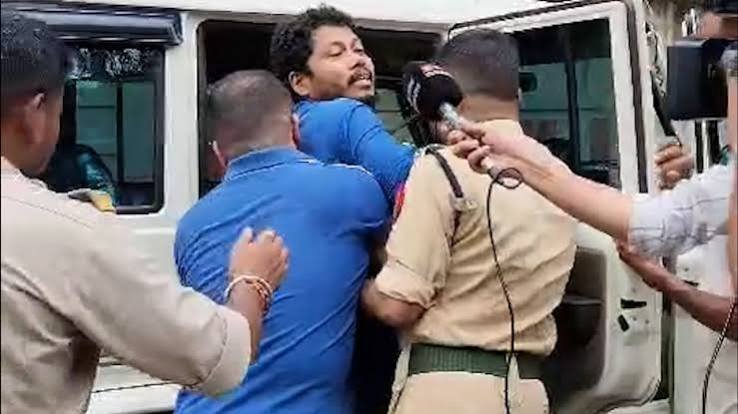
Doley’s detention has become a political flashpoint, with his supporters linking it to opposition to a proposed luxury hotel project on land claimed by local Mising and Adivasi communities.
BY PC Bureau
September 6, 2026: Thousands of people gathered in Bokakhat, the gateway to Kaziranga National Park, on Sunday demanding the unconditional release of tribal and land-rights activist Pranab Doley whose preventive detention under the National Security Act (NSA) has become a major political flashpoint in Assam.
The protest brought together opposition parties, tribal organisations, farmers’ groups, activists and civil-society organisations, who accused the Assam government of using the NSA to silence resistance to a proposed luxury hotel project near Kaziranga National Park and Tiger Reserve.
Doley, 40, is a prominent leader of Assam’s Mising community, a recognised Scheduled Tribe and one of the State’s largest plains tribal groups. He is the convenor of the Greater Kaziranga Land and Human Rights Protection Committee and has for years campaigned for indigenous and Adivasi land rights, opposing evictions and land acquisition around Kaziranga and advocating the protection of local livelihoods and wildlife corridors.
A graduate in social work from the Tata Institute of Social Sciences, Doley has represented affected communities at the UN Forum on Business and Human Rights in Geneva. He also contested the Bokakhat Assembly election as an Independent.
The Sunday protest was organised by the Pranab Doley Release Demand Committee, which had booked Mising Jironi Sora, or Mising Rest House, for a citizens’ meeting. Organisers alleged that the venue was locked, preventing the meeting from being held there.
Protesters subsequently blocked the National Highway and marched for nearly a kilometre, raising slogans such as “BJP Government Go Back” and “Free Pranab Doley”. The meeting was eventually shifted to Doley’s residence in Bokakhat town, where political leaders, activists and civil-society representatives addressed the gathering.
Congress MP Gaurav Gogoi alleged that Chief Minister Himanta Biswa Sarma’s government had detained Doley to weaken opposition to a proposed Hyatt hotel on Adivasi and Mising farmland adjoining Kaziranga.
READ: Singapore Probes Racist Posts Over Nepal Disaster, Air India
READ: Manipur Census Pause: Politics Behind the Centre’s Decision
Gogoi said the project and the government’s handling of the protests could have serious consequences for the future of Kaziranga and the communities living around the national park.
Asom Jatiya Parishad president Lurinjyoti Gogoi also connected Doley’s detention with the opposition to the proposed hotel, accusing the government of prioritising capital investment over natural resources and community rights.
Former IAS officer John Ingti Kathar alleged that the State machinery was curbing citizens’ fundamental rights and branding those who oppose government-backed projects as anti-national. Advocate Kishore Kumar Kalita said democratic rights were being undermined and alleged that Doley’s continued detention was intended to weaken the wider land-rights movement.
Congress, Raijor Dal, Asom Jatiya Parishad, the CPI, Jeepal Krishak-Shramik Sangha, Krishak Mukti Sangram Samiti and several farmers’, workers’ and civil-society organisations took part in the protest.
The participating groups resolved to launch a coordinated campaign against what they described as oppressive land policies and to intensify the demand for Doley’s release.
At today’s “Nagarik Sabha” in Bokakhat, APCC President and Deputy Leader of the Congress in the Lok Sabha, Shri @GauravGogoiAsm ji, demanded the unconditional release of land and human rights activist #PranabDoley.
He strongly condemned the Assam Government’s use of the NSA to… pic.twitter.com/Gvc3ua8jco
— Assam Congress (@INCAssam) September 5, 2026
NSA detention challenged in Gauhati High Court
Doley’s detention is already being challenged before the Gauhati High Court. On August 27, the court sought responses from the Centre and the Assam government on a writ petition challenging his preventive detention and fixed September 14 for further hearing. It also directed Assam’s Home and Political Department to appear before the court.
Doley was arrested on July 12 in connection with Bokakhat Police Station Case No. 108/2026 following protests at the proposed hotel site at Inlay Pathar, a village adjoining Kaziranga.
The Additional Sessions Judge, Golaghat, granted him bail on July 29 on a bond of Rs 20,000 with one surety. However, the Assam government issued an NSA detention order the following day, before he could walk out of jail.
The bail order raised questions about several of the allegations against Doley. The court noted that there was no prima facie video showing protesters directly attacking police personnel and that alleged machetes and sharp sticks had not been recovered.
On the allegation that protesters had attempted to burn a cement mixer, the court noted that footage showed a woman pouring diesel on the machine but did not show an attempt to ignite it.
The allegations of assault on women police personnel were also described as general and were not specifically attributed to Doley or any named individual.
The prosecution had additionally cited alleged suspicious domestic and foreign funding, overseas travel and money received from Delhi-based Environics Trust. The court held that these claims did not justify keeping Doley in custody in that particular criminal case, noting that key statements had already been recorded, video evidence secured and his passport seized.
The court also observed that the protests had emerged from concerns over possible environmental damage and the impact of the proposed project on the social and cultural life of local Tea Tribe communities, and called for structured and peaceful dialogue.
What the NSA order says
The July 30 detention order issued under Section 3(2) of the NSA cited a report from the Senior Superintendent of Police, Golaghat, along with case records, statements and intelligence inputs.
The order referred to 13 criminal cases allegedly registered against Doley between 2017 and 2026 and stated that his activities posed a threat to public order and State security.
Doley’s supporters have challenged that justification, arguing that criminal allegations and political dissent cannot by themselves become grounds for indefinite preventive detention.
The legal challenge before the Gauhati High Court will now determine whether the statutory requirements for invoking preventive detention under the NSA were satisfied in his case.
Access to father and legal adviser
On August 7, while hearing a separate petition filed by Doley’s father, the Gauhati High Court directed the superintendent of Golaghat District Jail to allow him to meet his son as well as a legal adviser of his choice.
The court also held that Doley’s father did not require permission from the district magistrate to visit him.
With the High Court scheduled to hear the main challenge to the NSA detention on September 14, the Sunday mobilisation has added a fresh political dimension to a case already caught between questions of national security, preventive detention, indigenous land rights and opposition to the proposed development near Kaziranga.
For Doley’s supporters, however, the issue is more immediate: they want him released and the government to engage directly with the communities opposing the project.
The Assam government’s justification for the detention, and the High Court’s eventual assessment of its legality, could determine whether the Doley case remains a local land-rights dispute or develops into a wider test of the State’s use of preventive detention against activists leading protests over land and development.