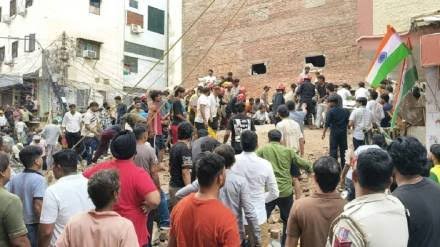
Rescue teams raced against time in Delhi’s Satya Niketan after a student hostel collapsed, with several people feared trapped and some reportedly making SOS calls from beneath the rubble.
BY PC Bureau
NEW DELHI: Hours after the five-storey Hostel Daze building came crashing down in Delhi’s Satya Niketan on Sunday, the rescue operation remained a race against time, with students feared trapped beneath the rubble and some reportedly using their mobile phones to send desperate calls for help.
RK Puram MLA Anil Kumar Sharma said rescuers were in contact with people beneath the debris. “Some of the children are even making phone calls from under the rubble,” he told reporters. DUSU president Aryan Maan also said rescue teams were communicating with students still trapped inside.
Witnesses reported hearing cries for help from beneath the wreckage. However, officials had yet to establish the exact number of people unaccounted for. Estimates from the site varied widely, while police said the number of those trapped was still being ascertained.
At least three persons were confirmed dead and three rescued students were taken to the AIIMS Trauma Centre in critical condition, according to reports. Rescue teams from the NDRF, Delhi Fire Services, Delhi Disaster Management Authority, Delhi Police, MCD and Civil Defence were working through the debris with heavy equipment, cutters and other specialised tools.
The narrow lanes around Nanakpura Gurdwara complicated the operation. Local residents initially joined the effort, attempting to clear debris by hand before heavy machinery reached the site. An adjoining building was also evacuated as a precaution after concerns about its stability.
The collapse occurred at a particularly vulnerable time. Satya Niketan is a densely populated student neighbourhood, with numerous paying guest accommodations housing students from across India. Hostel Daze was reportedly being used as a boys’ PG accommodation.
A multi storey building housing a paying guest accommodation collapsed in Delhi’s Satya Niketan on Sunday amid rain, leaving several students feared trapped under the debris. Thick smoke filled the area as students and others rushed to escape. pic.twitter.com/2Ja1UBgSCJ
— Lizard People’s Party🦎 (@1SanatanSatya) September 6, 2026
Parents wait for names, calls and answers
As the rescue operation continued, anxious families began calling classmates, friends, wardens and others who might know who was inside the building.
The absence of an immediately available, verified list of occupants added to the confusion. Families waited for information about those rescued, those admitted to hospital and those whose phones remained unanswered.
For relatives, the immediate question was brutally simple: Who is safe, who is in hospital and who is still beneath the rubble?
The larger questions can wait—but only for so long.
READ: Vigilante Bhardwaj Gets One-Day Judicial Custody, More to Follow
READ: Singapore Probes Racist Posts Over Nepal Disaster, Air India
The blame game begins before the rescue ends
Delhi Chief Minister Rekha Gupta visited the site as rescue agencies worked to locate those trapped. The administration said every possible effort was being made to rescue survivors.
But the political blame game began even as the search continued.
Opposition voices have questioned the enforcement of building and construction norms in Delhi, while attention has focused on the owner and the construction work reportedly under way in the basement when the building collapsed.
Police have registered an FIR against the building owner. That, however, is only the beginning of the legal process and does not establish guilt.
The central question now is whether the collapse was caused by unauthorised or unsafe structural alterations—and, if so, who permitted such work to continue while students were living above it.
A multi storey building housing a paying guest accommodation collapsed in Delhi’s Satya Niketan on Sunday amid rain, leaving several students feared trapped under the debris. Thick smoke filled the area as students and others rushed to escape. pic.twitter.com/2Ja1UBgSCJ
— Lizard People’s Party🦎 (@1SanatanSatya) September 6, 2026
What Delhi’s building laws actually say
The circumstances make the Delhi Unified Building Bye-Laws particularly relevant.
The UBBL 2016 applies across Delhi and governs building activity within the jurisdiction of the DDA and concerned local bodies. It defines an “alteration” broadly to include structural changes, including cutting into or removing a wall, column, beam, joist, floor or other structural support.
The bye-laws also provide for a Common Application Form for erecting, re-erecting, demolishing or making a material alteration in a building. The approval process requires declarations and certificates involving the owner, architect, structural engineer and supervisor.
The structural engineer is required to certify that the building has been designed for safety requirements and that the structural design complies with the National Building Code and relevant standards, taking soil conditions into account where required. The bye-laws place responsibility for structural, natural-disaster and fire safety on the owner as well as the professionals engaged for design, construction and supervision.
Basement construction carries an additional layer of responsibility. The UBBL requires an Indemnity for Basement as part of the approval process. The owner undertakes, among other things, that excavation will not extend beyond the permissible plot boundaries and accepts responsibility for damage caused by excavation to public sewers and water drains.
That makes the reported basement work at Hostel Daze a crucial line of investigation.
If excavation beneath or around an existing structure compromised its foundation, or if structural supports were altered without proper approval and engineering supervision, the issue would go far beyond a routine construction violation.
It would raise questions of structural safety, negligent construction, unauthorised alteration and regulatory failure.
The questions MCD must answer
The investigation now needs to establish some basic facts.
Was the basement shown in the sanctioned building plan?
Was permission obtained for the excavation or alteration?
Was a revised building plan sanctioned for the work?
Was a structural engineer appointed and was structural safety certified?
Was the excavation carried out under professional supervision?
Were any columns, beams, foundations or other structural supports altered or weakened?
And perhaps the most important question:
Did the civic authorities know that basement work was being carried out in an occupied student accommodation—and, if they knew, what action did they take?
These are not political questions. They are questions that should be answered through the building plan, sanction records, inspection records, structural drawings and the forensic investigation.
Delhi’s UBBL framework is not silent on structural safety. The official rules require sanctioned plans, professional responsibility and structural-safety certification.
The issue, therefore, may ultimately be less about whether Delhi has building-safety rules and more about whether those rules were followed and whether the enforcement machinery worked before the building collapsed.
Until the last person beneath the rubble is accounted for, however, the priority remains rescue.
The questions of responsibility can—and must—follow.