Singapore police are investigating racist and xenophobic online comments targeting victims of the devastating Nepal floods and remarks linked to Singapore Airlines’ investment in Air India, Senior Minister K. Shanmugam said.
BY PC Bureau
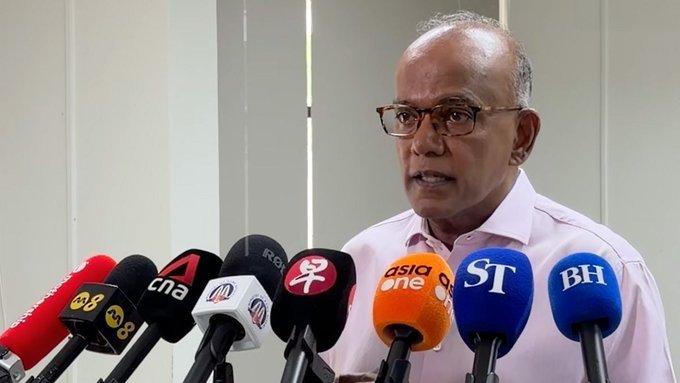
September 6, 2026: Singapore authorities have launched a police investigation into a series of racist and xenophobic comments posted online in connection with the deadly floods in Nepal and Singapore Airlines’ investment in Air India, Senior Minister K. Shanmugam said on Saturday.
Shanmugam, who is also Home Affairs Minister and Coordinating Minister for National Security, described the comments as “shameful”, “nasty” and “totally unacceptable”, saying he had directed the police to examine the posts.
The Ministry of Digital Development and Information will also approach social media platforms to seek removal of comments that violate their community standards, he said.
“The media tells me that they had to remove several comments because they were so nasty,” Shanmugam told reporters. “I have asked police to look into these comments.”
The intervention followed a wave of online abuse directed at Singaporeans affected by the devastating floods in Nepal. Nine Singaporeans remained missing after the disaster, which caused widespread destruction and claimed more than 1,000 lives.
Shanmugam cited several comments targeting the missing Singaporeans, including: “No they are not our own,” “I only see Indian faces here. Skip. Rescue cut,” and “All ABNNs look the same, how to AI?”
READ: Will Supreme Court Wake Up to Bhavnagar Police Brutality?
He said “ABNN” was a derogatory term used against Indians.
The comments have drawn condemnation from political figures and members of the public, with People’s Action Party MP Alex Yam describing the remarks earlier in the week as not only racist but “downright heartless”.
Shanmugam stressed that the views expressed online did not represent Singaporeans generally. He pointed to more than S$3 million raised by the Singapore Red Cross for relief efforts in Nepal as evidence of the broader public response.
“Singaporeans are generous, across all races,” he said, warning against allowing a small group to damage the country’s social cohesion.
Air India investment becomes another target
The online controversy has spilled into a separate debate over Singapore Airlines’ investment in Air India, with Shanmugam saying reports of possible additional capital being sought by the Indian carrier had prompted another round of racist and anti-Indian abuse.
He said some online posts had resorted to references to “snakes, curry, prata, black magic”, while an online group had also targeted Temasek chief executive Dilhan Pillay Sandrasegara and other senior executives because of their Indian ethnicity.
Temasek is the majority shareholder of Singapore Airlines.
According to Shanmugam, some of the online attacks accused the Temasek CEO of favouring Air India because of his ethnic background.
He rejected the argument, saying Sandrasegara was “as Singaporean as any of us” and describing the accusations as “nasty and libellous”.
The minister warned that allowing such arguments to gain acceptance could create a dangerous precedent in which business and public officials are judged on the basis of ethnicity rather than the merits of their decisions.
“These people should be unmasked and dealt with rather than be allowed to hide behind online anonymity,” he said.
Mr. Shanmugam, Singaporean Minister for Home Affairs called out the racist and xenophobic online mobs in light of the Nepal-Tibet disaster. A lot of anti-India media also originates from Singapore. Perhaps that has a role to play in this along with the Chinese ofcourse. pic.twitter.com/ppCABxuzco
— Singh (@Singh199888) September 5, 2026
Government warns against normalising racism
Shanmugam acknowledged that Singapore was not free of “latent racism” and said the Government would take a firm position against online racial and religious hostility.
He warned that such rhetoric can move from the margins into mainstream discourse if it is left unchecked.
“First, a minority says these nasty things; slowly it becomes normalised; then it becomes mainstream,” he said, adding that public discourse could be degraded and social harmony weakened.
Singapore, he stressed, is a small, multiracial and multi-religious country and cannot afford to allow divisions along ethnic or religious lines to deepen.
He also said some racist content targeting Indians appeared to originate from overseas or was being amplified from outside Singapore.
“We should not tolerate this. This is not who we are as Singaporeans,” he said.
Debate over Air India funding
The racial controversy comes as Singapore Airlines considers whether to provide additional capital to Air India.
A Reuters report last month said Air India was seeking another US$1.5 billion in support from its owners, Tata Sons and Singapore Airlines, after reporting a record annual loss.
SIA said last week that its board would carefully assess any request for additional capital, taking into account its own capital requirements and Air India’s business strategy.
The proposed investment has also generated political debate in Singapore.
Workers’ Party MP Kenneth Tiong said on August 26 that he would not support Temasek funds being used to support Air India through Singapore Airlines. He argued that regardless of whether the money came directly from SIA or indirectly affected Temasek’s position, the decision would have implications for the state-linked investment company.
Tiong said Singaporeans did not owe Air India a “living” and argued that if SIA wished to continue investing in the Indian carrier, it should do so on commercial grounds rather than through Temasek.
Shanmugam, however, defended the principle that investment decisions should remain with the companies concerned.
He said any decision on additional investment in Air India should be made by Singapore Airlines after assessing its resources, long-term growth prospects and profitability.
Temasek, as a shareholder in SIA, would expect the airline to make investment decisions responsibly, he said.
Temasek says investment decisions must remain commercial
Shanmugam also drew a distinction between the Government’s responsibility toward Temasek and the investment decisions made by individual portfolio companies.
Temasek is accountable to the Government for its overall portfolio and long-term performance, he said, but individual investment decisions should not be directed by politicians or the Government.
“If governments or politicians start directing individual investment decisions, commercial discipline will be compromised,” he said.
He warned that decisions could become politicised and driven by political considerations instead of commercial judgement, ultimately exposing Singaporeans to the cost of poor investment decisions.
The Government’s role, he said, was to ensure professional management at Temasek while providing the company and its portfolio firms with the confidence to make commercial decisions without inappropriate political pressure.
Temasek and several of its major portfolio companies, including Singapore Airlines, Sembcorp, Singtel and CapitaLand, have significant investments in India.
Shanmugam noted that Temasek’s India exposure stood at 7 per cent of its country allocation, while the Americas and China together accounted for 43 per cent. India, he said, had nevertheless been the firm’s best-performing market over the past decade.
He pointed to several successful investments, including Temasek’s sale of its stake in an Indian joint venture to Schneider Electric for more than S$8 billion, nearly ten times its original investment.
He also cited Temasek’s investment in Manipal Health Enterprises, which was listed last month and is now reportedly valued at more than S$11 billion.
The Government’s immediate concern, however, remains the online abuse.
Shanmugam said Singapore’s authorities would not allow anonymous online activity to become a vehicle for racial hostility, particularly in a country whose stability depends heavily on trust among its different ethnic and religious communities.
The police investigation into the comments will now determine whether any of the posts crossed the legal threshold for action, while social media platforms are being asked to remove material that violates their rules.