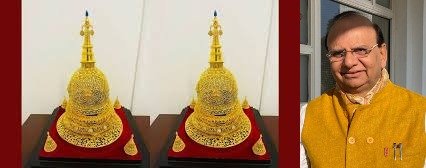
The revered relics of Arahant Sariputra and Arahant Mahamoggallana, among the most sacred treasures of the Buddhist world, have drawn thousands of devotees in Mongolia, reinforcing the deep spiritual and cultural bonds between the two nations.
BY PC Bureau
New Delhi, June 8, 2026: In a significant act of cultural diplomacy and spiritual cooperation between India and Mongolia, Ladakh Lieutenant Governor Vinai Kumar Saxena will travel to Ulaanbaatar on Sunday to lead the Indian delegation tasked with bringing home the sacred relics of two of Lord Buddha’s foremost disciples — Arahant Sariputra and Arahant Mahamoggallana.
Prime Minister Narendra Modi has personally entrusted Saxena with overseeing the return of the revered relics following the conclusion of a ten-day public exposition in Mongolia’s capital. The Lieutenant Governor will attend the closing ceremony on June 10 before accompanying the relics back to India aboard a special aircraft.
The relics, among the most treasured Buddhist artifacts preserved in India, were transported to Mongolia on May 30 aboard an Indian Air Force IL-76 “Gajraj” aircraft. Since June 1, they have been on public display at the historic Ganden Monastery in Ulaanbaatar, drawing thousands of devotees, monks and visitors from across Mongolia.
Their visit has generated immense spiritual enthusiasm in the Buddhist-majority nation, where the teachings of the Buddha remain deeply embedded in the country’s cultural and religious identity. The exposition has been viewed not only as a religious event but also as a powerful reaffirmation of the centuries-old civilisational bonds linking India and Mongolia.
The return of the relics follows a highly successful exposition in Ladakh from May 1 to May 14, where more than 1.18 lakh devotees paid homage. The event transformed the Himalayan region into a focal point of Buddhist pilgrimage and spiritual reflection, attracting worshippers from across India and abroad.
READ: Bharat Singh Chauhan: Five Decades of Building Indian Chess
The sacred relics belong to Arahant Sariputra and Arahant Mahamoggallana, regarded in Buddhist tradition as the Buddha’s two chief disciples. Sariputra is celebrated for his profound wisdom and mastery of Buddhist philosophy, while Mahamoggallana is revered for his spiritual attainments and extraordinary meditative powers. Their relics are among the most venerated objects in the Buddhist world.
Over the years, India has periodically shared these relics with Buddhist nations as part of its cultural outreach and efforts to strengthen people-to-people ties. Similar expositions have been organised in Sri Lanka, Thailand, Vietnam and Mongolia, enabling millions of devotees to pay their respects to sacred symbols of the Buddhist faith.
The Indian Air Force, which transported the relics to Mongolia, described the mission as carrying “faith, heritage and friendship across continents.” The initiative has been widely viewed as a reflection of India’s commitment to preserving and sharing its Buddhist heritage while deepening cultural engagement with partner nations.
For Ladakh, often regarded as one of India’s most important centres of Himalayan Buddhism, the exchange carries particular significance. The region has long served as a bridge between the Indian Buddhist tradition and the wider Buddhist world. LG Saxena played a key role in facilitating the Ladakh exposition, working closely with Buddhist leaders and monastic institutions to ensure smooth arrangements for pilgrims and visitors.
The return of the relics marks the culmination of another successful chapter in India-Mongolia relations, which are rooted in shared spiritual traditions, historical connections and mutual respect. As the sacred relics make their journey back to India, they carry with them not only centuries of religious reverence but also a powerful message of friendship and cultural unity across Asia.