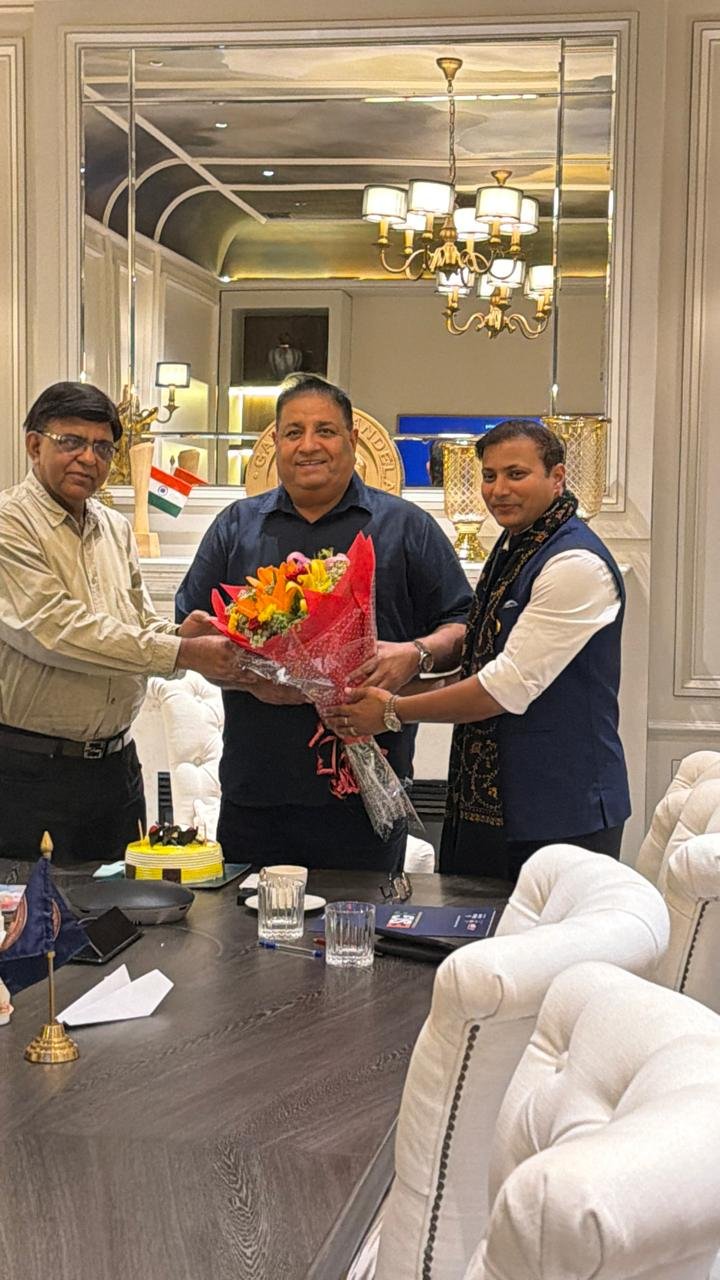
Whether hosting the Chess Olympiad, nurturing young talent or steering international chess bodies, Bharat Singh Chauhan has spent five decades serving the game he loves.
BY Navin Upadhyay
There are people who play chess. There are people who teach chess. There are people who administer chess.
And then there is Bharat Singh Chauhan — a man who has spent half a century doing all three.
This year marks fifty years since Chauhan first sat before a chessboard as a young, lanky player in Delhi. The journey that began on those sixty-four squares has since taken him across continents, into the highest corridors of world chess administration, and into the centre of India’s remarkable rise as a global chess power.
Today, when India celebrates world champions, hosts elite international tournaments, and produces grandmasters at a rate once considered unimaginable, it is easy to overlook the architects who worked behind the scenes to make such success possible. Chauhan is undoubtedly one of them.
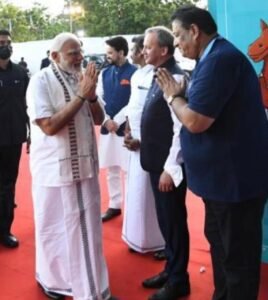
At an age when many administrators distance themselves from the game itself, he still cannot resist a blitz game. Walk into a tournament where he is present and chances are high that you will find him hunched over a board, challenging a young prodigy, an organiser, or a visiting grandmaster. The competitive spark that made him a multiple-time Haryana State Champion never quite disappeared.
“Chess has never been a job for me,” he says. “It has always been a passion.”
READ: Second LPG Hike in 3 Months; Delhi Cylinder at Rs 942
That passion shaped a remarkable career.

The titles tell part of the story: International Arbiter, Secretary of the All India Chess Federation, Chairman of the FIDE Advisory Board, Deputy President of the Asian Chess Federation, Chairman of the Commonwealth Chess Association. But anyone who has spent time around Chauhan knows that titles are, for him, beside the point.
His real language has always been events.
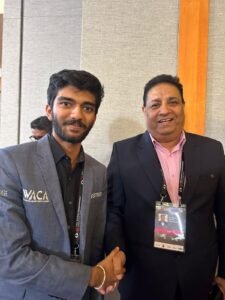
For over two decades, the Delhi International Open has been one of the most important tournaments on the Asian calendar — a place where established titled players come to compete and ambitious young Indians come to find out what they’re made of. The list of players who passed through its rounds and came away with something vital is long. One name stands out. In 2019, a teenager named D. Gukesh secured his final Grandmaster norm at the Delhi Open. The rest, as followers of Indian chess know well, is history.

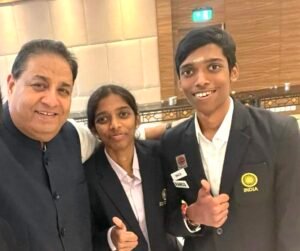
Beyond Delhi, Chauhan’s involvement in Indian chess runs deep. He was central to bringing the Anand-Carlsen World Championship match to Chennai in 2013 — a moment that electrified the country. He helped organise the World Junior Championship in New Delhi. He directed the Global Chess League across Dubai, London, and Mumbai.
And then came the moment that perhaps defined his career most clearly.
In 2022, when the original host of the Chess Olympiad withdrew with barely four months to spare, India stepped forward. The scale of what was being asked was staggering — 186 nations, thousands of players, officials and delegates, an event that ordinarily demands years of groundwork. As Tournament Director, Chauhan led the effort. It didn’t merely come together; it became one of the most warmly remembered Olympiads in the event’s history, a demonstration to the world of what Indian chess administration could do when it had to.
But elite tournaments and grand Olympiads are only half the dream.
“We have produced world champions, yes. But my real dream is the child in a small town in Rajasthan or Bihar or the Northeast who has never seen a chess board and never will — unless we go to them,” he says. “That child could be our next Gukesh. We just haven’t found her yet.”
It is a vision that has quietly driven much of his work behind the headlines. For Chauhan, the measure of Indian chess’s success cannot be counted only in grandmaster titles or Elo ratings. It has to be counted in reach.
“Chess is still seen as a game for the privileged — good schools, big cities, parents who know the game. I want to break that. Completely,” he says. “Every panchayat, every government school, every small-town club — that is where the future of Indian chess is sitting and waiting.”
Five decades in any field accumulate their share of friction, and Chauhan’s career is no exception. There have been disputes, criticism, political battles. He does not dwell on them.
“There will always be people who want to pull you down,” he says. “That’s the only way they think they can climb up. I know what my work is.”
Those who have worked alongside him describe someone who is constitutionally incapable of half-measures — stubborn to his critics, tireless to his supporters, and, most people would agree, impossible to ignore either way.
His unanimous re-election as Chairman of the Commonwealth Chess Association for 2026–2030 suggests the chess world’s appetite for his particular brand of commitment hasn’t dimmed. New projects are already in motion, among them the inaugural Commonwealth School Chess Championship — a competition he speaks about with particular warmth, precisely because it points toward the grassroots.
“When I see a twelve-year-old playing her first serious tournament, nervous, not sure of the rules — that is the moment I work for,” he says. “Not the closing ceremonies. Not the press conferences. That child’s face.”
Fifty years ago, a young man in Delhi sat down at a chessboard and felt something click into place. The board hasn’t changed. Neither, by all accounts, has he.