The NRC-Census dispute is deepening in Manipur, with protesters demanding citizenship records be updated before the population exercise
BY PC Bureau
August 20, 2026: Educational institutions across Manipur will remain closed for three days from Thursday as the state government responds to an intensifying agitation over demands to update the National Register of Citizens (NRC) before the upcoming Census exercise.
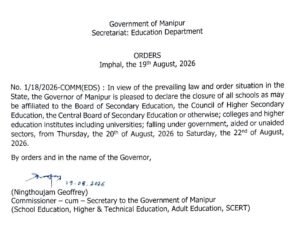
The Manipur Education Department has ordered the closure of all educational institutions from August 20 to August 22, citing the prevailing law-and-order situation and concerns over the safety of students and staff amid continuing protests and disruptions across several districts.
The order covers a wide range of institutions, including schools affiliated with the Board of Secondary Education, Manipur; Council of Higher Secondary Education, Manipur; Central Board of Secondary Education (CBSE); and other recognised boards.
It also applies to colleges, universities and other higher education institutions, irrespective of their management, bringing government, government-aided and private unaided institutions under the shutdown.
READ: Ladakh Rolls Out 4% Job Quota for Outstanding Sportspersons
The decision came as a 48-hour general strike called by the Campaign for Just and Fair Delimitation (JFD) entered its second day, with protesters stepping up their campaign for the NRC to be updated in the state before the Census is conducted.
NRC demand at the centre of agitation
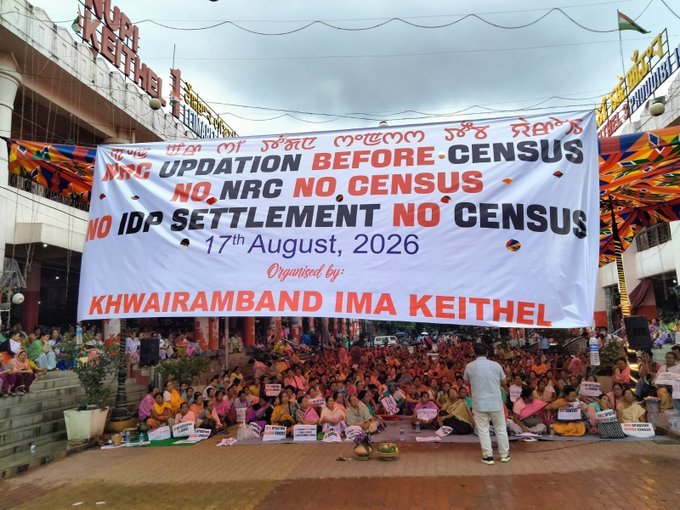
The JFD has made the updating of the NRC a central demand of its ongoing agitation. The organisation has argued that citizenship records should be verified and updated before the Census so that the exercise does not proceed without clarity over the state’s population and citizenship profile.
Protesters contend that conducting the Census without first resolving questions relating to citizenship and migration could have consequences for Manipur’s demographic composition and political representation.
The demand has acquired added significance in the backdrop of the state’s prolonged ethnic conflict, which has displaced large numbers of people from their homes and disrupted normal administrative and social life.
The protesters have also linked the Census issue with the status of internally displaced persons (IDPs), arguing that the exercise should take into account the inability of many displaced residents to return to their ancestral villages.
As part of its escalation plan, the JFD has announced a boycott of government offices from August 21, potentially adding further pressure on the state administration and disrupting the functioning of government departments.
Protests spread across valley districts
The agitation continued across several valley districts on Wednesday, with demonstrations, road blockades and attempts to enforce the general strike reported from different locations.
At Khurai Lamlong in Imphal East district, bandh supporters burnt effigies of Chief Minister Yumnam Khemchand Singh and Home Minister Govindas Konthoujam.
Demonstrators reiterated their demand that the Census should not be allowed to proceed until internally displaced persons are able to return to their native places.
The protesters said conducting a population exercise while a substantial section of the population remains displaced could create an incomplete picture of the state’s demographic situation.
In Imphal West, dozens of demonstrators took out a rally from Singjamei and marched for nearly two kilometres while raising slogans in support of their demands.
Road blockades were also reported from several locations in Imphal West, Imphal East, Bishnupur and Thoubal districts as supporters attempted to enforce the strike.
According to reports from the affected areas, bandh supporters stopped private vehicles and, at some locations, intercepted security forces and asked them to turn back. The disruptions affected normal movement on roads and added to the tension surrounding the agitation.
Census preparations disrupted
The protests have begun to affect not only ordinary public movement but also preparations for the Census.
Officials said a training programme scheduled in Thoubal district for supervisors, enumerators and field trainers was cancelled amid the ongoing agitation.
Such training programmes form part of the preparatory process for the large-scale field exercise required for the Census, involving personnel responsible for collecting and verifying population data.
The cancellation indicates that the continuing unrest is beginning to interfere with administrative preparations for the exercise that the protesters are seeking to delay until the NRC issue is addressed.
Educational shutdown amid security concerns
The three-day closure of schools, colleges and universities is the latest administrative response to the deteriorating situation.
The Education Department’s decision is aimed primarily at preventing students and teaching and non-teaching staff from being exposed to disruptions, road blockades or possible confrontations during the period of the agitation.
The closure also reflects the practical difficulties of keeping educational institutions functioning when transportation and public movement are being affected by a statewide strike.
For thousands of students, however, the shutdown comes at a time when educational activities in the state are already being conducted against the backdrop of prolonged instability.
The government has therefore opted for a temporary suspension of classes rather than risk exposing educational institutions to the consequences of the continuing protests.
The latest agitation highlights the growing sensitivity surrounding the Census in Manipur, where questions of identity, migration, citizenship, displacement and representation have acquired particular political significance.
For the JFD and its supporters, the demand for an updated NRC is not merely an administrative exercise but a mechanism they believe is necessary to establish a clearer record of citizenship before population data are formally compiled.
The government, meanwhile, faces the challenge of maintaining the Census-related preparatory process while dealing with protests that have already disrupted transport, government activity and educational institutions.
With the JFD announcing a government-office boycott from Friday, the impact of the agitation could extend beyond the current 48-hour strike.
For now, the closure of educational institutions through August 22 provides a temporary measure to minimise the risk to students and staff as the confrontation over the NRC and Census enters a more intense phase.
The immediate focus is likely to remain on whether the agitation expands further and whether the state government engages with the protesters’ demand to address the NRC issue before proceeding with the Census exercise.