BY PC Bureau
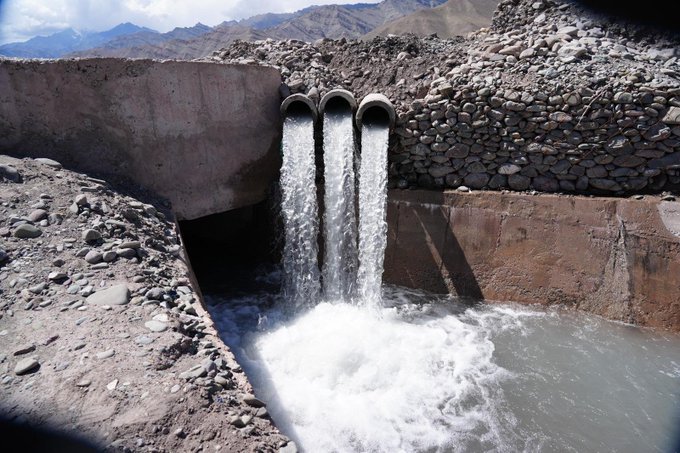
August 20: A simple water-diversion project in Ladakh is turning a long-wasted source of glacial meltwater into a major irrigation supply, with the administration redirecting around 90 million litres of water a day into the long-underused Igoo-Phey canal system.
The intervention, carried out primarily through basic earthwork and JCB operations, is expected to provide more dependable irrigation to around a dozen villages and bring more than 1,000 acres of previously water-stressed agricultural land under regular irrigation.
The water originates from the Stok Kangri Glacier near Leh and reaches the valley through the Stok village Nallah. For decades, much of this seasonal flow passed downstream and eventually entered the Indus without being used for irrigation.
Following directions from Ladakh Lieutenant Governor Vinai Kumar Saxena, the Irrigation and Flood Control Department created two diversions on August 14 to channel a substantial portion of the Nallah’s flow into the existing canal network.
Glacier water redirected into canal
Officials estimate that the Stok Nallah carries around 36.60 cusecs of water during the relevant period. The new diversion system is currently directing about 26 cusecs into the canal—approximately 19 cusecs towards Igoo and another seven cusecs towards Phey.
Authorities are examining ways of putting the remaining flow to productive use.
The intervention has increased the canal’s available flow from roughly 50 cusecs to nearly 80 cusecs, officials said. The additional supply is expected to reduce the dependence on rotational water distribution that has restricted irrigation in several villages.
The administration says the additional water will allow farmers to receive a more predictable daily supply rather than relying on a tightly controlled irrigation roster.
READ: NEET Aspirant Found Dead in Maha; Leaves Note for Parents
ed underused for decades
The 43-km Igoo-Phey Canal has a long history. Construction began in 1979 and the canal was completed in 2005. Despite the substantial infrastructure, water shortages prevented it from functioning to its intended capacity.
An interesting feature of the original canal design was a roughly 200-metre underground section constructed to allow the Stok Nallah to pass over the canal. This indicates that engineers were aware of the proximity and potential of the water source when the canal was built.
However, a systematic mechanism to divert the Nallah’s water into the irrigation network was not developed at the time.
The latest intervention has therefore sought to make use of infrastructure that already existed rather than constructing an entirely new irrigation project.
How gravity-based diversion works
The project relies on a relatively simple principle: water flows downhill under gravity.
Instead of pumping water mechanically, engineers modify the stream’s channel and create an intake or diversion point at an elevation from which water can naturally flow into an irrigation canal.
In a typical gravity-diversion system, a low bund, diversion weir or carefully constructed earth embankment partially redirects stream water towards an intake. The canal is positioned so that its bed is lower than the diversion point. Once water enters the canal, the difference in elevation provides the force needed to carry it downstream.
The system can therefore operate without continuous pumping or large electricity consumption.
In Ladakh’s terrain, such an approach can be particularly useful because mountain streams often descend rapidly from glaciers and snowfields towards agricultural settlements. The natural gradient can effectively provide the energy needed to transport water.
The challenge is to control the quantity diverted without obstructing the natural stream completely. Excess water can remain in the original channel, while the canal receives the portion required for irrigation.
Ladakh has taken a monumental leap towards water-efficiency, agriculture-security and Self-Sustainability!
By utilizing simple, zero-capital earthwork, the UT Administration has successfully created two diversions from Stok Nallah, to divert massive 90 million litres of untapped… pic.twitter.com/0MxbXrAI27
— LG Ladakh (@lg_ladakh) August 20, 2026
Why the approach suits Ladakh
Ladakh presents an unusual irrigation challenge. It has abundant seasonal water from glaciers and snowmelt but extremely limited rainfall and a short agricultural season.
Much of the region’s agricultural activity therefore depends on carefully managing meltwater.
A gravity-fed diversion has several advantages in such conditions. It requires relatively little energy, has fewer mechanical components than a pumping system and can be constructed using local earthwork and simple hydraulic structures.
The administration said the latest work involved no major capital expenditure beyond basic earthmoving.
More streams being considered
Officials are now looking at similar interventions elsewhere in the region.
Potential sources include Matho Nallah, Tuchik Chenmo Nallah, Tuchik Chon Nallah and Stakna Nallah, which could potentially feed water into existing irrigation systems.
The objective is to replicate the model wherever the terrain, stream flow and canal elevations make gravity-based diversion technically feasible.
Potential impact on agriculture
The administration expects the additional water to improve agricultural productivity in villages served by the canal.
More reliable irrigation could allow farmers to increase cropping intensity, reduce crop losses caused by water shortages and potentially expand cultivation onto land that has remained underused because of inadequate water.
Higher yields could, in turn, improve farm incomes and create additional employment in agriculture and related activities.
The intervention also has a broader significance for Ladakh, where climate change is altering the availability and timing of snow and glacial meltwater.
“By successfully saving 90 million litres of glacier water daily and diverting this huge volume of water from the Stok Nallah into the Igoo-Phey and Yokyur canals, we have proven that large-scale, sustainable water management is entirely feasible in our cold desert,” Saxena said.
He described the project as a step towards making Ladakh more water-secure and said similar low-cost interventions would be expanded across the Union Territory.
The larger challenge will now be to ensure that the diversion structures and canals remain functional through changing seasonal flows, sediment accumulation and extreme weather. If the model proves durable, however, Ladakh could potentially make far greater use of water that currently flows through its valleys for only a limited period each year.