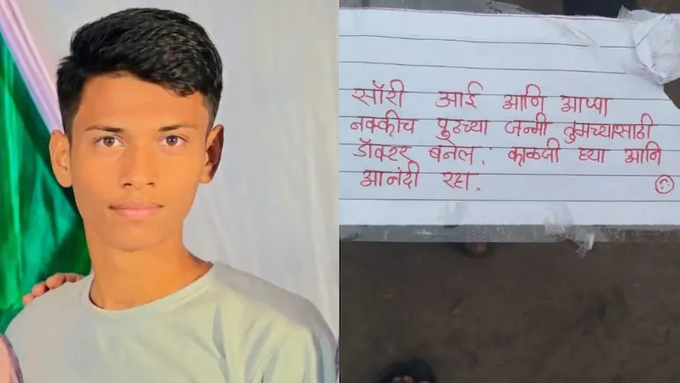
Suraj Subhash Shinde, who was preparing for NEET in Khandala village, reportedly left an emotional message for his parents. Police are investigating the circumstances surrounding his death.
BY PC Bureua
August 20, 2026: A 19-year-old medical aspirant was found dead at his home in Maharashtra’s Chhatrapati Sambhajinagar district, with a note reportedly left behind for his parents expressing regret over failing to fulfil his dream of becoming a doctor.
The student, identified as Suraj Subhash Shinde, was found at his home in Khandala village of Vaijapur taluka, where he had been preparing for the National Eligibility cum Entrance Test (NEET). Police are investigating the circumstances surrounding his death, while preliminary reports have pointed to academic and career-related stress as a possible factor.
According to reports, Suraj had been preparing for NEET in an upstairs room of his house. He reportedly left behind a brief handwritten message addressed to his parents.
Sorry, Mom and Dad… I will definitely become a doctor for you in the next life. Please take care of yourselves and stay happy
—19yo NEET aspirant dies by suicide in Khandala💔 pic.twitter.com/IJKOUbvRRX
— The Indian Idiot (@theindianidiot) August 20, 2026
“Sorry, Mom and Dad… I will definitely become a doctor for you in the next life. Please take care of yourselves and stay happy.”
The note has intensified concerns over the pressure faced by students preparing for highly competitive entrance examinations, particularly those who see admission to a medical college as the defining goal of their academic careers.
A dream tied to one examination
For thousands of students across India, NEET represents the principal route to an undergraduate medical seat. The examination attracts a vast pool of candidates competing for a comparatively limited number of seats, making the preparation process intensely competitive.
Students often spend years preparing through schools, coaching centres and self-study. Those who do not secure a seat may attempt the examination again, extending the period of academic uncertainty and increasing the financial and emotional burden on their families.
Suraj’s death has once again highlighted the human cost of an environment in which academic performance can become closely linked to a young person’s sense of identity and future.
Police have not yet established conclusively why the teenager took the extreme step. Any link between his death and examination pressure will have to be established through the investigation.
NEET controversy and examination stress
The tragedy comes at a time when NEET remains at the centre of a wider debate over the country’s competitive-examination system.
The examination has faced allegations of question-paper leaks and other irregularities, prompting protests by students and demands for greater transparency and accountability. The controversy has also raised questions about the security and technological infrastructure used to conduct examinations involving millions of candidates.
READ: Ethanol Diversion, Falling Output Send Sugar Prices Soaring
The Central Bureau of Investigation is probing allegations connected with the NEET paper leak. The Supreme Court has also stressed that the National Testing Agency, which conducts NEET-UG, must have adequate infrastructure, manpower and technological capabilities.
The Centre has announced several initiatives aimed at reforming the examination system. A committee headed by former ISRO chairman K. Radhakrishnan was tasked with recommending measures relating to examination reforms, data security and the functioning of the NTA. The government has also announced a high-powered task force headed by Infosys co-founder Nandan Nilekani to examine structural reforms in competitive examinations.
Beyond examination reforms
While questions over examination integrity remain important, incidents involving distressed students also point to a broader issue: the enormous psychological burden associated with competitive education.
For many young aspirants, failure to clear an examination is experienced not merely as an academic setback but as a threat to years of preparation, family expectations and personal ambitions. Repeated attempts can further prolong that pressure.
Suraj’s reported final message, particularly his reference to becoming a doctor “in the next life”, has resonated because it captures the extent to which the medical profession can become intertwined with a student’s hopes and a family’s expectations.
His death is now under investigation. For his family, however, the examination and the debate surrounding it have been overshadowed by the loss of a 19-year-old who had been preparing for a future he never got the chance to see.