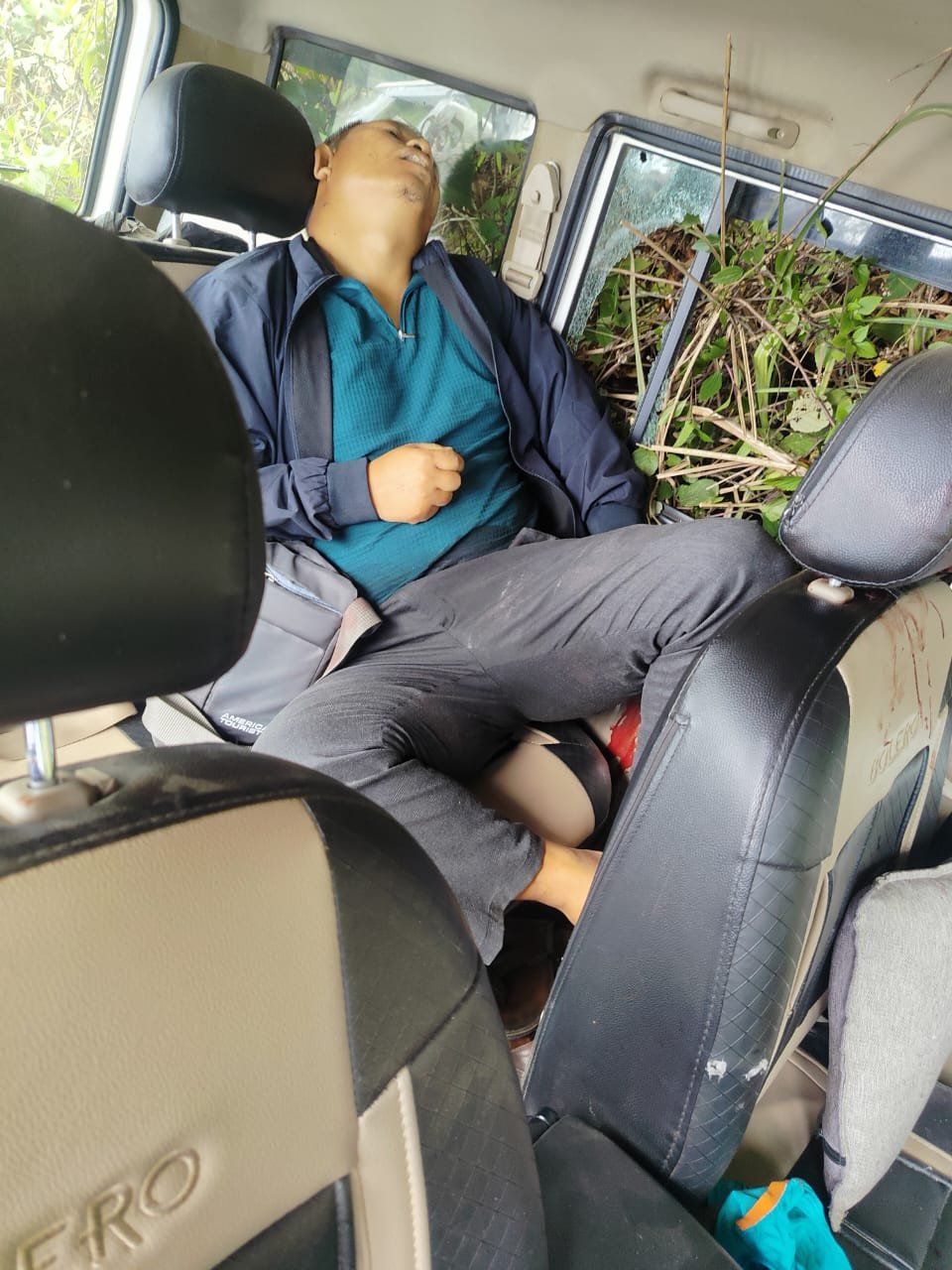
The killing of three Kuki-Zo church leaders in Kangpokpi has exposed a growing disconnect between Kuki-Zo civil society groups and elected MLAs over who was responsible for the ambush.
BY PC Bureau
May 14, 2026: The killing of three Kuki-Zo church leaders in Kangpokpi district has exposed a growing disconnect between elected Kuki-Zo legislators and the powerful civil society organisations that increasingly shape political sentiment in Manipur’s conflict-hit hills.
While major Kuki-Zo organisations such as the Kuki-Zo Council, Indigenous Tribal Leaders’ Forum (ITLF), and Kuki Inpi Manipur directly accused the ZUF-Kamson group of carrying out the ambush, a joint statement issued by Kuki-Zo MLAs avoided naming any organisation and instead referred only to “unidentified assailants.”
The contrast has become one of the most discussed political subtexts following the May 13 ambush near Kotzim and Kotlen that killed Rev. V. Sitlhou, Rev. Kaigoulen and Pastor Paogoulen, while critically injuring five others.
In statements issued within hours of the attack, Kuki-Zo CSOs alleged that the killings were carried out by the ZUF-Kamson faction, which they described as a proxy outfit linked to the Tangkhul-led National Socialist Council of Nagalim (NSCN-IM). Some statements also accused Meitei radical groups of indirect involvement.
READ: From Delhi To Manipur Hills, Kuki-Zo Community Holds Vigils For Slain Pastors
The ITLF described the ambush as a “barbaric” attack on peace and reconciliation efforts, while the Kuki-Zo Council said the pastors were travelling in vehicles clearly marked “Mission & Evangelist” when they were attacked. Kuki Inpi Manipur called the killings a “merciless and calculated act of violence” targeting leaders committed to peace-building.
By contrast, the statement signed by nine Kuki-Zo MLAs, including Deputy Chief Minister Nemcha Kipgens adopted markedly restrained language.
The MLAs condemned the “heinous incident” and expressed grief over the deaths of the church leaders and civilians, but refrained from naming the alleged perpetrators or linking the killings to any militant faction. Instead, the legislators urged the government and security agencies to conduct an impartial investigation and bring those responsible to justice.
The divergence in tone reflects the delicate and increasingly complicated political landscape emerging within the Kuki-Zo movement itself.
Since ethnic violence erupted in Manipur in May 2023, Kuki-Zo civil society organisations have taken an increasingly assertive role, often functioning as the primary political voice of the community. Groups such as KZC, ITLF, Kuki Inpi Manipur and the Committee on Tribal Unity have spearheaded shutdowns, public mobilisation, diplomatic outreach and negotiations over demands for a separate administration.
The elected MLAs, despite publicly supporting separate administration demands, have often appeared more cautious — constrained by constitutional office, and dictated allegedly by “unseen hands.’
The difference became particularly visible in the aftermath of the church leaders’ killings because the victims themselves were widely regarded as bridge-builders rather than political actors.
Rev. V. Sitlhou, in particular, had recently participated in peace and reconciliation efforts alongside the Nagaland Joint Christian Forum in Kohima, where Kuki-Zo and Tangkhul Christian leaders discussed ways to reduce tensions between their communities.
That context has made the killings especially sensitive.
Unlike the broader Meitei-Kuki conflict that has dominated Manipur since 2023, tensions between Kuki-Zo and Tangkhul Naga groups have remained comparatively localised and politically delicate. Many Kuki-Zo political leaders have therefore avoided publicly escalating the dispute, wary of opening another ethnic front in an already fragmented conflict landscape.
This helps explain why the MLAs’ statement leaned toward institutional language — “unidentified assailants,” “restraint,” and “peace” — while civil society groups directly named ZUF-Kamson and framed the killings as part of a larger proxy conflict.
Yet the very fact that the Kuki-Zo MLAs issued a rare joint condemnation at all is politically significant.
Since the outbreak of violence in 2023, Kuki-Zo legislators have often struggled to maintain a united public posture, divided by party affiliations, administrative responsibilities and relations with the state government. Joint statements from all Kuki-Zo legislators have remained relatively uncommon and usually reserved for moments perceived as existential for the community.
For many observers in the hills, the killing of church leaders crossed precisely that threshold.
Religious leaders occupy a uniquely influential position within Kuki-Zo society, where churches often function not only as spiritual centres but also as pillars of social authority, humanitarian coordination and conflict mediation.
The killing of Baptist pastors returning from a peace meeting was therefore seen not merely as another episode of ethnic violence, but as a symbolic attack on the community’s moral and spiritual leadership.
That symbolism may also explain why the reactions from churches, pastors’ fellowships and Christian organisations across India and abroad were unusually swift and unified.
Whether the differing narratives between the MLAs and civil society organisations remain tactical or evolve into deeper political fault lines could shape how the Kuki-Zo movement navigates the next phase of Manipur’s conflict — especially as questions of negotiations, armed actors and inter-ethnic reconciliation become increasingly unavoidable.