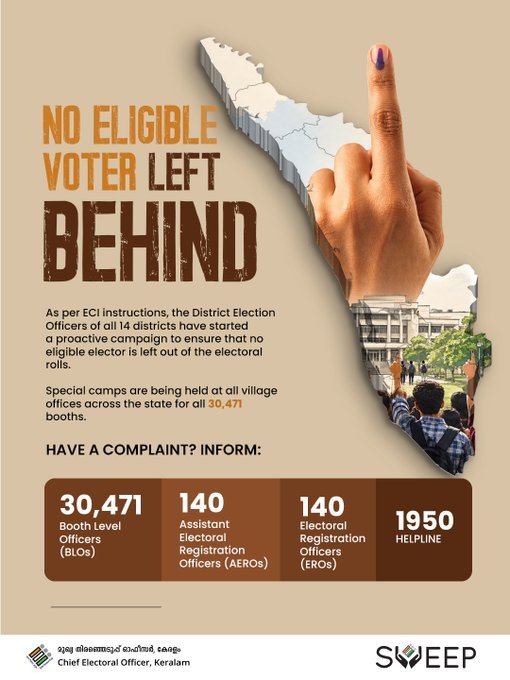
The month-long exercise will cover 20 states and Union Territories where SIR is complete, with Booth Level Officers tasked with identifying missing electors and facilitating fresh enrolment through Form 6.
BY PC Bureau
The Election Commission of India (ECI) has directed around 20 states and Union Territories where the Special Intensive Revision (SIR) of electoral rolls has been completed to launch a special drive to identify and enrol eligible voters who may have been left out of the revised lists.
The initiative comes amid growing scrutiny of the scale of deletions during SIR, which has removed millions of names from electoral rolls across the country. The Commission’s instructions, issued on September 29 and reiterated at a meeting with state Chief Electoral Officers on October 1, call for a month-long exercise involving door-to-door verification and assistance with fresh voter registration.
Booth Level Officers (BLOs) have been instructed to compare the old and revised rolls, identify missing names, verify the status of the affected electors and facilitate applications for enrolment through Form 6 wherever they are eligible. Each BLO is expected to cover around 20–25 such electors a week, with the exercise scheduled for completion in approximately one month.
West Bengal emerges as a major flashpoint
#SpecialCamps ✨
West Bengal📍
#ECI
— Election Commission of India (@ECISVEEP) October 12, 2026
West Bengal has drawn particular attention because of the scale of deletions during its SIR exercise.
The figures cited in reports on the revision indicate that approximately 90.8–91 lakh names were removed from a pre-SIR electorate of around 7.66 crore, although the precise total depends on the categories and stages of deletion included.
The removals comprised an initial round involving electors classified as absent, shifted, deceased or duplicated, followed by the exclusion of approximately 27 lakh voters during adjudication of cases involving alleged “logical discrepancies”.
READ: SC Rebuts ECI Claim on Revised Form 6, Says Its Validity Remains Open
The Election Commission has defended the revision, arguing that electoral rolls must be updated to remove ineligible and duplicate entries. The central issue, however, is whether the verification process reliably distinguished ineligible electors from legitimate voters whose names should have remained on the rolls.
Districts including Murshidabad, North 24 Parganas, Malda and South 24 Parganas have featured prominently in reporting on the Bengal exercise.
Appeals process faces questions
The special enrolment drive is unfolding alongside a separate appellate process for people whose names were deleted during the SIR.
The process in West Bengal has faced criticism over delays and technical problems. A report by The Indian Express published on October 6 said judges serving on special tribunals had raised concerns about the Election Commission’s digital portal, including difficulties with serving notices, uploading documents, conducting hearings and restoring deleted voters to the rolls.
The figures relating to appeals also require careful interpretation. The number of applications filed, the number disposed of and the number of voters actually restored are different measures. A high restoration rate among a limited number of decided cases cannot, by itself, establish how many of all deleted electors were eligible or how many will ultimately be reinstated.
Form 6 to provide the route back
Under the new special drive, eligible electors whose names are missing from the revised rolls can apply for fresh enrolment through Form 6 under the continuous-updating process.
The ECI has instructed election officials to compare pre-SIR and post-SIR rolls and conduct house-to-house visits to identify people whose names have disappeared. BLOs are expected to facilitate applications and record the status of the electors identified during the exercise. Lists of missing electors are also to be shared with Booth Level Agents of recognised political parties.
The use of Form 6 is significant because it provides a route for people to seek inclusion even after the intensive revision has concluded. However, the process requires eligible applicants to complete the prescribed formalities, and the success of the drive will depend on how effectively election officials identify missing electors and assist them with registration.
Wider implications for electoral-roll integrity
The special drive covers the 20 states and Union Territories where SIR has been completed, including Bihar and West Bengal, as well as other jurisdictions in which the revision has concluded. The remaining states and Union Territories are on separate SIR schedules.
The scale of deletions elsewhere has also fuelled concerns. Uttar Pradesh and Gujarat have reported substantial reductions in their electoral rolls, although figures from different states are not directly comparable without accounting for the stages of revision, the size of the electorate and the reasons recorded for deletion.
The ECI maintains that SIR is intended to improve the accuracy of electoral rolls and that the continuous-updating process allows eligible people to apply for inclusion. Opposition parties and civil society groups have called for stronger safeguards, greater transparency and closer scrutiny of deletions to ensure that genuine voters are not disenfranchised.
The special drive will provide an opportunity to identify and enrol eligible electors who were omitted from the revised lists. But its effectiveness will ultimately be judged by how many missing voters are contacted, how many eligible applicants complete registration and how promptly their names are included.
The central test is whether the exercise restores access to the electoral rolls for every eligible voter who was wrongly left out, while maintaining accurate and verifiable voter lists.