

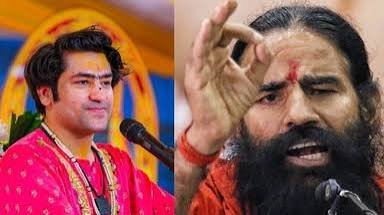
Objecting to comparisons between Lord Ram and Lord Krishna, Ramdev said religious figures must observe limits and decorum while speaking about revered deities. He also questioned the practice of making controversial remarks and subsequently apologising.
BY PC Bureau
November 23: Yoga guru Baba Ramdev has launched a sharp attack on religious storytellers and preachers whom he accused of exploiting devotees, spreading superstition and creating religious frenzy, using unusually harsh language to describe those who claim to be protectors of Sanatan Dharma.
Speaking at a provincial women’s conference organised by the Mahila Patanjali Yoga Samiti in Jamshedpur on Sunday, Ramdev called such preachers “bawle”, “dhongi”, “pakhandi” and “dhurta” (deranged, fraudulent, hypocritical and cunning). Although he did not name anyone, his remarks were widely interpreted as targeting Bageshwar Dham head priest Dhirendra Krishna Shastri, whose recent comments comparing Lord Ram and Lord Krishna had triggered a controversy.
Ramdev questioned the religious and constitutional knowledge of those who publicly claim to represent and defend Hinduism without having studied its scriptures or understanding the country’s democratic and constitutional framework.
“Some people have neither read the Vedas, philosophy, Upanishads, Quran, Ramayana or Mahabharata, nor do they understand the Constitution and democracy. Yet they stand up and say they are Sanatanis and will save Hinduism. First save yourself,” he said, using the words “bawle, pakhandi and dhurta” to describe such individuals.
He accused certain religious speakers of exploiting people’s faith by invoking gods, goddesses, ghosts and supernatural forces. He said they used dramatic performances to convince devotees that they were possessed by spirits and then claimed to have removed those spirits through ritual gestures.
Describing what he called the mechanics of such performances, Ramdev said some preachers claimed they could summon spirits inside people, shake them repeatedly, scatter their hair and sprinkle water before declaring that the supposed supernatural influence had been removed.
He accused them of using such practices to mislead devotees, generate religious excitement and exploit vulnerable people in the name of faith.
“Such hypocritical and fraudulent storytellers create religious frenzy and exploit people,” he said.
बाबा रामदेव भी कई बार तारीफ़ के लायक़ काम कर देते हैं। बाबा ने बागेश्वर धाम के धीरेन्द्र कृष्ण शास्त्री की जोरदार धुलाई की।
बोले – पाखंडी कहीं का, कहता है श्रीकृष्ण तो टेढ़े मेढ़े है, महिलाएं ढोंग करने वालों से बचकर रहें।
@yogrishiramdev @bageshwardham https://t.co/FU4IgZD3Zy— Ajit Singh Rathi (@AjitSinghRathi) November 23, 2026
Women Most Vulnerable to Exploitation
Ramdev singled out women as particularly vulnerable to what he described as religious fraud and superstition. He said mothers, sisters and daughters were often the worst affected by such practices and urged women not to fall for claims made by self-proclaimed spiritual figures.
He asked the audience to distinguish between genuine religious knowledge and theatrical displays presented in the name of Sanatan Dharma.
The yoga guru also argued that no individual or organisation could claim exclusive authority to protect Sanatan traditions. He warned against those who allegedly create an atmosphere of fear and division before presenting themselves as defenders of Hinduism.
In a broader criticism of religious mobilisation, he said some people were promoting confrontation in the name of a more assertive Hindu identity. Referring to slogans about carrying a rosary in one hand and a spear in the other, he questioned whether weapons could protect society when the Constitution, democratic institutions and the law were meant to govern the country.
He maintained that India should be guided by constitutional principles and legal order rather than calls for violence or religious confrontation.
Objection to Ram-Krishna Comparison
A significant part of Ramdev’s remarks concerned the controversy triggered by Dhirendra Krishna Shastri’s comments about Lord Ram and Lord Krishna.
During a Ram Katha in Karera, in Madhya Pradesh’s Shivpuri district, on October 29, Shastri compared the physical postures and attributes of the two deities. He described Lord Ram as standing straight while referring to Lord Krishna’s traditional three-bend posture, known as tribhanga, as crooked.
Shastri also made comparisons involving Krishna’s flute-playing and Ram’s use of the bow. A video of the remarks circulated widely, prompting criticism from religious figures and devotees, particularly in the Mathura-Vrindavan region.
Ramdev objected to the comparison, saying that religious figures should not make disparaging remarks about revered deities and then seek to settle the controversy through an apology.
He referred to Shastri’s reported remarks that Lord Ram was great while Lord Krishna was “crooked”, and questioned the subsequent apology and visit to the Banke Bihari temple.
Ramdev said there were limits to humour and public commentary, particularly when discussing religious traditions and revered figures. No one, he argued, had the right to demean one deity while elevating another through comparisons.
“We have no standing to compare or insult gods and goddesses,” he said, adding that even jokes and light-hearted remarks must observe certain limits and decorum.
Ramdev said he normally tried to explain such matters privately but had decided to speak publicly because silence could be interpreted as acceptance of what he considered religious hypocrisy.
He said he wanted people to understand that the name of Sanatan Dharma could not be used to justify pretence, ostentation or misleading religious practices.
Shastri Had Apologised After Backlash
The controversy surrounding Shastri’s remarks had erupted earlier this month after a video of his discourse in Madhya Pradesh went viral.
Religious figures from Mathura and Vrindavan objected to what they considered an inappropriate comparison between Lord Ram and Lord Krishna, arguing that both were manifestations of the same divine being and were equally revered.
Shastri subsequently issued a clarification and apologised if his words had hurt anyone’s religious sentiments. He said his remarks had been misunderstood and were made while explaining a devotional verse. He also described himself as a devotee of Lord Krishna and said he had no intention of creating divisions between followers of the two deities.
The controversy also drew a political response. Samajwadi Party president Akhilesh Yadav condemned the remarks and called for action against the preacher. A criminal defamation complaint was later filed against Shastri in an Agra court by advocate Ajay Pratap Singh. The court registered the complaint and fixed December 14 for the next hearing.
Ramdev did not explicitly identify Shastri by name in his Jamshedpur speech. However, his direct references to the Ram-Krishna controversy, the apology and the visit to the Banke Bihari temple left little doubt about the episode he was addressing.
His intervention has also brought into focus a wider debate over the conduct of religious preachers, the use of supernatural claims to attract devotees and the responsibility of influential spiritual figures when speaking about India’s religious traditions.