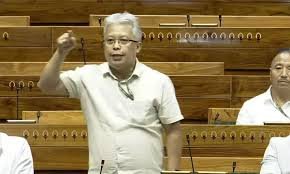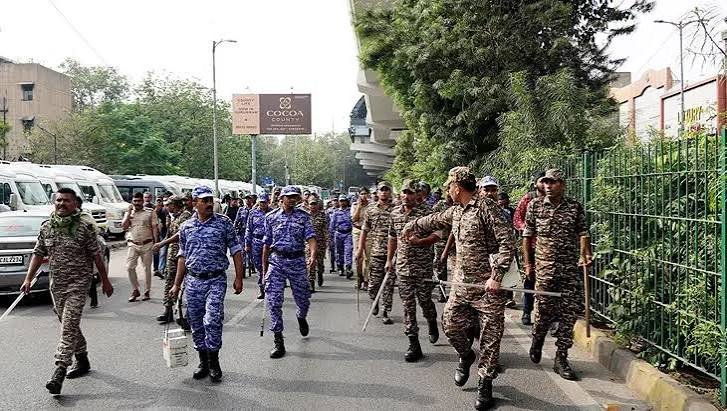
Rahul Gandhi escalated his attack on the Modi government, alleging that the police were being directed to act against young protesters while allowing RSS supporters a free hand. He also said the opposition was taking its allegations of electoral irregularities and concerns over the SIR to the Supreme Court.
BY PC Bureau
New Delhi: It took a massive crowd to bring a measure of restraint to the streets of Delhi after two days of police action against protesters demanding the resignation of Chief Election Commissioner Gyanesh Kumar over alleged irregularities in the Special Intensive Revision (SIR) of electoral rolls.
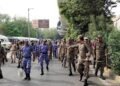
After two days of barricades, detentions, physical pushbacks and confrontations, the scale of the latest gathering appeared to alter the dynamics of the police response. Unlike the smaller groups that had been intercepted or dispersed in the preceding days, the large assembly posed a greater challenge to any attempt at forcible clearance, raising the political and public-relations costs of an aggressive crackdown.
With the police on the defensive, the alleged right-wing goons accused of attacking protesters over the past two days went into hiding. Those who still dared to show up were nearly beaten up by protesters.
दिल्ली 📍
BJP RSS के गुंडों की हेकड़ी निकल जाती है जब सामने वाला कोई टक्कर का हो।
कल तक जिन छात्रों को अकेला पाकर पीटते थे आज वही गुंडे भीम आर्मी वालों को देखकर भाग रहे हैं।
BJP RSS के गुंडों की सारी मर्दानगी बस कमजोरों के लिए है। https://t.co/EreXc3bEoR
— रितेश देशमुख ( 𝙿𝚊𝚛𝚘𝚍𝚢 ) (@Deshmukh_0) October 12, 2026
Senior journalist Seema Chishti captured the contrast in a post on X, “It took a crowd this size for some sense to prevail and for the thousands of security forces to not attack, thwart and push protestors as they had done for 2 days. Why were protesters attacked over the weekend???”
Rahul Gandhi Accuses BJP-RSS of Targeting Students
Addressing a press conference, Leader of Opposition Rahul Gandhi launched a sharp attack on the BJP and the RSS, accusing their supporters of attacking students, particularly women, to intimidate them and discourage them from joining the protests against Gyanesh Kumar.
Gandhi alleged that the police had been instructed to turn a blind eye to such attacks. He played footage on a display screen that he said showed several instances of saffron-clad men assaulting students.
He claimed the alleged attacks were intended to send a message to parents that their sons and daughters would not be safe if they joined the demonstrations.
“They are doing it to send a message to the parents of these children that their sons and daughters are not safe in these protests and so they should not allow them to join,” Gandhi said.
Urging protesters not to be intimidated, he described the alleged attackers as cowards who were afraid of the growing movement. “They know their days are numbered, so they are taking help of goons,” he said, adding that those responsible would not escape accountability.
The allegations against the BJP-RSS supporters and the police require independent verification. Gandhi’s presentation of video footage, however, brought the question of alleged assaults on student protesters to the centre of the political confrontation.
‘We Want 20,000 to 30,000 Police Personnel on the Streets’
Gandhi also challenged Prime Minister Narendra Modi over the deployment and conduct of security personnel, arguing that the government was making a grave political mistake by protecting the CEC while attempting to contain the protests.
“We want 20,000 to 30,000 police personnel deployed on the streets,” Gandhi said, arguing that the government’s response would only intensify scrutiny of Gyanesh Kumar and those he accused of shielding him.
He claimed that police personnel were distressed by orders to use force against young protesters while, according to him, members of the RSS were being allowed to act with impunity.
Gandhi further asserted that a section of police personnel, as well as members of the ITBP and CRPF, sympathised with the protesters’ demands. He sought to frame the confrontation as one between ordinary citizens and officials whom he accused of facilitating electoral manipulation.
In another pointed remark, Gandhi said that around 200 government officials were in contact with the opposition and passing on information, including officials associated with the Enforcement Directorate, the CBI and the Ministry of External Affairs. The claim could not be independently verified.
Gandhi named Modi, Home Minister Amit Shah, National Security Adviser Ajit Doval and Gyanesh Kumar among those he accused of being responsible for the situation. These were political allegations, not judicial findings.
Did the Crowd Force a Change in Police Tactics?
The contrast between the earlier confrontations and the latest gathering has raised questions about the way Delhi Police handled the protests. In the preceding days, demonstrators reported being stopped en route, detained or prevented from reaching their intended destinations. Accounts and footage from earlier confrontations also showed physical clashes and the use of force.
READ: Will Gyanesh Kumar Apologise to Rahul Gandhi After SC’s Fresh Take on Form 6?
Police authorities have generally defended restrictions and deployments as necessary to enforce prohibitory orders, maintain public order and protect infrastructure. Critics argue that pre-emptive detentions and forceful dispersals have restricted peaceful assembly and prevented protesters from making their voices heard.
The large turnout appeared to coincide with a more restrained police response. It is not possible, on the available evidence, to establish whether this resulted from specific instructions, operational constraints, concern about public perception or a combination of factors. Nor does the correlation alone prove that crowd size was the decisive factor.
Yet the episode illustrates a recurring dilemma in protest policing. Smaller gatherings can be easier to contain through targeted interventions. A much larger crowd, particularly one that remains largely peaceful, raises the risks of injuries, wider confrontation and intensified public scrutiny if authorities attempt to clear it by force.
For protesters who had experienced the preceding days, the apparent difference in police tactics was significant. The question now is whether the authorities will ensure that peaceful demonstrators, including students and journalists, can exercise their rights without intimidation or arbitrary detention.
Beyond the immediate confrontation, the central dispute over the SIR and the integrity of electoral rolls remains unresolved. The opposition is taking its allegations to the Supreme Court, while the Election Commission’s decisions and the legality of the disputed procedures remain matters for judicial scrutiny.
The events in Delhi have therefore brought two questions into sharper focus: whether the alleged attacks on protesters will be independently investigated, and whether the institutions responsible for conducting elections can address the opposition’s concerns through transparent, legally defensible procedures.