



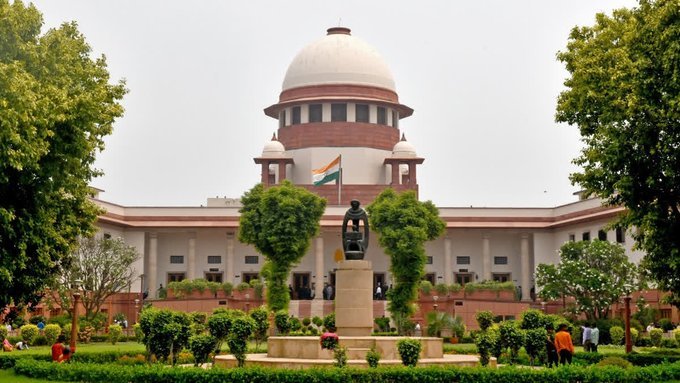
The clarification came after the ECI appeared to cite the Supreme Court’s May 2026 Bihar SIR judgment to suggest that the revised Form 6 had been upheld. The Bench said the form did not exist when that judgment was delivered.
BY PC Bureau
New Delhi: October 12: The Supreme Court on Monday clarified that it has neither approved nor disapproved the revised Form 6 introduced by the Election Commission of India (ECI) for new voter registration, stressing that the validity of the amended declaration has not yet been adjudicated.
A Bench comprising Chief Justice of India Surya Kant and Justices Joymalya Bagchi and V. Mohana made the clarification while hearing a writ petition filed by Priya Mishra challenging aspects of the functioning of the ECI.
The clarification came after advocate Narendra Mishra, appearing for the petitioner, pointed out that the ECI had claimed that the Supreme Court had upheld the revised Form 6. The submission referred to an ECI press release issued on September 26, which appeared to rely on the Court’s May 2026 judgment on the Bihar Special Intensive Revision (SIR) of electoral rolls.
Justice Bagchi made it clear that there had been “no adjudication on the new Form 6.” He explained that the revised form was not before the Court when it delivered its Bihar SIR judgment.
“What the Hon’ble Chief Justice said was that when the Bihar SIR judgment was delivered, new Form 6 was not there. That does not either say it is approved or disapproved by the Supreme Court. We will examine it,” Justice Bagchi said.
Chief Justice Surya Kant also cautioned lawyers against selectively interpreting observations made by the Court.
The Bench issued notice on the petition and listed the matter for October 27, along with connected petitions challenging the functioning of Chief Election Commissioner Gyanesh Kumar.
Dispute over revised Form 6
The revised Form 6 has become a fresh point of contention in the ongoing dispute over the ECI’s SIR exercise. Applicants seeking registration as new voters are now required to declare whether they or their parents were included in the previous SIR.
That declaration was not part of the earlier Form 6 used during previous electoral-roll revision exercises.
The controversy intensified after reports that Election Commissioners Sukhbir Singh Sandhu and Vivek Joshi had raised objections to the modification, arguing that such a statutory change could not be introduced without an amendment to the Registration of Electors Rules, 1960 by the Central Government.
Following reports highlighting the objections, the ECI issued its September 26 press release, stating that the Supreme Court had upheld the declaration in its Bihar SIR judgment.
Monday’s clarification makes clear that the Court had not examined the revised Form 6 in that judgment, because the new form was introduced subsequently.
Petition challenges ECI decision-making
The petition, filed by Priya Mishra and former Madhya Pradesh Law Minister P.C. Sharma under Article 32 of the Constitution, also challenges what the petitioners allege was a failure by CEC Gyanesh Kumar to follow collective decision-making within the three-member Election Commission.
According to the petition, around 14 decisions were taken over nearly 10 months without the concurrence of the other two Election Commissioners.
The petition seeks quashing of decisions, orders, notifications and executive instructions allegedly issued without following the mandatory procedure for collective decision-making. It also asks the Court to direct the ECI to reconsider such decisions in accordance with Article 324 of the Constitution and the applicable statutory framework.
The petitioners have referred to alleged objections raised by Sandhu and Joshi and sought production of original ECI records, including minutes of meetings, agendas, voting records and dissenting notes.
The challenge specifically questions the addition of the previous-SIR declaration to the online Form 6 process, arguing that the change was made without following the procedure prescribed under the Registration of Electors Rules, 1960.
The Supreme Court’s clarification on Monday therefore leaves the legality of the revised Form 6 open for judicial examination.






Comments 1