

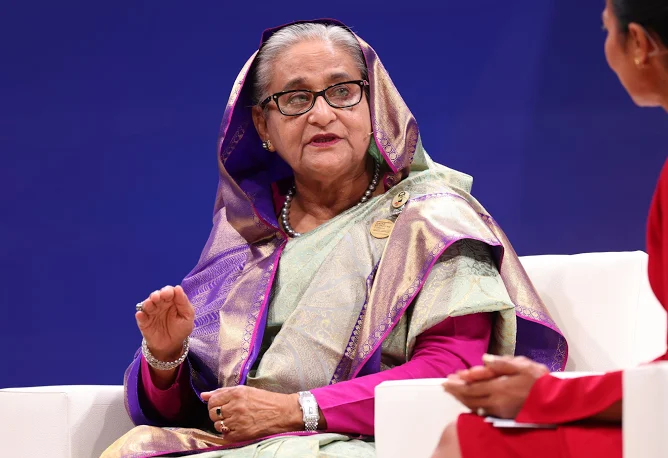
In a first specific date announcement, Sheikh Hasina aims to land in Dhaka on December 16, 2026, calling it the government’s constitutional duty to facilitate her return. Bangladesh authorities say she will be arrested immediately as a convicted fugitive, while her party remains banned and tensions rise.
BY PC Bureau
NEW DELHI / November 24: Ousted Bangladesh prime minister Sheikh Hasina plans to return home on December 16, 2026, marking Victory Day, after more than two years in exile in India. Her spokesperson, Syed Mozammel Ali, said she had asked the Bangladeshi government to arrange her return from Delhi aboard the national carrier, Biman Bangladesh Airlines.
The announcement marks the first time Hasina has specified a date for her return. She fled Bangladesh on August 5, 2024, amid a mass uprising against her government and has remained in India since then.
“Since Sheikh Hasina was flown to India on a Bangladesh aircraft on August 5th, 2024, she now calls upon the government to arrange for her air transport from Delhi back to Dhaka,” Ali said.
He argued that the Bangladeshi government had a responsibility to facilitate her return on Victory Day, maintaining that her departure from the country had taken place under circumstances that violated the Constitution.
Hasina’s proposed return, however, faces formidable legal and political obstacles. She has been sentenced to death in absentia by Bangladesh’s International Crimes Tribunal over the violent crackdown on protests in 2024. She has rejected the verdict and questioned the legitimacy of the proceedings.
Bangladesh’s State Minister for Foreign Affairs warned that ousted PM Sheikh Hasina will be immediately arrested if she returns from India next month. Her December homecoming plans have sparked renewed street protests and violence across the country. https://t.co/uWE2ZBhZ0H
— IndiaZap (@TheIndiaZap) November 23, 2026
Hasina has also sought a new Bangladeshi passport and national identity card after her previous documents were cancelled. Her applications were rejected by the authorities, who described her as a convicted fugitive.
A senior Bangladeshi minister has said she would be arrested and imprisoned if she returned. Dhaka has maintained that her extradition from India, under the existing bilateral treaty, is the appropriate course rather than arranging a voluntary return.
The Bangladeshi government had not publicly responded to her spokesperson’s latest demand by November 24.
The 2024 uprising and Hasina’s exile
Hasina, daughter of Bangladesh’s founding leader Sheikh Mujibur Rahman, was the country’s longest-serving prime minister. She held power almost continuously from 2009 until August 2024, having also served an earlier term from 1996 to 2001.
She fled Dhaka on August 5, 2024, as a student-led uprising against her government escalated into a nationwide movement. The protests initially centred on a controversial public-sector job quota system but widened into a broader revolt against her administration.
Demonstrators accused the government of authoritarianism, corruption and suppressing political dissent. The security crackdown that followed resulted in widespread casualties.
The United Nations estimated that as many as 1,400 people were killed during the unrest and the subsequent crackdown. Hasina has denied responsibility for the violence and maintains that the legal cases against her are politically motivated.
After leaving Bangladesh, she took refuge in India. Dhaka has repeatedly sought her extradition, but New Delhi has not handed her over.
In November 2025, Bangladesh’s International Crimes Tribunal convicted Hasina in absentia of crimes against humanity linked to the crackdown and sentenced her to death. She did not appeal within the prescribed period. Bangladeshi authorities have maintained that the verdict leaves her with no further avenue of appeal.
Her Awami League party has also been banned, while several of its leaders and supporters face criminal cases and arrests. Hasina and her allies have described the actions against the party as politically motivated.
From an intention to a specific date
Hasina had indicated earlier that she wanted to return to Bangladesh in December 2026. In July, she said she and senior Awami League colleagues were considering returning and facing the courts, despite the possibility of arrest or harsher consequences.
She has since repeated that intention, presenting her return as a responsibility towards her country and party supporters.
In one public statement, she said she was not afraid of being arrested, tortured or even killed, and described returning to Bangladesh as her duty. She has also said she would prefer to die on Bangladeshi soil rather than remain in exile.
Earlier this month, she formally sought fresh travel and identity documents through legal representatives at Bangladesh’s high commission in Delhi. The request was rejected. The tribunal’s chief prosecutor said there was no legal basis for issuing documents to a person convicted in absentia.
The choice of December 16 is politically significant. Bangladesh celebrates Victory Day on that date to commemorate the country’s liberation from Pakistan in 1971. The Awami League draws much of its political identity from the independence movement led by Hasina’s father.
By choosing the anniversary, Hasina has attached a powerful national symbolism to her proposed return.
Political and diplomatic complications
A return facilitated by Bangladesh’s national carrier would present an immediate challenge for the government in Dhaka. Officials have made clear that Hasina would face arrest if she entered the country, given the death sentence against her.
Her supporters, meanwhile, portray the proposed return as an attempt to challenge what they regard as an illegitimate judicial process and to reassert the Awami League’s political presence.
Her opponents see her possible return as a threat to the political changes brought about by the 2024 uprising. They fear that her reappearance could deepen divisions and trigger fresh unrest.
The situation also places India in a delicate position. New Delhi has hosted Hasina since her departure while seeking to maintain workable relations with Bangladesh’s post-uprising authorities. Dhaka’s extradition request remains a sensitive issue, with no clear indication of when or how India might act.
Political tensions have also intensified following the disclosure of Hasina’s passport application and her renewed statements about returning. The possibility of her re-entry has become a flashpoint in an already polarised political environment.
Whether Bangladesh will agree to arrange a flight, whether India will facilitate her departure and whether Hasina will ultimately attempt to return on December 16 remain uncertain.
A high-stakes deadline
With less than a month remaining before Victory Day, Hasina’s announcement has turned a long-standing declaration of intent into a specific political challenge.
The coming weeks will test the willingness of Bangladesh’s authorities to deal with a proposed voluntary return by a leader convicted in absentia, as well as India’s handling of her continued presence on its territory.
For Hasina, the return is being presented as a matter of political duty and personal resolve. For her opponents, it represents the possible re-entry of a leader whose 15-year rule ended amid a mass uprising and a deadly crackdown.
December 16 could therefore become more than a symbolic date. It may test the political stability of Bangladesh, its legal commitments and the already complicated relationship between Dhaka and New Delhi.