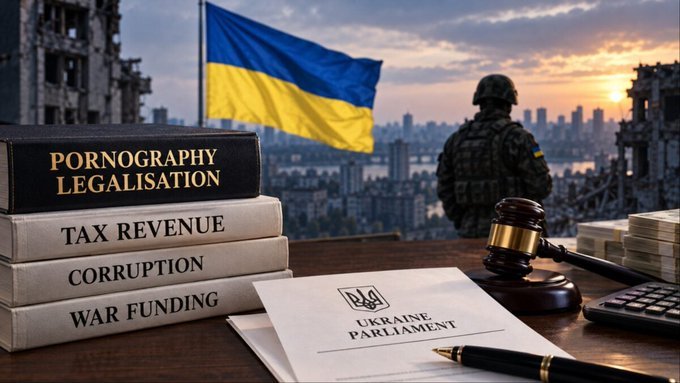
The debate has also highlighted alleged police corruption and the growing scale of Ukraine’s online adult-content industry, with thousands of Ukrainians earning millions through platforms such as OnlyFans.
BY PC Bureau
September 7, 2026: A proposal to legalise pornography in Ukraine is gaining traction in parliament as the government looks to bring a largely underground industry into the tax net and generate additional revenue during the war with Russia.
The legislation, backed by lawmaker Yaroslav Zhelezniak, chairman of parliament’s finance committee, could raise as much as $25 million in taxes, according to an estimate cited by The Wall Street Journal. Zhelezniak said the money could be enough to pay for about 30,000 drones.
Pornography remains illegal in Ukraine. Producing, possessing or distributing it can attract a prison sentence of up to seven years. Yet the industry has continued to operate, with authorities only recently taking a more active interest in taxing adult-content creators.
That has created an unusual legal dilemma. Creators who disclose their earnings to tax authorities can potentially draw the attention of prosecutors because the activity from which they earned the money remains prohibited.
“These women either don’t pay taxes and face criminal charges for that, or they pay taxes and get charged with violating pornography laws,” Zhelezniak told the Journal. He described the situation as “tragicomic.”
Ukraine eyes becoming global porn hub to fund its war chest — WSJ
The government estimates taxing the country’s thousands of OnlyFans models could rake in $25 million a year alone
A porn legalization bill passed its first vote in July and now awaits a second reading pic.twitter.com/u8OxHVuid7
— RT (@RT_com) September 6, 2026
READ: Assam Brings Back 180 ml, 375 ml Liquor Bottles at On-Shop Outlets
The issue has also exposed allegations of corruption within the enforcement system. Before Russia’s full-scale invasion, authorities largely turned a blind eye to the adult-entertainment business. The Journal reported that Ukraine’s General Prosecutor’s Office has recently uncovered cases involving officials in three regions who allegedly took bribes of up to $20,000.
The size of the online adult-content economy is substantial. Data from OnlyFans parent company Fenix International, cited by the Journal, showed that 7,900 Ukrainians earned more than $131 million through the platform in 2023.
Some creators who reported their earnings to the authorities later received notices from Kyiv accusing them of tax evasion and illegally producing adult content.
OnlyFans creator Svitlana Dvornikova told the Journal that police raided her home one morning, taking $20,000 in cash, her laptop and hard drives. She said officers offered to drop the case in exchange for a bribe, which she refused.
Another creator told the Journal that police conducted a similar search of her apartment. She said she subsequently stayed away from court because she feared being pressured into paying a bribe.
The legal uncertainty has prompted some Ukrainian creators to leave the country or temporarily move elsewhere in Europe. Dvornikova is among those who have relocated.
Tax lawyer Lesia Mykhalenko, who has represented more than 100 OnlyFans creators, said pursuing such cases diverted resources from more pressing wartime priorities.
“This is a victimless crime,” she told the Journal, arguing that prosecutions unnecessarily burden the legal system when Ukraine needs to concentrate on defending the country.
Dvornikova has also taken her case to the political arena. After criminal proceedings were initiated against her, she submitted a petition through President Volodymyr Zelensky’s website, arguing that she should not be treated as a criminal after paying nearly $900,000 in taxes. The petition received more than 25,000 signatures within a week, the Journal reported.
Zelensky subsequently indicated that parliament would consider Zhelezniak’s proposal.
The bill cleared its first reading in July and is awaiting a second reading. If approved, the measure would formally recognise an industry that already generates significant income while removing the contradiction between taxing adult-content earnings and criminalising the activity itself.