



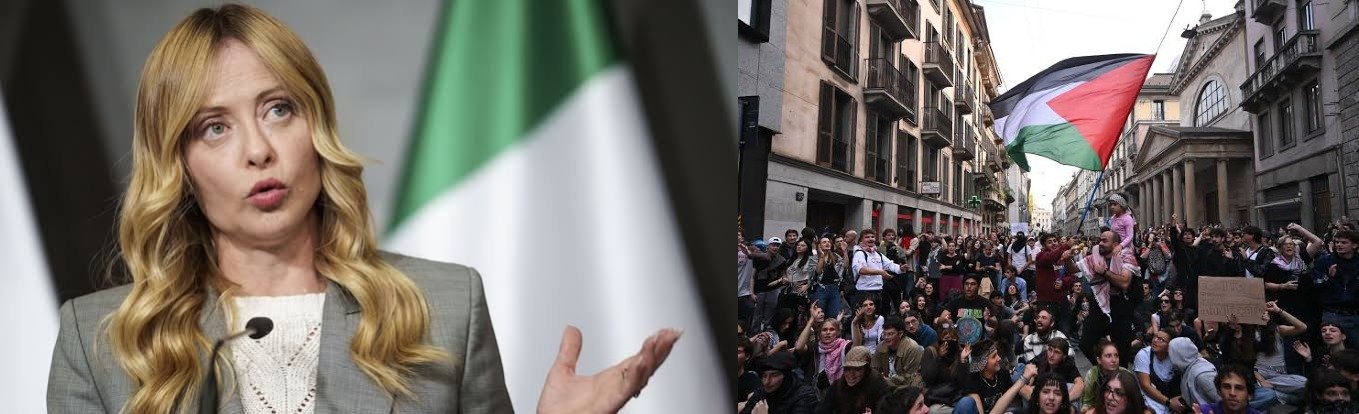
A march against rising living costs turned violent in Milan, with masked demonstrators clashing with riot police, shops damaged and parts of the city centre shut down. Meloni condemned the violence as economic grievances fuelled wider unrest.
BY PC Bureau
October 18 — After France, Italy has become the latest flashpoint in Europe’s growing wave of public discontent, with Prime Minister Giorgia Meloni facing mounting pressure as demonstrations over the cost of living descended into violent clashes in Milan and other cities.
What began as a march against rising prices, expensive fuel, low wages and shortcomings in public services turned into hours of confrontation between masked protesters and riot police in Milan on Saturday. Officers were injured, shops were damaged and looted, and public property was vandalised, forcing authorities to shut down parts of the city centre.
The unrest has put Meloni’s government in the spotlight, raising questions about its response to economic insecurity and the frustration of younger Italians struggling with the cost of everyday life. Her government has condemned the violence, but the demonstrations have also brought wider grievances over wages, education, taxation and public spending back into the political debate.
The protests followed large-scale demonstrations in France on October 17 and coincided with unrest and public mobilisation in other parts of Europe, including Belgium and Albania. Although the countries face different political and economic circumstances, the demonstrations have highlighted a common source of tension: the growing gap between household expenses and people’s expectations of what their governments should deliver.
Meloni’s government faces mounting pressure
Meloni responded forcefully to the violence, drawing a distinction between the right to protest and attacks on police officers, businesses and public infrastructure.
“Demonstrating is a right. Setting our cities ablaze is not,” she said in a social media post, condemning those who exploited demonstrations to cause disorder and disrupt the lives of ordinary citizens.
The Italian prime minister also called on opposition parties to condemn the violence unequivocally, arguing that failing to do so risked appearing to condone attacks on law enforcement and damage to public property.
Her response reflects the immediate challenge facing the government: restoring public order while confronting the economic grievances that have brought demonstrators onto the streets.
The political implications extend beyond the clashes themselves. When protests focus on wages, household costs, education and public services, the debate inevitably turns towards the policies of the government in office and its ability to respond to the concerns of ordinary citizens.
The violence does not, by itself, establish the scale of opposition to Meloni or demonstrate that the protests represent a unified movement against her government. But the prominence of anti-government slogans and the emergence of demonstrations under the banner of No Meloni Day have given the unrest an unmistakable political dimension.
The footage captures the “Italia in Piazza” demonstration on October 17, 2026, against high living costs, public health failures, and poor school conditions, where stones, barriers, and fireworks were thrown leading to police charges and injuries.
Over 5,000 demonstrators gathered in the city center near Piazza del Duomo and Via Broletto
#Italy #Protesthttps://t.co/NunxF3kHGa
— Prakash Raghavadass (@PrakashRaghav) October 17, 2026
Milan descends into chaos
The most serious clashes occurred in Milan, where the Italia in Piazza mobilisation brought together young people and other demonstrators protesting against rising living costs, fuel prices, inadequate wages, taxation, education and public services.
The march began peacefully before groups of masked and hooded protesters broke away and confronted police near the city’s iconic Duomo cathedral.
Demonstrators threw stones, paving blocks, firecrackers and other objects at officers. Barricades were set alight, a Carabinieri vehicle was vandalised, and damage was reported to shopfronts, public transport infrastructure and buildings.
Police responded with tear gas, water cannons and charges to disperse the crowds. The confrontations spread towards Piazza San Babila and surrounding streets, disrupting one of the city’s busiest commercial and tourist districts.
Piazza del Duomo, normally crowded with shoppers and visitors on a Saturday, was emptied as police moved to restore order. Shops pulled down their shutters, tourists fled the area and the nearby Galleria Vittorio Emanuele II shopping arcade was closed. The central Duomo Metro station was also shut during the disturbances.
Reports on detentions varied. The Associated Press, citing Italian media, reported that around 50 demonstrators, including many minors, had been detained, while other Italian reports gave lower provisional figures. At least two police officers were reported injured. The final figures for arrests and injuries remained subject to confirmation.
The violence has overshadowed the march’s economic demands, although the actions of those who attacked police or damaged property remain distinct from the concerns expressed by peaceful demonstrators.
Bologna and Turin add to the unrest
The disturbances were not confined to Milan.
In Bologna, police used water cannons to disperse crowds after a demonstration turned violent. Seven arrests were reported by the ANSA news agency, according to Reuters.
Turin also witnessed confrontations during protests against rising prices, expensive fuel and wages that demonstrators considered insufficient to meet everyday expenses. Reports described stone-throwing, firecrackers and damage to public and commercial property.
The demonstrations followed student-led No Meloni Day protests a day earlier, in which young people raised concerns about school conditions, government education policies and increased military spending.
For Meloni’s government, the student protests and the subsequent street violence present related but distinct challenges. The former raise questions about policy priorities and the prospects facing younger generations; the latter have placed public order and the policing of demonstrations at the centre of the debate.
A general strike was also announced for November 20, according to Spain’s EFE news agency. If the planned action proceeds, it could extend pressure on the government beyond street demonstrations and into workplaces and public services.
READ: When Paris Marches and Delhi Barricades: ‘Democracy’ and a Tale of Two Cities
The economic grievances behind the anger
At the heart of the protests are concerns about the rising cost of living and the difficulty of maintaining a reasonable standard of living on existing wages.
Fuel costs, household bills, education expenses and pressure on public services have featured prominently in demonstrators’ demands. For younger Italians, the concerns extend to secure employment, affordable education and whether they can build independent, financially stable lives.
When earnings fail to keep pace with essential expenses, people in employment can find themselves struggling despite having a regular income. Pressure on public services adds to the burden, particularly for households dependent on accessible education, healthcare and transport.
These concerns create a political challenge for any government, including Meloni’s: public anger cannot be addressed solely through policing when the grievances extend to economic security and the quality of public services.
However, the demonstrations should not be treated as proof that all Italians share the same political objectives or that the entire protest movement is directed against the prime minister. The participation of different groups, including students and people concerned about household costs, reflects a range of demands.
Nor does economic frustration justify arson, looting or attacks on police. Such acts endanger people, damage communities and risk undermining peaceful campaigns for policy change.
The government’s task is therefore twofold: to respond proportionately to violence and to engage with the substantive concerns driving public mobilisation.
From Macron to Meloni: a wider European challenge
The unrest in Italy follows the October 17 demonstrations in France, where large crowds protested over living costs and public services. Similar expressions of discontent have been reported in Belgium and Albania, though the causes and political circumstances differ from country to country.
The sequence has placed European leaders under renewed scrutiny over their handling of economic pressures and public frustration. In Italy, the focus has now turned to Meloni and whether her government can demonstrate that it is responding to concerns over wages, prices, education and public services while maintaining order.
The comparison with France should not obscure the differences between the two countries. Nor does unrest in several European states necessarily amount to a single, coordinated revolt against their governments. But the simultaneous emergence of protests has drawn attention to the political risks when economic anxiety spills into the streets.
For Meloni, condemning violence is an immediate response to the events in Milan. The longer-term test is whether the government can address the concerns that have given the demonstrations their wider resonance.
Police deployments and arrests may restore order in the short term. They cannot, on their own, resolve disputes over wages, household expenses, education or the allocation of public money.
Whether Italy’s protests lead to policy changes, further industrial action or sustained political mobilisation remains uncertain. What is clear is that the unrest has moved the debate beyond isolated incidents of street violence and towards the government’s response to the economic pressures confronting ordinary people.
After France, Italy is now at the centre of Europe’s latest wave of protest. For Meloni, the challenge is not simply to bring the streets under control, but to confront the grievances that have brought demonstrators out in the first place.


Comments 1