As geopolitical rivalries, trade disputes and energy insecurity reshape international relations, India is seeking to protect its national interests without becoming dependent on any single power. The article explores the role of BRICS, the G20, the Quad and India’s expanding partnerships in advancing this strategy.
BY Annpurna Nautiyal
October 16: Indian foreign policy has undergone a remarkable transformation over nearly two decades, evolving from a largely responsive approach towards a more proactive, influential, inclusive and goal-oriented one. India’s expanding engagement—from regionalism to multi-alignment and collective action—reflects a foreign policy increasingly shaped by national interests, including the need to secure uninterrupted supplies of food, fuel, fertilisers and finance.
In an increasingly complex international environment, countries are pursuing their interests according to their own strategic priorities. They are willing to engage even with rival powers when interests converge. The engagement between the United States and China, as well as Washington’s decision to facilitate Russian diesel supplies to help ease energy-price pressures, illustrate the pragmatic calculations underpinning contemporary geopolitics.
US President Donald Trump, who has repeatedly pressured India over its purchases of Russian oil, announced an arrangement to facilitate Russian diesel supplies to US and global markets amid rising fuel prices. The apparent contradiction between Washington’s pressure on India and its own willingness to engage Russia highlights how energy security and domestic economic considerations can reshape foreign policy positions. The arrangement, announced in October 2026, also raises questions about the consistency with which sanctions and trade restrictions are applied. <Cite refs={[“turn933605news42″,”turn933605news36”]} />
Trump’s reported interest in hosting Russian President Vladimir Putin at the G20 meeting in Miami in December 2026, following their meeting in Alaska in 2025, is another indication of Washington’s willingness to pursue engagement with Moscow despite continuing international tensions. Similarly, Chinese President Xi Jinping’s reported visit to the United States in September 2026, following Trump’s visit to China in May, underscores the importance both countries attach to maintaining high-level communication despite strategic rivalry.
Trump’s warm reception of Xi and his portrayal of US–China engagement as a potential force shaping the global order have fuelled discussion about the prospect of a G2 arrangement dominated by Washington and Beijing. Yet high-level diplomacy has not erased their fundamental differences over trade, artificial intelligence, Taiwan, Japan’s regional role, control of the Pacific and the broader balance of power in Asia.
Washington’s engagement with Pakistan’s political and military leadership after India’s Operation Sindoor, launched following the killing of tourists in Pahalgam, Kashmir, also raised concerns in India about the reliability of US support. These developments suggest that the Trump administration’s approach is driven primarily by its assessment of American interests, rather than by an automatic preference for democratic partners. For India, the lesson is clear: strategic partnerships cannot be taken for granted, and diplomatic engagement must be accompanied by a capacity to act independently.
BRICS and the Search for Collective Strength
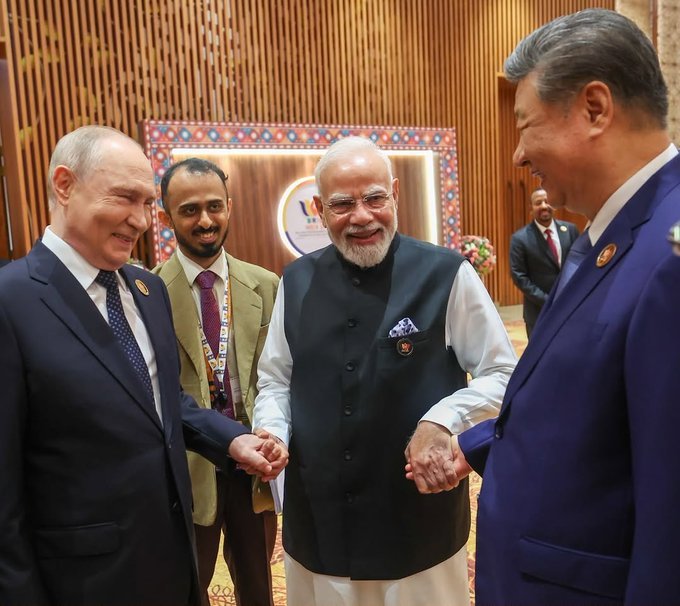
The 18th BRICS Summit, held in New Delhi on September 12–13, 2026, under Prime Minister Narendra Modi’s chairmanship, provided an important platform for India to demonstrate its commitment to collective engagement. The participation of leaders including Putin and Xi gave the summit added diplomatic significance. Its discussions on global challenges, economic cooperation and a more representative international order reflected the grouping’s ambition to amplify the voice of emerging economies. The New Delhi Declaration emphasised solidarity, inclusive global governance and reform of the multilateral system.
The summit also highlighted the limitations of collective diplomacy. India and China continue to face a serious strategic challenge arising from their unresolved boundary dispute, despite renewed diplomatic engagement. Their participation in BRICS does not eliminate mutual suspicion, nor does cooperation in multilateral forums necessarily translate into agreement on bilateral security concerns.
India’s participation in BRICS must therefore be understood as an exercise in strategic autonomy rather than as an endorsement of every position taken by its members. The grouping gives India an opportunity to work with China and Russia on selected issues while retaining the freedom to cooperate with the United States, Europe, Japan and other partners in areas where their interests converge.
Washington’s response to countries purchasing Russian oil has further complicated this balancing act. The prospect of a US law imposing tariffs of up to 100 per cent on goods from countries continuing to buy Russian oil has intensified uncertainty for India. At the same time, the US decision to facilitate Russian diesel supplies for its own market has raised questions about the consistency of its approach. The contrast strengthens the argument that India should diversify its economic and strategic partnerships rather than depend excessively on any single power.
Indias Finance Minister Nirmala Sitharaman has criticised the weaponisation of tariffs, while trade negotiations between India and the United States have encountered difficulties over concessions and market access. As of October 2026, Indian officials have said that the first phase of a bilateral trade agreement is nearing completion, but unresolved tariff questions and the need to secure competitive terms for Indian exporters remain important issues.
The BRICS summit’s diplomatic significance was also reflected in the participation of countries with differing regional interests. The willingness of Iran and the United Arab Emirates to support the New Delhi Declaration’s calls for restraint, civilian protection, energy security and maritime safety demonstrated the potential of multilateral platforms to establish common ground even among states with serious differences.
High-level contacts between Indian and Chinese officials ahead of the summit also contributed to efforts to stabilise bilateral relations. Following the 2020 Galwan Valley clash, both countries have pursued dialogue to manage tensions and address outstanding issues. Any improvement in relations, however, must be judged by concrete progress towards a peaceful settlement of the boundary dispute, not simply by the symbolism of high-level visits.
At the 81st session of the United Nations General Assembly in September 2026, External Affairs Minister S. Jaishankar called for reformed multilateralism and new frameworks to strengthen the security of essential supplies, including fuel, fertilisers, food and finance. His emphasis reflected India’s concern that global crises, geopolitical competition and unilateral economic measures can disrupt the supply chains on which developing countries depend.
India engagement with partners such as Australia, Brazil, Canada, Barbados, Kenya and the European Union on the margins of the UN General Assembly also illustrates the importance of cooperation among middle powers and emerging economies. Such initiatives seek to defend international law, promote peace and prosperity, and strengthen collective responses to global stress.
Jaishankar has outlined the broad diplomatic challenge facing India as one of engaging the United States, managing relations with China, cultivating Europe and reassuring Russia and Japan about India’s intentions. These objectives require a flexible foreign policy that recognises the distinct interests of each partner without allowing any one relationship to dictate the course of the others.
Economic Security and Diversification of Partnerships
In a global order increasingly shaped by strategic competition and economic pressure, India is seeking alternatives and additional partners for trade, employment generation, critical-mineral supplies, energy security and climate action. Bilateral agreements, regional initiatives and multilateral institutions have become important instruments in this effort.
India’s outreach to Central Asia and Africa is intended to strengthen access to energy, minerals, uranium and agricultural resources, while its engagement with Southeast Asia, Australia, New Zealand and Indian Ocean states seeks to expand trade, improve maritime cooperation and diversify critical supply chains. These partnerships are not merely diplomatic exercises; they are linked to India’s domestic development priorities and its ambition to become a leading economic power.
Connectivity projects form an important part of this strategy. The India–Myanmar–Thailand Trilateral Highway and the Kaladan Multimodal Transit Transport Project are intended to improve connectivity between India’s Northeast and Southeast Asia through Myanmar, reinforcing the Act East Policy. Their full strategic and economic potential, however, depends on security conditions, implementation and the political situation in Myanmar.
Other initiatives include the India–Middle East–Europe Economic Corridor, the International North–South Transport Corridor, and cooperation connected with the Northern Sea Route. India has also promoted international cooperation on renewable energy and disaster resilience through initiatives such as the International Solar Alliance and the Coalition for Disaster Resilient Infrastructure.
Taken together, these efforts reflect an understanding that strategic autonomy depends not only on military capability or diplomatic influence but also on resilient infrastructure, diversified supply routes and reliable access to essential resources. The greater the number of viable trade and transport options available to India, the less vulnerable it becomes to disruption or political pressure from individual countries.
READ: Ankita Bhandari Case: Sikkim Rises Against Dushyant Gautam’s Appointment as Governor
Multilateral Diplomacy and the Global South
India has increasingly used international summits and institutional initiatives to project the country’s priorities and strengthen its role in global governance. Its G20 presidency in 2023 placed particular emphasis on the theme Vasudhaiva Kutumbakam—“One Earth, One Family, One Future”—and on giving the African Union permanent membership of the G20. These initiatives reflected India’s effort to make global institutions more representative of developing countries.
India has also convened Voice of Global South summits to provide developing nations with a platform to articulate shared concerns. These include debt pressures, food and energy insecurity, unequal access to technology, climate finance and the need for greater representation in international decision-making.
India participation in BRICS, the G20, the Shanghai Cooperation Organisation and other multilateral forums enables it to pursue overlapping interests with different groups of countries. These institutions do not always share the same objectives, and their members frequently disagree on security and economic questions. Nevertheless, participation gives India opportunities to negotiate, build coalitions and shape discussions on issues that affect its long-term interests.
India’s hosting of the AI Impact Summit in February 2026 also reflected its interest in the governance of emerging technologies. Safe and responsible artificial intelligence, equitable access to technological capabilities and the participation of developing countries in setting global standards are increasingly important dimensions of foreign policy.
The conclusion of negotiations on the India–European Union Free Trade Agreement on January 27, 2026, marked another significant step in India’s efforts to diversify its economic relationships. The agreement was described by political leaders as the “Mother of All Deals” and was presented as a major development in trade and strategic cooperation. Its long-term value will depend on implementation, market access and the extent to which businesses and workers in both economies benefit. <Cite refs={[“turn933605search7″,”turn933605search9”]} />
India’s engagement with the European Union extends beyond trade to technology, defence, mobility, climate policy and economic security. Stronger ties with Europe can help India broaden its options at a time when trade relations with the United States face uncertainty and competition with China remains a defining feature of the international environment.
India has also continued to participate in the Quadrilateral Security Dialogue, or Quad, with the United States, Japan and Australia, while maintaining engagement with the SCO and BRICS. Such simultaneous participation in groupings with different strategic orientations is a defining feature of multi-alignment. Rather than committing itself exclusively to one bloc, India seeks cooperation where it advances specific national interests.
Neighbourhood First and Act East
India’s Neighbourhood First and Act East policies remain central to its regional strategy. Under Neighbourhood First, New Delhi has sought to build trust, improve physical and digital connectivity, support development and provide assistance to neighbouring countries during crises. The policy reflects the recognition that regional stability is closely linked to India’s own security and economic development.
India’s response to natural disasters in neighbouring countries, including assistance following the glacial-collapse floods in Nepal in August 2026 as described in contemporary reporting, illustrates the importance of humanitarian assistance and disaster-response cooperation in regional diplomacy. Such support can strengthen relationships, although its longer-term impact depends on sustained cooperation and sensitivity to the concerns of neighbouring societies.
The policy’s political record, however, has been mixed. The presence of leaders from South Asian countries at Modi’s first swearing-in ceremony in 2014 demonstrated the priority attached to regional diplomacy. Persistent mistrust between India and Pakistan, alongside China’s growing economic and strategic influence in South Asia through infrastructure investment, the Belt and Road Initiative and the China–Pakistan Economic Corridor, has complicated New Delhi’s efforts to build a cohesive regional framework.
At Modi’s second swearing-in ceremony in 2019, leaders from the Bay of Bengal Initiative for Multi-Sectoral Technical and Economic Cooperation (BIMSTEC) were invited instead of leaders from the South Asian Association for Regional Cooperation (SAARC). The shift reflected the difficulties facing SAARC amid India–Pakistan tensions and the search for alternative regional mechanisms.
The Act East Policy complements this approach by strengthening India’s links with Southeast Asia through trade, culture, connectivity and capacity-building. Cooperation with the Association of Southeast Asian Nations (ASEAN), as well as maritime engagement through forums and initiatives such as the Quad, MILAN, SAGAR and MAHASAGAR, supports India’s broader interests in maritime security and regional stability.
For India, the Indo-Pacific is both an economic space and a strategic arena. Maintaining open sea lanes, protecting maritime commerce and improving cooperation with regional partners are essential to securing energy supplies and trade routes. Yet these objectives require sustained investment, effective implementation of connectivity projects and a careful balance between competition and cooperation with China.
The Road Ahead: Strategic Autonomy Through Multi-Alignment
India’s foreign policy has moved beyond a narrow focus on its immediate neighbourhood towards a more extensive network of bilateral partnerships, regional initiatives and multilateral engagements. This evolution reflects the changing distribution of global power, the growing importance of economic security and the need to preserve policy independence amid intensifying competition among major powers.
China and Pakistan remain significant security concerns for India, while uncertainty in US trade and sanctions policies reinforces the need to diversify partnerships. At the same time, India cannot afford to overlook the economic and diplomatic value of engagement with Washington, Beijing, Moscow, Europe, Japan and other important partners.
The answer lies not in choosing one power against another, but in defining clear priorities and negotiating from a position of greater resilience. Cooperation with the United States can advance technology, defence and trade interests; engagement with Russia can contribute to energy and defence requirements; dialogue with China can help manage tensions and expand economic opportunities where appropriate; and closer relations with Europe, Japan, Australia and middle powers can widen India’s strategic choices.
An improvement in India–China relations following the 2026 BRICS summit would be welcome if it produced tangible progress on the boundary dispute and reduced the risk of confrontation. But a diplomatic thaw should not be mistaken for the resolution of structural differences. India must continue to strengthen its border infrastructure, economic capabilities and diplomatic leverage while pursuing peaceful dialogue.
If India is to realise its ambition of becoming the world’s third-largest economy and a consequential power in Asia, multi-alignment must be supported by domestic economic strength, technological capacity, energy diversification and effective regional diplomacy. Collective action with Russia, China and other emerging and middle powers may help India respond to external economic pressure, but such cooperation must remain issue-specific and consistent with India’s own strategic interests.
Ultimately, India’s foreign policy will be judged not by the number of summits it attends or agreements it signs, but by its ability to secure its borders, sustain economic growth, protect access to essential resources, expand its international influence and contribute to a more representative global order. In a world of shifting alliances and competing interests, strategic autonomy will depend on India’s capacity to adapt without losing sight of its long-term national priorities.
*Annpurna Nautiyal is a former Vice-Chancellor and Professor of Political Science, Hemvati Nandan Bahuguna Garhwal University.