What if Rahul Gandhi had made the remarks attributed to Delhi Chief Minister Rekha Gupta and Rajasthan BJP chief Madan Rathore? Would the BJP have stayed silent, or would the political and media outrage have erupted nationwide?
BY PC Bureau
Ocober 16: In Indian politics, the outrage often depends less on what is said than on who says it. Three controversies involving figures associated with the BJP in mid-October 2026 offer a useful test of this double standard. Had the same words come from Rahul Gandhi or another senior opposition leader, would the political, media and organisational response have been different?
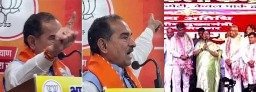
Delhi Chief Minister Rekha Gupta, speaking at a Ramlila event in Azadpur, was reported as saying: “Jab tak har ek Ram maara na jaaye, samaj saaf suthra na ho jaye” — roughly, “Until every Ram is killed, society will not be clean.” Opposition parties, including the AAP and Congress, accused her of insulting Lord Ram and hurting Hindu religious sentiments. Her side treated the remark as a slip of the tongue, arguing that she meant Ravana, while the authenticity and context of the circulating clip also became subjects of dispute.
Blasphemy by CM Rekha Gupta
CM Rekha Gupta says – “Jab tak Har ek RAM Mara Na Jaye, Samaj Saaf Suthra Na Ho Jaye”
“जब तक हर एक राम मारा ना जाए” https://t.co/0ZjW4t9D6t
— Saurabh Bharadwaj (@Saurabh_MLAgk) October 14, 2026
Rajasthan BJP president Madan Rathore sparked another controversy after a speech went viral in which he appeared to say that India would support Pakistan if it went to war with the United States because Pakistan was a neighbouring country. Opposition leaders accused him of making an anti-national statement. Rathore subsequently argued that his words had been misinterpreted, with some accounts pointing to a cricket-related context.
अगर अमेरिका और पाकिस्तान में युद्ध हुआ… तो हम पाकिस्तान के साथ हैं…
राजस्थान BJP अध्यक्ष मदन राठौर https://t.co/c9zmtqIvAd
— Romita Tiwari (@romita_tiwari) October 15, 2026
A third controversy concerned newly appointed Odisha Governor Braj Mohan Ram, who reportedly told reporters that he would work to activate the BJP’s Scheduled Caste Morcha and help the party secure more votes. The remarks prompted the Biju Janata Dal (BJD) and Congress to question whether such partisan political activity was compatible with the neutrality expected of a constitutional governor.
Newly appointed Odhisa governor Braj Mohan openly says he will work for the BJP. Even the pretense of neutrality of Governors has gone in the Modi/Shah regime https://t.co/9aVE2uwz15
— Prashant Bhushan (@pbhushan1) October 15, 2026
The three episodes are different in substance. One concerns a statement invoking a revered religious figure, another concerns India’s relationship with Pakistan, and the third raises questions about the political impartiality of a constitutional office. Yet they share a common question: would the political consequences have been the same if the speakers had belonged to the opposition?
If Rahul Gandhi had said it
Imagine Rahul Gandhi making the same remark about Lord Ram. The BJP would have had an obvious opportunity to accuse him of insulting Hindu beliefs. Party leaders could have demanded an apology, questioned his commitment to Sanatan traditions and called for action by the police. Protests outside Congress offices, demonstrations by affiliated organisations and demands for his resignation would have been entirely foreseeable.
Now imagine Gandhi saying that India would support Pakistan in a war against the United States. The charge of being soft on Pakistan, or even anti-national, would almost certainly have become a central political weapon. The remark could have been repeated in election rallies and used to question the Congress’s commitment to national security. The surrounding context might have mattered less in the initial political battle than the most damaging interpretation of the words.
Finally, suppose a Congress-appointed governor had declared an intention to activate the party’s Scheduled Caste organisation and secure votes for it. The BJP would have been well placed to invoke constitutional propriety, demand an explanation and question the governor’s suitability for office. The controversy would extend beyond the individual to the conduct of the party that appointed the governor.
These are hypothetical scenarios, not claims about events that actually occurred. But they point to a familiar feature of Indian political competition: parties often judge the same conduct differently depending on whether it helps or hurts their opponents.
READ: Manipur: Kuki Woman Shot Dead, Husband Injured, Couple Missing
The street and organisational response
A controversial statement by a senior opposition leader can quickly become an organisational campaign. BJP workers and affiliated groups could mobilise outside Congress offices, stage demonstrations in state capitals and demand an apology. Effigy burning, denunciations of the leader as anti-Hindu or anti-national, and demands for police action would all be plausible responses.
Social media could magnify the controversy further. Hashtags built around the most provocative interpretation of the remarks might spread rapidly, with party supporters, political influencers and television personalities amplifying them. Senior leaders could connect the controversy to earlier disputes involving the Congress leadership and present it as evidence of a broader ideological failure.
Such a response cannot be assumed to occur in every case, nor can every protest or online campaign be attributed to a centrally directed operation without evidence. The point is that the organisational resources and political incentives exist to turn a single sentence into a national controversy.
The question, therefore, is not whether the BJP would necessarily mobilise in precisely this fashion. It is whether comparable remarks by opposition figures would receive more aggressive political treatment than remarks by leaders associated with the ruling party.
The media amplification gap
Television coverage would be another important test.
Had Rahul Gandhi made the three statements, channels critical of the Congress would have had strong incentives to devote prime-time airtime to them. The remarks could have been replayed repeatedly, placed alongside images of the Ram Mandir or Indian soldiers, and discussed by panels debating the Congress’s alleged hostility to Hindu traditions or national interests.
That is a plausible scenario, not a verified account of coverage that never occurred. Establishing a genuine media double standard requires comparing actual airtime, headlines, the frequency of repeated clips, the range of invited voices and the treatment of subsequent clarifications.
The label “Godi media” is often used by critics of television outlets they consider too accommodating towards the government. But a rigorous comparison should not rely on the label alone. It should demonstrate whether similar statements received substantially different treatment according to the speaker’s political affiliation.
If an opposition leader’s words were repeatedly presented as proof of an entire party’s ideological character, while a ruling-party leader’s comparable words were treated as an unfortunate slip or stripped of sustained attention, the disparity would be significant. If the coverage was broadly comparable, the argument of selective amplification would need to be reconsidered.