The BJP has accused Prashant Bhushan and opposition-linked protesters of pursuing an agenda beyond electoral reform. Yet the party itself backed Anna Hazare’s anti-corruption movement against the Manmohan Singh government in 2011. Should the demand for political change be treated differently depending on who makes it?
BY Navin Upadhyay
When the BJP and its allies mobilised against the Manmohan Singh government, they invoked democracy, accountability and the people’s right to protest. Now, when Prashant Bhushan speaks of changing the government, the same demand is being portrayed by the ruling party as evidence of a sinister design. Is seeking a change of government a crime—or is the real controversy about who is demanding it?
A curious transformation is taking place in India’s political discourse. A phrase as old as parliamentary democracy itself—regime change—is being invested with the sinister connotations of a coup, as though demanding a different government were equivalent to plotting the overthrow of the Indian state.
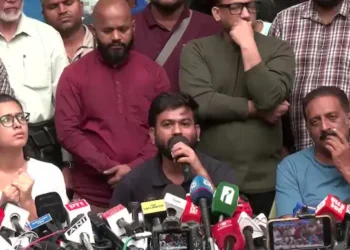
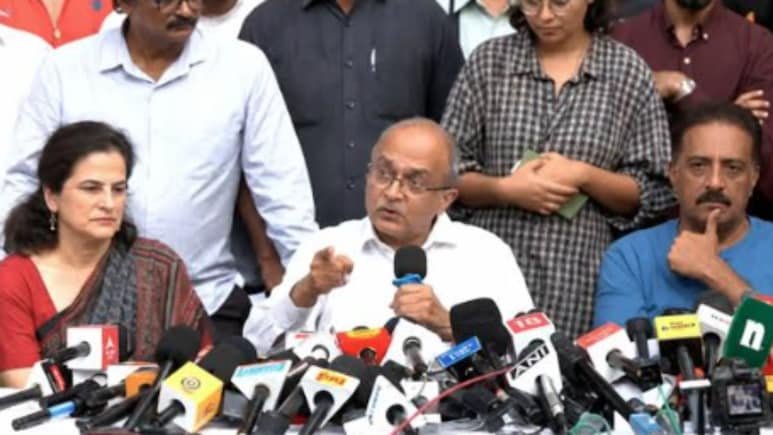
The latest controversy erupted after senior advocate Prashant Bhushan, addressing a press conference on October 15, 2026, alongside student activist Neha Bora, actor Prakash Raj and Cockroach Janta Party founder Abhijeet Dipke, said that the demand had indeed become one for regime change. He argued that citizens had a democratic right to seek a change of government and that creating disaffection against a government was not, in itself, a crime.
“Yes, we want regime change,” Bhushan said at the press conference on Thursday.
Prashant Bhushan also insisted that spreading “disaffection” against a government is not a crime in a democracy, adding that the struggle is now “really for a regime change”.
“The government alleges the opposition wants a regime change… We are currently fighting to ensure that elections are conducted properly. But if this kind of brutality continues, there will certainly be regime change. Yes, we all want regime change,” he announced.
“What is wrong with that?” he continued, pointing out: “BJP led several movements for regime change? Now they are saying there is a conspiracy for regime change…”
The BJP seized upon the statement to accuse the opposition and its associates of pursuing an agenda beyond electoral reform. Party spokespersons portrayed the demand as evidence that the protests against Chief Election Commissioner Gyanesh Kumar and the Special Intensive Revision of electoral rolls were merely a cover for a larger attempt to seize power.
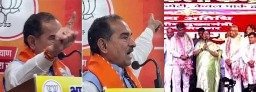
BJP spokesperson Pradeep Bhandari alleged on Thursday that Rahul Gandhi and his entire ecosystem do not merely want to offer political resistance; their aim is regime change. Citing an interview or video message, he said Neha Bora stated that she is inspired by the Gen Z-led movement in Bangladesh and that what happened there should happen in India as well.
But this argument raises a fundamental question: when did the democratic demand for a change of government become synonymous with a conspiracy to overthrow it?
A change of government is not a coup
The distinction should be elementary in a constitutional democracy. Governments are not permanent institutions. They are elected for limited terms, subjected to public scrutiny and expected to face the electorate again. Citizens, political parties, trade unions, student organisations and civil society groups are entitled to campaign for their removal.
The expression regime change can carry different meanings in different contexts. In international affairs, it is sometimes associated with foreign intervention, covert operations or the forcible removal of a government. But in domestic political debate, it can simply mean replacing the party or leadership in power.
The context matters. A demand that an elected government be defeated at the ballot box is not equivalent to a plan to overthrow the constitutional order by force. Nor does invoking another country’s protest movement, without more, establish a conspiracy to reproduce its political upheaval in India.
There is a legitimate distinction between advocating peaceful political change and advocating violence, insurrection or the unconstitutional seizure of power. The former is a normal feature of democratic competition. The latter may attract serious legal consequences, depending on the conduct and applicable law.
Bhushan’s statement should therefore be assessed in its entirety, including his explanation of what he meant by regime change, rather than treated as proof of a coup merely because the phrase was used.
Did the BJP forget its own political history?
The BJP’s response is particularly revealing when viewed against its own record as the principal opposition party during the Congress-led United Progressive Alliance government.
In 2011, the anti-corruption movement led by Anna Hazare became a national political event. It demanded a stronger Lokpal law and challenged the credibility of the Manmohan Singh government, which was under sustained pressure over corruption allegations and controversies. People like Prashant Bhushan were actively involved in that movement, too.
The BJP did not stand aloof from that agitation. It publicly backed Hazare’s campaign, endorsed several of Team Anna’s demands and used the controversy to attack the UPA government. On August 16, 2011, after Hazare was detained, the BJP announced protests across the country. Party president Nitin Gadkari condemned the government’s handling of the agitation, while party leaders demanded Hazare’s release and accused the UPA of undermining democratic rights.
The party’s engagement went beyond general expressions of sympathy. On August 25–26, senior BJP leaders, including L.K. Advani, Nitin Gadkari, Sushma Swaraj and Arun Jaitley, met representatives of Team Anna to discuss the Jan Lokpal Bill. The BJP subsequently expressed support for key demands of the movement.
The political circumstances were different, and the Anna movement’s principal stated objective was anti-corruption legislation, not an armed overthrow of the government. That distinction should be acknowledged. But it also exposes the weakness of any argument that a mass movement, a coalition of civil society groups and opposition parties demanding fundamental political change are inherently engaged in an undemocratic enterprise.
The BJP was entitled to oppose the Manmohan Singh government, mobilise citizens and use the public anger surrounding corruption to advance its political position. Indeed, that was the legitimate function of an opposition party.
Why, then, should the right to demand political change be treated as suspicious when activists and opposition figures exercise it against the BJP-led government?
The question is not whether the two movements are identical. They are not. The question is whether the democratic principle being invoked is the same.
READ: Selective Outrage : What If Rahul Gandhi Had Said “Kill All Rams” and “Support Pakistan”?
The opposition’s right to challenge the government
The BJP’s present argument appears to conflate two separate questions: whether the government should change and whether the methods used to pursue that change are constitutional.
The first is a political question. The second is a question of law and democratic conduct.
Opposition parties exist, in part, to persuade voters that the incumbent government should be replaced. Student organisations campaign against governments. Civil society groups mobilise over public policy, civil liberties and institutional accountability. Citizens can demand resignations, call for fresh elections and advocate the defeat of a ruling party.
None of these actions, by itself, establishes a criminal conspiracy.
In the present controversy, the protests centre on allegations concerning electoral-roll revision and demands for accountability from the Election Commission. The BJP disputes the opposition’s interpretation of the SIR exercise and maintains that the constitutional process for changing governments is through elections. <Cite refs={[“turn230689search2″,”turn230689news8”]}/>
That is a legitimate argument to make. Elections are indeed the constitutional means through which governments change. But the existence of elections does not remove the right to protest between elections, criticise public institutions, challenge alleged irregularities or demand that officeholders resign.
Nor does an opposition movement lose its democratic character simply because its ultimate political objective is to defeat the government in power.
If the BJP believes the current protests are being used to pursue an agenda unrelated to electoral reform, it is entitled to present evidence and make that case. But the phrase regime change, on its own, cannot settle the matter.
Is the media importing the language of foreign intervention?
A second issue concerns the manner in which the controversy is being framed in sections of the television and digital media that critics often describe as Godi media.
The phrase regime change has a powerful international association. It evokes covert foreign operations, the destabilisation of governments and the overthrow of political systems. In the context of American foreign policy towards countries such as Iran, it can suggest an external power seeking to determine who governs another nation.
But a domestic activist like Prashant Bhushan calling for the replacement of India’s government is not the equivalent of a foreign government seeking to install a preferred leadership in another country.
The distinction is not subtle. One concerns the exercise of political rights by citizens within their own constitutional system; the other may involve external coercion, intervention or clandestine operations.
The comparison with American policy towards Iran is useful only insofar as it exposes the danger of conflating two fundamentally different meanings of regime change. It would be misleading to imply that Bhushan’s statement itself establishes any foreign-backed operation or conspiracy.
Delhi: Advocate Prashant Bhushan says, “There will definitely be a regime change. We all want a regime change. Is there anything wrong with that?…” https://t.co/vUDowEBAI8
— IANS (@ians_india) October 15, 2026
Media outlets are free to scrutinise his language, question his intentions and examine whether the wider protest movement has made demands inconsistent with constitutional methods. But that scrutiny should begin with the actual words spoken and the available evidence, not with the most alarming interpretation that can be attached to them.
A short audio clip can be newsworthy. It can also be misleading when detached from the surrounding remarks. The appropriate response is to examine the complete recording, establish the context and distinguish what the speaker actually said from what political opponents claim it means.
The question for journalists is straightforward: are they investigating a possible conspiracy, or simply repeating an accusation that turns an ordinary demand for political change into a story about the overthrow of the state?
The Bangladesh comparison requires evidence, too
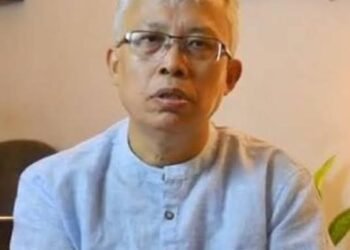
The controversy has also been fuelled by Neha Bora’s reported praise for Bangladesh’s Gen Z-led uprising, which she described as having shown the way. The BJP interpreted the statement as evidence that the protesters wanted to reproduce the events in Bangladesh in India.
That interpretation deserves scrutiny rather than automatic acceptance.
Political movements frequently draw inspiration from events abroad. Activists study protests in other countries, borrow slogans, learn organising techniques and express solidarity with movements they admire. Such expressions can raise legitimate questions about political strategy, but they do not, without further evidence, prove an intention to overthrow a government unlawfully.
The relevant questions are what the speakers proposed, what methods they advocated and whether there is evidence of plans for violence or the unconstitutional seizure of power.
If the proposal is to mobilise citizens, protest electoral practices and defeat the ruling party, it belongs to the domain of democratic politics. If evidence emerges of an organised plan to use violence or dismantle constitutional institutions by force, that is a different matter and should be investigated on its merits.
The distinction cannot be erased merely because a foreign protest movement is invoked as an inspiration.
The same standard must apply to every party
India’s political history is full of movements that sought to change the government of the day. Opposition parties have organised demonstrations, called for resignations, demanded early elections and joined civil society campaigns against incumbent administrations.
The BJP itself used the language of democratic rights and popular resistance while opposing the UPA government during the Anna Hazare agitation. It criticised the use of police powers against protesters and argued that citizens must be allowed to challenge those in power.
That history does not invalidate the BJP’s present concerns about the methods or objectives of the protests against the Election Commission. Nor does it establish that every action by the current protest movement is justified. Each allegation must be assessed on its own evidence.
But it does establish a principle that should not change with the identity of the ruling party: the right to demand a government’s removal is not the same as the right to remove it by unconstitutional means.
A party cannot reasonably invoke the democratic legitimacy of mass mobilisation when it is in opposition and then treat the mere demand for political change as evidence of subversion when it holds office.
The government has every right to defend its record, challenge its opponents’ arguments and insist that political power be transferred through constitutional means. The opposition has an equally legitimate right to campaign for its defeat, question institutions and mobilise public opinion.
Neither side should be allowed to redefine these rights according to political convenience.
In a democracy, the desire to change the government is not evidence of a conspiracy. The evidence lies in the means proposed to achieve that change—and those means, not the political identity of the speaker, should determine the judgment.