In this opinion piece, Dr. Chinkholal Thangsing reflects on the enduring human cost of Manipur violence and urges a constitutional path towards justice and reconciliation.
By Dr. Chinkholal Thangsing
“When the law fails the people, silence becomes complicity. The world must not forget those displaced, those killed, those whose homes were reduced to ashes—and those whose very identity was targeted in the shadows of India’s largest democracy.”
— Adapted from testimonies of Manipur’s displaced
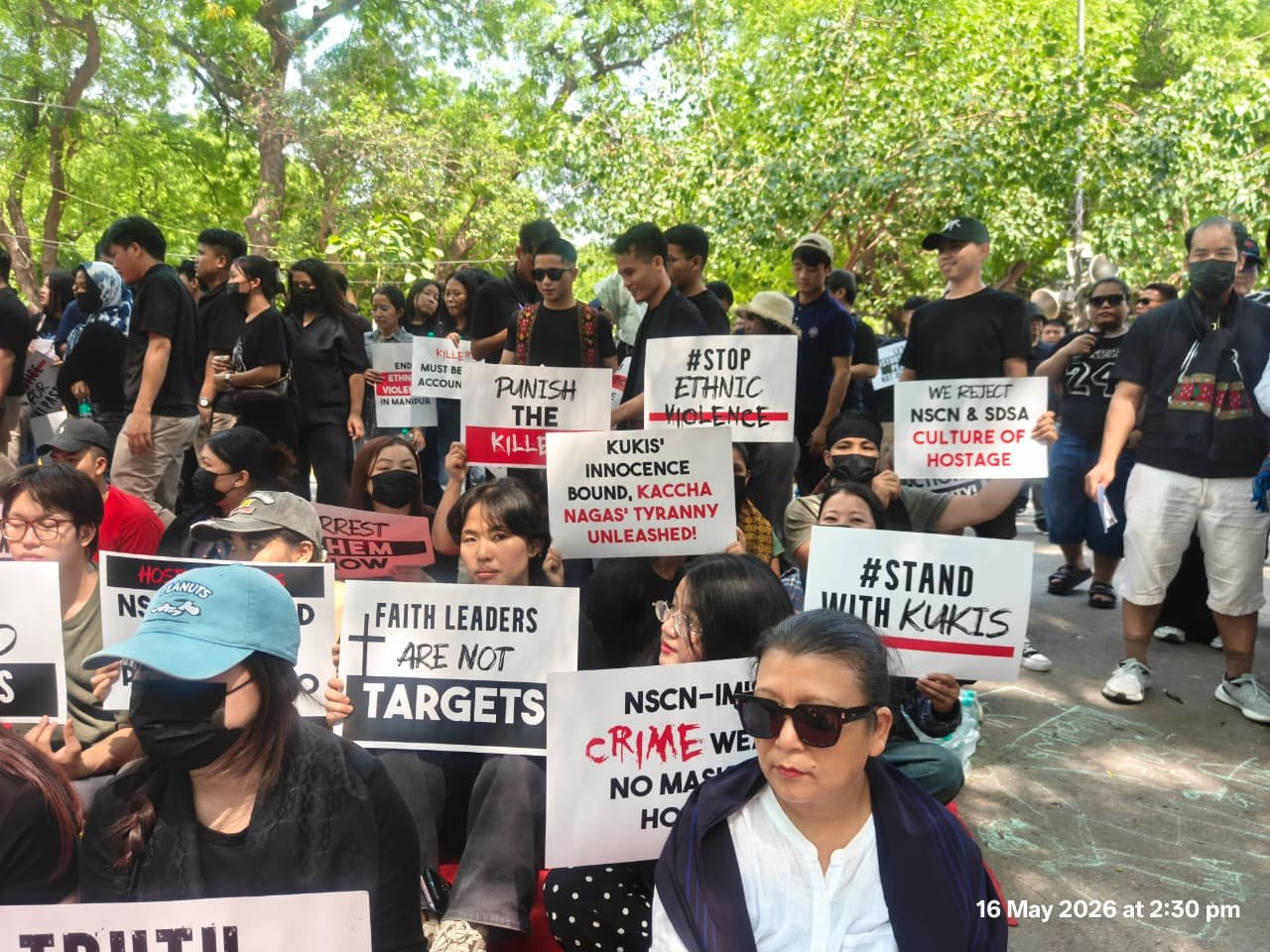
June 14 2026: More than three years have passed since 3 May 2023—an inflection point that altered the trajectory of Manipur. In the weeks that followed, the valley witnessed what many survivors, human rights organizations, and international observers describe as ethnic cleansing: large numbers of Kuki-Zo families were forcibly expelled from their homes in the Imphal valley, fleeing with little more than the clothes on their backs.
An estimated 60,000 people were displaced—60,000 souls now residing in relief camps with no end in sight even after 27 months of violence.[2][3][4] Nearly 300 have been killed in brutal attacks, with government figures recording 258–260 fatalities as of November 2024, while unofficial counts suggest higher numbers.[2][5][6] Women and girls, predominantly from the Kuki-Zo ethnic minority, suffered systematic sexual violence including gang rape; one prominent case involved two Kuki women paraded naked and gang-raped in July 2023, with one 20-year-old survivor dying in January 2026 from prolonged injuries and trauma.[1][5]
Places of worship were deliberately torched—estimates range from 249 churches destroyed in the first 36 hours to over 400 churches damaged or burned overall, alongside vandalized temples.[5] Hundreds of villages were razed, with destruction of over 300 villages documented and thousands of houses burned.[5] Homes were destroyed, livelihoods shattered, and thousands of citizens were left to contend with profound loss, psychological trauma, and lingering insecurity.[1][7]
READ: Fake Army Vehicle Carrying 15 Kg Opium Seized In Manipur
READ: ‘American Zionist Enemy Defeated’: Iran Hails Peace Deal With US
For a time, many dared to hope that dialogue would prevail, that reason would temper rage, and that reconciliation would begin to heal old wounds. Recent waves of violence—killings, arson, and renewed displacement—have dimmed that fragile light. The wounds remain raw, and each new incident risks plunging the state deeper into despair.
The crisis has also outgrown its original binaries. What began as strife principally between two groups now implicates a larger constellation of peoples and political aspirations. The Kuki-Zo demand for constitutional and political security, the Meitei aspiration to preserve and advance Kangleipak’s historical and cultural identity, and the Naga pursuit of long-standing political objectives now coexist in a landscape of competing narratives and unresolved grievances. The diffusion of the conflict raises urgent questions about the future of all who call Manipur home.
How long can this imbroglio continue?
How long must generations come of age amid buffer zones, checkpoints, suspicion, and separation? How long must communities that have shared centuries of history remain caught in cycles of fear, retaliation, and grief? How many more lives must be disrupted before a genuine and lasting settlement becomes possible?
The tragedy of Manipur is not merely political; it is fundamentally human. Behind every statistic is a family; behind every displaced person is a life story; behind every burnt household are memories reduced to ash. The cries of mothers, the fears of children, the frustrations of youth, and the anxieties of elders cut across ethnic and political lines. Suffering recognizes no tribe.
At the heart of this crisis lies an acute deficit of trust. Decades of competing historical memories, unmet political expectations, perceived injustices, and reciprocal suspicions have accumulated into a reservoir of resentment that threatens to consume the prospects of a generation. Communities that once traded, studied, celebrated, and mourned together increasingly regard one another through lenses of fear and grievance. Such social fragmentation is corrosive: it weakens the civic fabric on which peaceful coexistence and democratic governance depend.
Can such a future be sustained?
India’s constitutional framework supplies mechanisms for dialogue, accommodation, autonomy, and democratic representation. The crucial question is whether political actors—at both the state and union levels—will marshal the necessary urgency and political will to employ those instruments creatively and decisively. Will the Union Government and Manipur’s political leadership commit to a settlement that addresses legitimate security concerns while upholding constitutional values, human rights, and the rule of law?
Temporary arrangements and episodic assurances will not suffice. The people of Manipur deserve a durable constitutional solution that moves beyond buffer zones and indefinite separation. They deserve security, the restoration of normal civic life, and a credible pathway for the return of displaced families in safety and dignity. Above all, they deserve hope.
The continued stagnation of Manipur is detrimental not only to the state but to the nation. Manipur’s cultural plurality, strategic location, natural endowments, and human potential remain unrealized when instability persists. Economic growth, education, healthcare, investment, and social development become casualties of protracted conflict. Every month of uncertainty imposes a heavy cost: opportunities foregone by youth, businesses shuttered, families torn apart, and public confidence eroded. The psychological scars multiply.
Peace will not come from silence or inertia alone. It requires sustained, inclusive engagement involving local communities, civil society, faith leaders, and political representatives. It requires willingness to listen to uncomfortable truths and to acknowledge legitimate fears and aspirations on all sides. Any meaningful way forward must rest on justice, mutual respect, enforceable guarantees, and an unwavering commitment to constitutional processes.
Do we need another Mahatma Gandhi? Nelson Mandela, Desmond Tutu, or any such global peace makers or negotiators? Or do we need international organizations such as Amnesty International, Human Rights Watch, and the United Nations? I do not believe that is necessary. We have a strong government and leadership capable of bringing clear justice and a lasting solution.
As citizens of the world’s largest democracy and members of a free republic, we must continue to hope that one day the era of buffer zones will come to an end, and safety and dignity, and a permanent constitutional structure will emerge in which the distinct identities, rights, and aspirations of the Kuki-Zo, Meitei, and Naga peoples are protected separately yet equally as citizens of India. Such a framework need not require all aspirations to be accommodated within a single state arrangement, but it must ensure constitutional security, democratic representation, peaceful coexistence, and mutual respect for all.
For peace is not merely the absence of violence. It is the restoration of dignity, the rebuilding of trust, and the resurrection of hope.
Peace is more than the absence of violence. It is the restoration of dignity, the rebuilding of trust, and the resurrection of hope. Only through determined, inclusive, and principled action can this long night give way to a durable dawn.
Footnotes
- Kashmir Media Service, “Manipur: Two Kuki Women Paraded Naked and Gang-Raped in July 2023,” January 25, 2026, https://kashmirmediaproject.com/manipur-women-rape-case.
- PUCL (People’s Union for Civil Liberties), *Report on the Violence in Manipur: 2023–2025* (Bangalore: PUCL, 2025), 15–22.
- United Nations Office of the High Commissioner for Human Rights, *Situation of Human Rights in India: Report on Manipur* (Geneva: UN OHCHR, 2024), 8.
- Christian Solidarity International, *Systematic Destruction: Churches and Villages Burned in Manipur* (London: CSI, 2024), 4–7.
- Amnesty International, *India: Armed Groups and State Forces Impunity in Manipur* (London: Amnesty International, 2024), 12–18.
- Human Rights Watch, *India: 2024 Year in Review—Manipur Violence and Impunity* (New York: HRW, 2024), 23.
- United Nations Office for the Coordination of Humanitarian Affairs, “Manipur Displacement Crisis: 60,000 Still in Relief Camps,” November 15, 2024, https://ocha.un.org/manipur-displacement-2024.
Bibliography
- Amnesty International. *India: Armed Groups and State Forces Impunity in Manipur*. London: Amnesty International, 2024.
- Christian Solidarity International. *Systematic Destruction: Churches and Villages Burned in Manipur*. London: CSI, 2024.
- Human Rights Watch. *India: 2024 Year in Review—Manipur Violence and Impunity*. New York: HRW, 2024.
- Kashmir Media Service. “Manipur: Two Kuki Women Paraded Naked and Gang-Raped in July 2023.” January 25, 2026. https://kashmirmediaproject.com/manipur-women-rape-case.
- PUCL (People’s Union for Civil Liberties). *Report on the Violence in Manipur: 2023–2025*. Bangalore: PUCL, 2025.
- United Nations Office for the Coordination of Humanitarian Affairs. “Manipur Displacement Crisis: 60,000 Still in Relief Camps.” November 15, 2024. https://ocha.un.org/manipur-displacement-2024.
- United Nations Office of the High Commissioner for Human Rights. *Situation of Human Rights in India: Report on Manipur*. Geneva: UN OHCHR, 2024.
(Dr. Chinkholal Thangsing, MBBS, FCAMS, is a physician, politician, philanthropist and social worker. A recipient of Cambodia’s Royal Order of the Sahametrei for his humanitarian and international health contributions, he founded The Touch of Hope Foundation and Lamka City of Hope to promote healthcare, compassion and community development.)