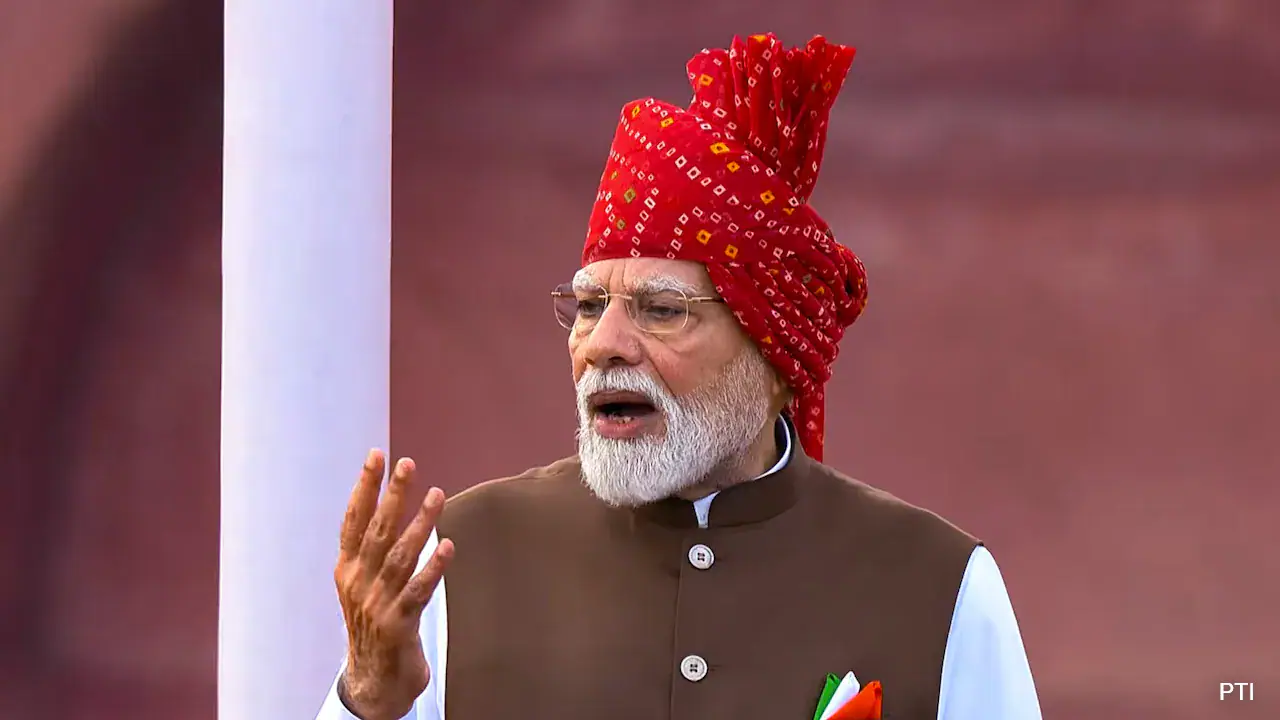
Declaring that Naxalism was “breathing its last”, Modi said areas once dominated by Maoist violence were now witnessing roads, schools, connectivity and development.
BY PC Bureau
August 15, 2026: Prime Minister Narendra Modi on Saturday warned against the “Naxal mindset” and declared that the violent Maoist movement that once held large parts of India in its grip was now on its last legs, as he used his 80th Independence Day address from the Red Fort to present the decline of Left-Wing Extremism as one of his government’s major internal-security achievements.
Addressing the nation from the historic ramparts of the Red Fort, Modi said Naxalism and Maoism had destroyed the future of millions of young people, snatched away the sons of countless mothers and shattered families across India.
For nearly four decades, he said, Naxalism had gripped large parts of the country, ruling through the barrel of a gun and undermining the Constitution.
More than 3,500 police and security personnel, Modi said, had sacrificed their lives while protecting ordinary citizens from the violence.
“Naxalism had turned the land red with blood,” he said, describing the legacy of the insurgency that once stretched across what was popularly known as India’s Red Corridor.
‘Naxalism is breathing its last’
Modi recalled that when his government came to power in 2014, it had resolved to free the country from Naxalism.
More than a decade later, he said, the movement no longer possessed the strength to sustain itself.
“Naxalite and Maoist violence no longer has the strength to sustain itself and is breathing its last,” Modi said, projecting the campaign against Left-Wing Extremism as being close to its final phase.
The Prime Minister said areas that once echoed with Naxalite gunfire and witnessed bloodshed were now seeing the Tricolour fly alongside development, infrastructure and greater public confidence.
The government has for years pursued a combination of security operations, intelligence gathering, infrastructure construction, welfare schemes and efforts to bring remote tribal areas into the mainstream.
The Home Ministry has previously set March 31, 2026, as its target for eliminating Naxalism from the country. It has pointed to a dramatic reduction in the number of districts affected by Left-Wing Extremism and a shrinking geographical footprint of Maoist violence.
From the Red Corridor to roads, schools and development
Modi sought to contrast the past with the changes taking place in former Maoist strongholds.
He said areas once dominated by fear were now witnessing roads, schools, improved connectivity, sports events and cultural programmes.
The Bastar Olympics, he said, represented a new spirit in regions once associated with armed insurgency.
The government has increasingly presented development and security as two sides of the same strategy: security forces establish control and infrastructure follows, while education, healthcare, connectivity, employment and welfare are intended to reduce the conditions that helped sustain insurgency.
Modi’s message was that the battle against Maoism could not be measured only by encounters and arrests. The more significant victory, he suggested, was the restoration of normal life in communities that had lived for years under the shadow of violence.
A human cost running into thousands
The Prime Minister also invoked the human cost of the insurgency.
Thousands of security personnel and civilians have been killed over decades of Left-Wing Extremist violence, while entire communities in remote forested areas have lived amid conflict between Maoist groups and the state.
Modi said more than 3,500 police and security personnel had made the ultimate sacrifice.
His emphasis on their deaths was intended to underline the scale of the challenge faced by successive governments and the price paid by security forces operating in some of India’s most difficult terrain.
A security victory claimed after years of operations
The government’s claim of a near-collapse of Naxalism follows years of intensified counter-insurgency operations.
The Centre has expanded fortified security camps, deployed specialised forces, strengthened intelligence networks and improved road and air connectivity in previously inaccessible areas.
The government has also highlighted surrenders, arrests and the deaths of senior Maoist commanders as evidence that the insurgency’s organisational structure has been severely weakened.
In 2025, the government described major anti-Maoist operations in Chhattisgarh and neighbouring states as landmark successes and said the movement’s geographical and organisational footprint had been sharply reduced.
The government’s assessment is that the combination of sustained security pressure and development has broken the insurgency’s ability to operate as a parallel authority across large territories.
READ: Seating Row: Rahul, Kharge Skip Red Fort Celebrations Again
VIDEO | Independence Day 2026: Addressing the nation from ramparts of Red Fort, PM Modi, says, “In the 21st century, it is imperative that we eliminate the decades-old challenges that have held the country back. Naxalism and Maoism have destroyed the future of millions of young… pic.twitter.com/HLuYSfKVlN
— Press Trust of India (@PTI_News) August 15, 2026
Modi links internal security to Viksit Bharat
The Prime Minister placed the Naxalism issue within his larger vision of a Viksit Bharat by 2047.
He argued that a developed India cannot be built while sections of the country remain trapped in violence, insecurity and underdevelopment.
From the issue of internal security, Modi moved to what he called “Sapt Dhara” — seven streams of national strength that he said would drive India’s transformation over the next five to seven years.
The agenda included manufacturing, agriculture and food processing, technology and innovation, connectivity through Gati Shakti, defence and security, the green and blue economy, and India’s soft power.
The Prime Minister particularly stressed the importance of manufacturing at scale, semiconductor production, artificial intelligence, skill development and the creation of globally competitive Indian products.
Youth at the centre
Youth remained one of the central themes of the address.
Modi argued that India’s young population represented the country’s greatest advantage and said the next generation would be responsible for carrying the nation towards its 2047 development target.
He highlighted initiatives relating to coaching, AI training, skilling and employment, while calling for greater ambition among young Indians.
The contrast with Naxalism was deliberate: an ideology that, according to Modi, once drew young people into armed violence was being replaced by education, skills, entrepreneurship, sports and economic opportunity.
From violence to the Tricolour
The Prime Minister’s Naxalism message was ultimately framed as a story of transformation.
Regions once identified with the Red Corridor, he said, were moving towards a future defined not by Maoist violence but by development and national integration.
The government has made the elimination of Left-Wing Extremism a major internal-security objective, with Home Minister Amit Shah previously declaring that the country would be free of Naxalism by March 31, 2026.
Modi’s Independence Day address suggested that the government now regards that goal as being within reach.
The broader message from the Red Fort was that the India of the future could not carry the unresolved conflicts of the past. Naxalism, terrorism and other forms of violence, he argued, had to give way to security, development and opportunity.
Against that backdrop, Modi presented the weakening of Maoist violence not merely as a counter-insurgency achievement but as part of a larger transformation — from the “Red Corridor” to a development corridor, and from a politics of the gun to the promise of a developed India by 2047.