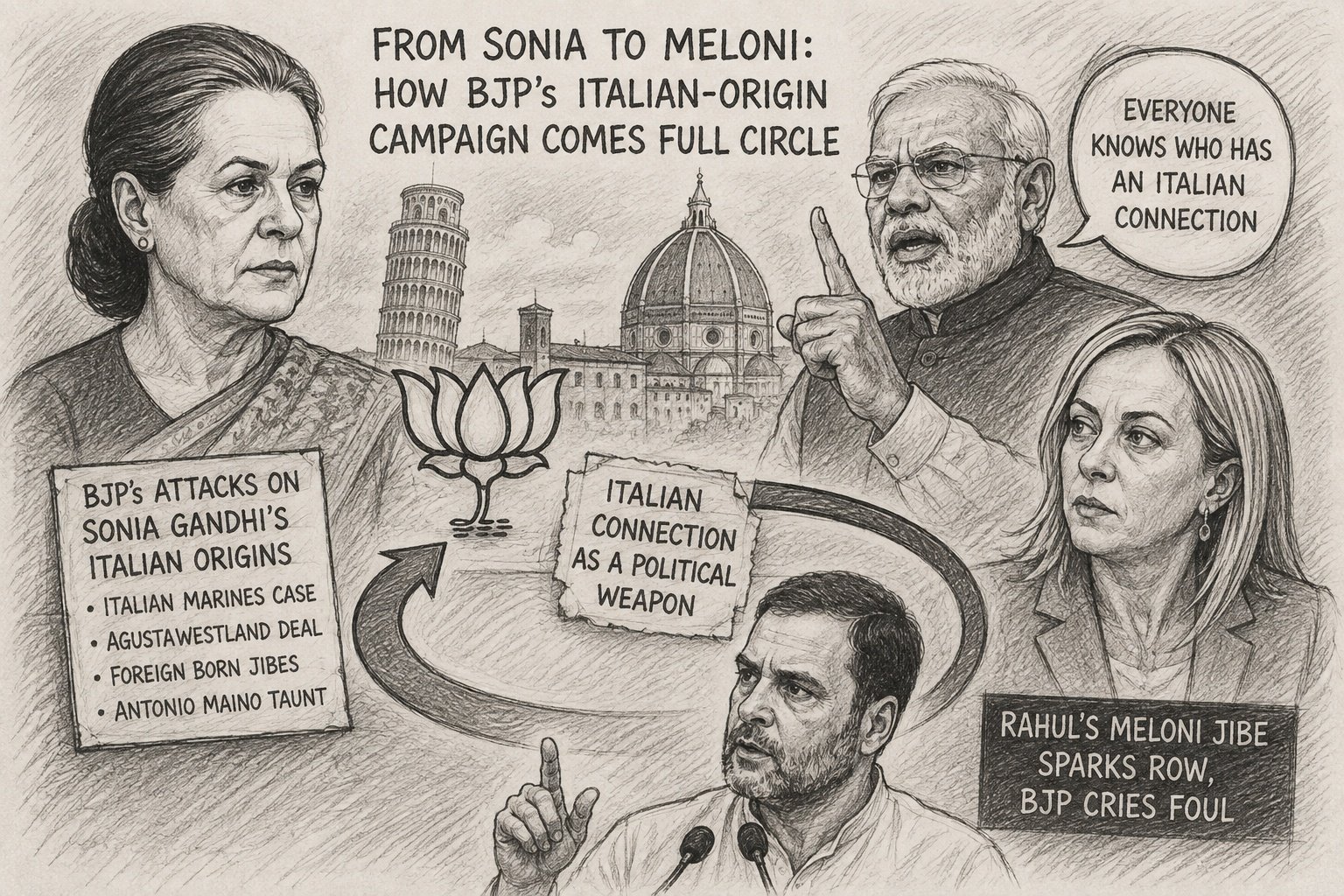
As the “Italian connection” returns to political debate, a look back at how Narendra Modi and other BJP leaders once invoked Sonia Gandhi’s Italian birth offers a revealing glimpse into India’s partisan politics.
By Navin Upadhyay
August 15, 2016: The controversy over an alleged “Italian connection” in Indian politics is hardly new.
The latest political sparring over Rahul Gandhi’s remarks involving Italian Prime Minister Giorgia Meloni and Prime Minister Narendra Modi has prompted sharp criticism from the Ministry of External Affairs and the BJP. But the episode also revives an older political narrative: for years, Narendra Modi and other BJP leaders repeatedly invoked Congress leader Sonia Gandhi’s Italian birth while attacking the UPA government and the Gandhi family.
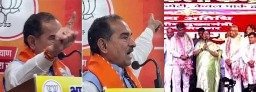
Ironically, as the BJP attacked Rahul Gandhi over his remarks involving Italian Prime Minister Giorgia Meloni and the Ministry of External Affairs urged politicians to be mindful of India’s “strong” ties with Italy, BJP MP Kangana Ranaut also invoked Sonia Gandhi’s Italian origins while targeting Rahul Gandhi — bringing the very Italian connection that BJP leaders have repeatedly raised against the Gandhi family back into the political debate
The Italian Marines case became one of the most contentious examples of BJP attacks on Sonia Gandhi over her Italian link. The BJP accused the then UPA government of showing undue leniency towards the two Italian marines accused of killing two Indian fishermen, suggesting that Sonia Gandhi’s Italian origins had influenced the government’s handling of the case.
The Italian Marines Case: Modi’s Sharp Attack
During the 2014 Lok Sabha election campaign, Narendra Modi, then the BJP’s prime ministerial candidate, repeatedly attacked Sonia Gandhi over the Italian Marines case.
At an election rally, Modi demanded that Sonia Gandhi explain how the two Italian marines had obtained permission to leave India after the fishermen were killed.
“Sonia Gandhi should answer the people on who helped the two Italian marines get safe passage from India after killing two fishermen in Kerala,” Modi said.
He questioned why the marines were not in an Indian jail and challenged the Congress leadership to explain where they were being held.
“Just because they are from Italy, they cannot be subjected to different treatment,” Modi said.
The controversy dated back to February 2012, when Italian marines Massimiliano Latorre and Salvatore Girone, aboard the Italian-flagged oil tanker Enrica Lexie, shot dead two Indian fishermen off Kerala. The marines maintained that they had mistaken the fishermen for pirates.
The incident triggered a prolonged legal and diplomatic confrontation between India and Italy.
The marines were subsequently permitted to leave India under conditions imposed during the legal proceedings. Girone was allowed to return to Italy in 2016, while Latorre had earlier been permitted to remain in Italy on medical grounds.
The dispute eventually reached international arbitration. In 2020, the Permanent Court of Arbitration ruled that the marines were entitled to immunity from Indian jurisdiction because they were acting as Italian state officials, while also holding that India was entitled to compensation for the loss of life and damage suffered.
Modi used the controversy to question the UPA government’s handling of the case and to suggest that the Italian nationals had received preferential treatment.
He also linked the issue to a broader attack on the Congress’s claims about patriotism, asking whether India’s citizens needed to learn patriotism from Sonia Gandhi.
Massive Quake Rocks Indonesian Island, Wrecks Buildings, Triggers Tsunami Alert
AgustaWestland: Another Italian Connection
The “Italian connection” resurfaced years later in the AgustaWestland VVIP helicopter controversy.
The Indian government had signed a contract in 2010 with AgustaWestland, a subsidiary of Italy’s Finmeccanica, for 12 AW101 helicopters intended for use by senior Indian officials, including the President and Prime Minister.
The deal was worth around €556 million.
The controversy erupted after allegations that middlemen had bribed officials to manipulate technical specifications and secure the contract. India cancelled the agreement in 2014 and sought recovery of money paid under the contract.
The issue became a major political weapon for the BJP against the Congress-led UPA.
During public rallies in May 2016, Modi repeatedly invoked the case while targeting Sonia Gandhi. In Kerala, he argued that allegations involving her had not originated with his government but had emerged from proceedings in Italy.
“Madam Soniaji, aap ki yeh himmat?” Modi said at one rally, accusing her of spreading “lies” about the helicopter deal.
He then asked the crowd a series of questions about whether Sonia Gandhi had relatives or acquaintances in Italy before declaring that “everyone knows who has an Italian connection.”
Even earleir, In January 2010, then Gujarat Chief Minister Narendra Modi said, while attacking the UPA government over inflation:
“Now I guess I will have to write to them in Italian.”
The political rhetoric far exceeded the narrow legal question of the helicopter contract, turning Sonia Gandhi’s foreign birth into a recurring campaign theme.
Sonia Gandhi’s Response
Sonia Gandhi consistently rejected attempts to portray her Italian birth as evidence of divided loyalty.
“I was born in Italy and I am not ashamed of it, but India is my home and my country,” she said.
The distinction was central to her response: her opponents focused on her place of birth, while she argued that her political identity and allegiance were Indian.
The Attacks Did Not Stop With Modi
The references to Sonia Gandhi’s Italian origins were not confined to Narendra Modi.
In January 2017, BJP MP Ramesh Bidhuri made a controversial remark during an election campaign in Uttar Pradesh, invoking what he described as differences between Italian and Indian culture. The comment was widely criticised as a personal and culturally offensive attack.
In May 2018, the Karnataka BJP’s official Twitter account referred to Sonia Gandhi by her maiden name, “Antonio Maino”, while attacking her ahead of her visit to the state during the Assembly election campaign.
The BJP tweet accused her of being responsible for “wasting” India’s 10 years under the UPA government.
Earlier, in June 2015, BJP MP Ashwini Kumar Choubey had referred to Sonia Gandhi as an “Italian doll” and used other derogatory expressions while attacking the Congress leadership.
Such remarks repeatedly brought Sonia Gandhi’s foreign birth back into political debate, even when the immediate issue had little to do with Italy.
#BREAKING BJP MP @KanganaTeam slammed @RahulGandhi, alleging his “Italian mother” @INCIndia imposes him despite election losses, and accused him of colluding with foreign powers like Soros to destabilize India. [ANI ]#KanganaRanaut #RahulGandhi #SoniaGandhi #BJP #Congress pic.twitter.com/KeSavhHfX9
— jarvis ☠️ (@Vishii14) August 12, 2026
Italy and India: A Relationship Far Bigger Than Political Rhetoric
The recurring political references to Italy obscure the broader reality of India-Italy relations.
India and Italy maintain extensive economic, commercial and diplomatic ties. Italy is an important European trading partner for India, with bilateral commerce running into several billion euros annually and cooperation extending across manufacturing, machinery, infrastructure, defence-related industry, automobiles, pharmaceuticals, energy, science and technology.
Italy is also part of the European Union, making the relationship important beyond bilateral trade. India and the EU have been negotiating a broader trade and investment framework, while Rome has increasingly sought a stronger strategic relationship with New Delhi in the Indo-Pacific.
Italian companies operate in India across sectors including engineering, infrastructure, automotive components, energy and luxury goods. Indian companies, meanwhile, have invested in Italy.
The relationship therefore extends well beyond the political controversies surrounding the Gandhi family.
This is absolute cinema 🍿😂
Rahul Gandhi –– I will show you what foreign policy means for Modi
*He runs and hugs Sandeep Dixit*
Rahul Gandhi –– Modi thinks foreign policy is all about hugging leaders 🤣
Sandeep Dixit –– Did you do this like Meloni?
Rahul Gandhi –– No, i… pic.twitter.com/USFQwVD8zi
— Amock_ (@Amockx2022) August 13, 2026
From Sonia Gandhi to Giorgia Meloni
That history provides the backdrop to the latest controversy surrounding Rahul Gandhi and Giorgia Meloni.
The political roles have changed, but the rhetorical theme is familiar: Italy has once again become part of an Indian political argument.
The BJP and the government have objected to Rahul Gandhi’s remarks involving Meloni and Modi, while the Congress has pushed back against what it sees as selective outrage.
The irony is difficult to miss.
For more than a decade, the BJP itself repeatedly invoked Italy when attacking Sonia Gandhi — sometimes in connection with substantive issues such as the Italian Marines case and AgustaWestland, and at other times through direct references to her birth, maiden name and alleged cultural differences.
READ: Massive Quake Rocks Indonesian Island, Wrecks Buildings, Triggers Tsunami Alert
A Political Weapon That Refuses to Disappear
The history shows how the “Italian connection” evolved from a question of national interest into a broader political symbol.
The Italian Marines controversy raised legitimate questions about jurisdiction, diplomacy and the treatment of foreign nationals accused of killing Indian citizens.
The AgustaWestland affair raised serious questions about defence procurement, corruption allegations and the role of intermediaries.
But alongside those substantive issues grew a more personal line of attack centred on Sonia Gandhi’s Italian origins.
That distinction matters.
Criticism of a government decision, a defence contract or the handling of a criminal case is part of legitimate political debate. Questioning a politician’s loyalty solely because of where they were born is a different proposition.
The latest controversy involving Rahul Gandhi and Meloni therefore sits within a much longer political history. Italy has repeatedly served as both a diplomatic issue and a political metaphor in India’s partisan battles — and the “Italian link” remains one of the most enduring themes in the political discourse surrounding the Gandhi family.