Political observers view the development as a significant step towards consolidating Kuki-Zomi unity at a time when Manipur remains deeply polarised following the violence that erupted in May 2023.
BY PC Bureau
May 12, 2026: In a major development amid Manipur’s continuing ethnic crisis, the Kuki National Organisation (KNO) and the Zomi Re-unification Organisation (ZRO) have initiated a formal reconciliation process aimed at ending decades-old divisions between the Kuki-Zo and Zomi communities.
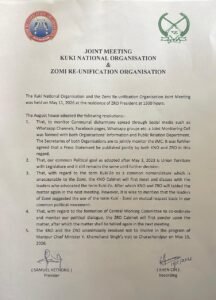
The two influential apex organisations held a joint meeting on May 11 at the residence of the ZRO president in Churachandpur, where they adopted a series of resolutions focused on unity, political coordination, and preventing future communal discord.
The meeting is being viewed as a significant step towards consolidating internal unity among the Chin-Kuki-Mizo-Zo communities at a time when the ongoing conflict in Manipur has sharply reshaped political and ethnic alignments across the state.
The discussions were the outcome of nearly two months of sustained dialogue between the two organisations. The reconciliation effort formally began in March 2026 when KNO spokesperson Seilen Haokip met ZRO leaders in Churachandpur to initiate talks aimed at resolving longstanding disagreements.
The latest deliberations, referred to in the resolution as the “August House,” focused on communal harmony, shared political objectives, nomenclature disputes, and future coordination mechanisms.
READ: Manipur: New Twist to Tronglaobi Blast Case, IED Seized from Meitei Houses
Key Decisions Taken
Among the major resolutions adopted during the meeting was the creation of a Joint Monitoring Cell consisting of representatives from the Information and Public Relations departments of both organisations. The cell will monitor and counter inflammatory or divisive content circulating on social media platforms such as WhatsApp, Facebook pages, and online groups.
The organisations stated that communal tensions and misinformation spread through social media had become a serious concern and required coordinated monitoring. A separate joint statement on the issue is expected shortly.
The KNO and ZRO also reaffirmed their collective political demand for a separate Union Territory with a legislature — a position adopted following the outbreak of ethnic violence in Manipur on May 3, 2023. The resolution stated that this demand remains unchanged unless reviewed jointly at a later stage.
Nomenclature Dispute Remains Sensitive
One of the most delicate issues discussed during the meeting was the use of the term “Kuki-Zo,” which has been a point of disagreement between sections of the Kuki and Zomi communities.
According to the resolution, Zomi representatives reiterated that the nomenclature “Kuki-Zo” remains unacceptable to the Zomi side. In response, the KNO Cabinet agreed to hold internal consultations with leaders who had advocated the term before the matter is revisited in future meetings.
Zomi leaders instead proposed the use of the term “Kuki-Zomi,” describing it as a formulation based on mutual recognition and respect.
Despite the unresolved disagreement over terminology, both sides agreed to continue dialogue and avoid allowing the issue to derail broader efforts toward political unity.
Proposal for Central Working Committee
The meeting also tasked the ZRO Cabinet with examining the formation of a Central Working Committee that would coordinate future political negotiations and oversee discussions relating to the community’s political aspirations and engagement with the government.
Observers believe such a committee could eventually become a unified political platform representing various Kuki-Zomi groups in future talks concerning administrative arrangements and peace negotiations.
Boycott of Chief Minister’s Visit
In another politically significant decision, both organisations unanimously resolved not to participate in Manipur Chief Minister Y. Khemchand Singh’s proposed visit to Churachandpur on May 15, 2026.
The decision is likely to be interpreted as a sign of continuing distrust between Kuki-Zomi organisations and the Manipur government amid the prolonged ethnic conflict.
The joint resolution was signed by Samuel Hethong, president of the KNO, and Khen Cin, recording secretary.
Historical Context
The Kuki-Zo and Zomi communities belong to the larger Chin-Kuki-Mizo ethnic family and inhabit several hill districts of Manipur, particularly Churachandpur. They share deep linguistic, cultural, and historical ties, though differences over identity, leadership, and nomenclature have persisted for decades.
The KNO, formed in 1988, represents several Kuki tribes and associated armed groups, while the ZRO, established in 1993, primarily represents Zomi subgroups including Paite, Vaiphei, Zou, and related communities.
Relations between the two sides have at times turned violent, most notably during the Kuki-Zomi clashes of 1997–98, which left deep scars within the community.
Significance of the Reconciliation
Political observers say the latest rapprochement reflects a growing recognition among Kuki-Zomi organisations that internal unity has become crucial amid the ongoing crisis in Manipur.
By prioritising dialogue, coordinated messaging, and conflict prevention, both organisations appear intent on preventing historical divisions from resurfacing at a time when the community is collectively pushing for greater political and administrative autonomy.
The joint meeting is also expected to strengthen the negotiating position of Kuki-Zomi groups in future discussions with the Centre and other stakeholders over demands for a separate administrative arrangement.
Further meetings between the KNO and ZRO are expected in the coming weeks as both organisations continue efforts to institutionalise cooperation and build a more unified political framework.