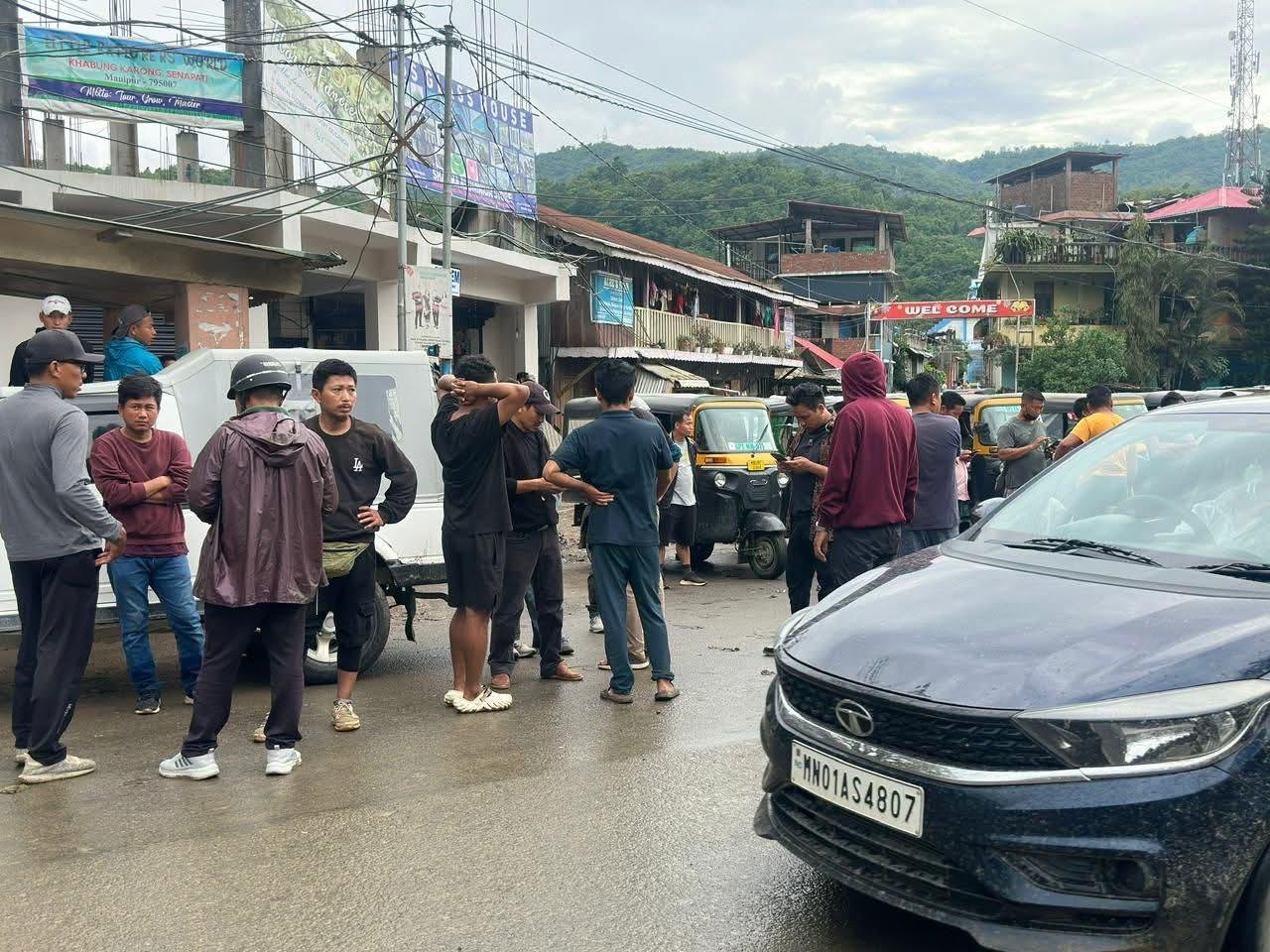
Naga organisations continue to demand clarity on the wellbeing and whereabouts of six missing Naga civilians allegedly held hostage, even as Kuki-Zo civil society groups deny any knowledge of them.
By PC Bureau
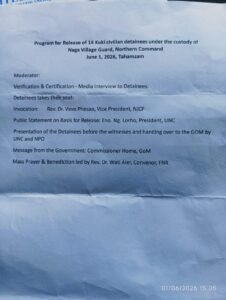
June 1, 2026: Hopes for a major humanitarian breakthrough in Manipur were dashed on Monday evening after last-minute disagreements among Naga organisations stalled the planned release of 14 Kuki-Zo detainees who have been held captive for nearly 18 days amid escalating ethnic tensions in the hill districts.
The United Naga Council (UNC) decided to defer the release of the hostages until further deliberations following strong protests from student organisations and civil society groups. As of now , there was little hope of their release today.
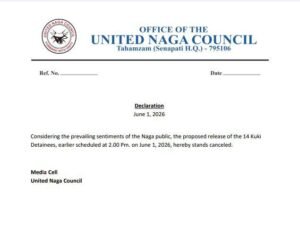
In a late-evening press release, the UNC said, “In view of the prevailing sentiments, the proposed release of the 14 Kuki-Zo detainees, earlier scheduled for 2 PM on June 1, 2026, stands cancelled.”
Earlier in the day, the United Naga Council (UNC) had publicly announced that the detainees would be released following consultations with church bodies, tribal organisations, civil society groups, and government authorities. However, by evening, the release had not taken place amid reports of resistance from powerful student organisations and federating units in Senapati district.
Reports said that while the UNC leadership agreed in principle to release the detainees, some local organisations — including the Senapati District Students’ Association (SDSA) and allied federating units — objected to the decision, arguing that it had been taken without broader consultation.
“The UNC agreed to release them, but the NPO and SDSA refused to proceed with the release. Negotiations are still continuing,” a source involved in the talks said.
NPO stands for Naga Peoples’ Organisation, the prominent apex civil society and tribal body representing the Naga tribes of Senapati district in Manipur.
Internal Differences Surface Within Naga Organisations
In a significant indication of internal differences, sources from the SDSA reportedly maintained that the UNC leadership had announced the release decision without formally consulting the student body or its affiliated units.
“The decision to release the 14 hostages was taken by the office of the UNC. However, this decision was made without the knowledge, consultation, or consent of the SDSA office and its federating units,” a source associated with the organisation said.
The disagreement has complicated what was earlier being viewed as a major confidence-building measure between sections of the Naga and Kuki-Zo communities following weeks of tension and uncertainty.
UNC Announces Release at Public Gathering
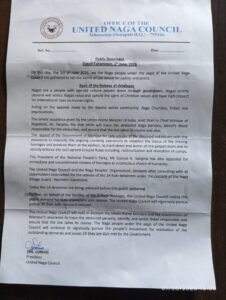
The original announcement was made during a public gathering at the UNC headquarters in Tahamzam, Senapati headquarters, where the organisation formally declared that the 14 detainees would be released.
In a statement signed by UNC President Ng. Lorho, the council said the detainees had been under the custody of the Naga Village Guard–Northern Command.
“Today, the 14 detainees are being released before this public gathering,” the statement declared.
At the same time, the UNC reiterated its demand for the immediate and safe release of six missing Naga civilians whose whereabouts remain unknown.
“On behalf of the families of the six Naga hostages, the United Naga Council makes this public demand for their immediate safe release,” the statement added.
Appeals From Churches and Political Leaders
The UNC said its decision was influenced by repeated appeals from the Baptist world community, Naga churches, tribal organisations, and civil society groups urging restraint and humanitarian intervention.
The council also referred to assurances reportedly conveyed by Union Home Minister Amit Shah to Nagaland Chief Minister Neiphiu Rio regarding efforts to trace missing civilians and restore peace in the affected regions.
Appeals from the Government of Manipur and National People’s Party President Conrad K. Sangma calling for the unconditional release of hostages were also cited by the UNC.
Political observers say the combined intervention of church institutions, tribal leaders, and political figures helped create conditions for dialogue, even though final implementation now appears delayed by internal disagreements.
Crisis Rooted in May 13 Violence
The current hostage crisis originated from violence that erupted on May 13 after three Kuki-Zo church leaders were killed in an ambush by unidentified gunmen in Kangpokpi district.
The killings triggered retaliatory actions, civilian abductions, road blockades, and heightened mobilisation between sections of the Kuki-Zo and Naga communities along the volatile Kangpokpi-Senapati border.
During the escalation, dozens of civilians from both communities were reportedly detained or taken hostage. Although an earlier agreement facilitated the release of 14 individuals from each side on May 15, 14 Kuki-Zo civilians — including women and minors from Taphou Kuki village — continued to remain in captivity.
The prolonged detention led to emotional protests, sit-ins by families, and repeated humanitarian appeals from church groups and civil society organisations.
Government Intensifies Security Operations
Meanwhile, the Manipur government has assured the UNC that all efforts are being intensified to trace six missing Naga civilians and stabilise the security situation.
In an official communication, the Home Department stated that security forces are carrying out sustained Cordon and Search Operations (CASO), combing exercises, area domination patrols, and intelligence-based operations in sensitive areas.
The government has also transferred the case involving the missing civilians to the National Investigation Agency (NIA) for an independent investigation.
Authorities have pledged strict enforcement of the Suspension of Operations (SoO) ground rules and warned that all individuals involved in abductions and violence would face legal action irrespective of affiliation.
Fragile Peace Process Faces New Test
The delay in the release underscores the fragile and deeply fragmented nature of peace efforts in Manipur’s hill districts, where multiple tribal bodies, student organisations, armed groups, and civil society institutions often exercise parallel influence.
Analysts warn that while the UNC’s announcement represented an important humanitarian gesture, the lack of consensus among all stakeholders highlights the complexities involved in conflict resolution in the region.
Community leaders from both sides continue to appeal for restraint and dialogue to prevent further escalation.
The crisis has also revived memories of the violent Naga-Kuki clashes of the 1990s, which left thousands displaced and entrenched longstanding disputes over land, political representation, territorial claims, and ethnic identity.
For the families of the detainees waiting anxiously in Taphou and surrounding villages, however, uncertainty continues.
As negotiations reportedly continue behind closed doors, hopes remain that the deadlock can still be resolved peacefully and the promised release carried out without further delay.