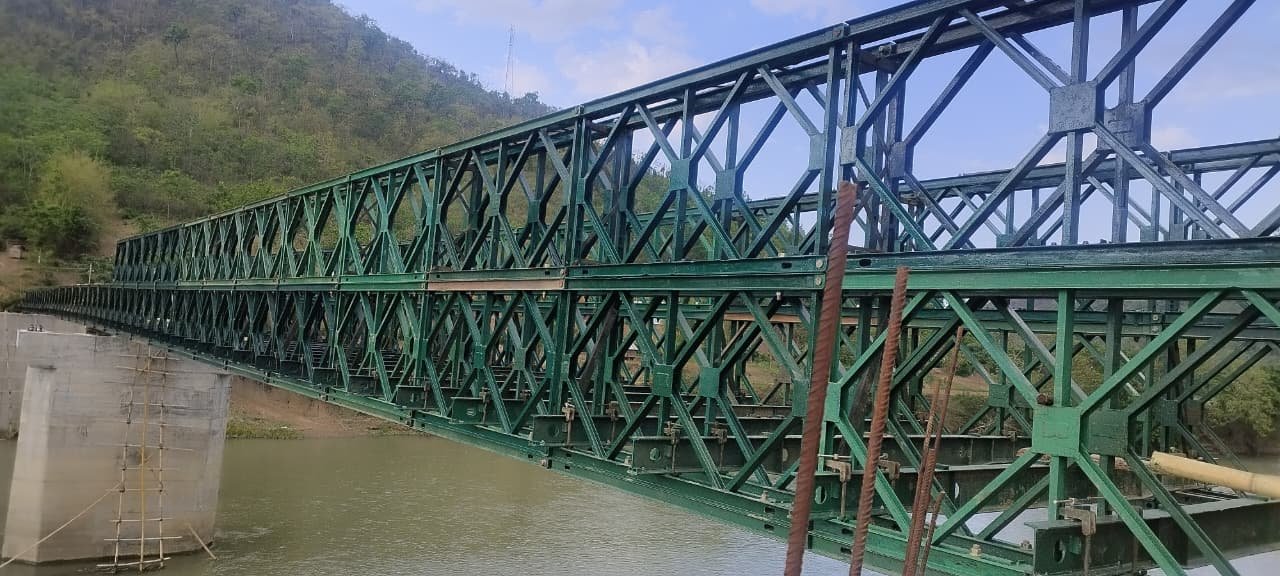
Constructed over 18 months without government assistance, the Khulmi Bridge has become a symbol of resilience and survival for the Kuki-Zo community, even as its inauguration sparked political controversy and competing narratives.
By Navin Upadhya
July 12, 2026: When Dasrath Manjhi, the legendary “Mountain Man” of Bihar, spent 22 years chiselling through a mountain with nothing more than a hammer and chisel, he was ridiculed as a madman. Yet, by the time he finished, he had carved a 110-metre passage through solid rock, transforming the lives of thousands of villagers who no longer had to undertake a perilous journey for medical care, education and trade.
More than six decades later and nearly 2,000 kilometres away, another extraordinary story of collective human determination has emerged—not of one man moving a mountain, but of an entire community building a bridge in the midst of conflict.
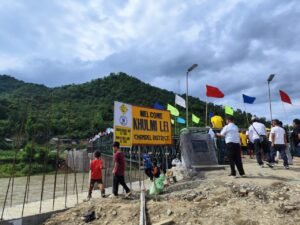
The newly inaugurated Khulmi Bailey Bridge, spanning the Gunpi (Imphal) River between Chandel and Churachandpur districts, is more than a steel structure. For the Kuki-Zo community, it represents survival, self-reliance and hope after violence severed one of the few remaining lifelines connecting three districts of Manipur.
The bridge, inaugurated on Wednesday in Gammnom village in Chandel district, links Chandel, Churachandpur and Tengnoupal, reconnecting communities that had been effectively cut off after the ethnic violence that erupted on May 3, 2023, rendered the Sugnu route unusable.
Unlike most infrastructure projects, this one was not conceived in a government office, financed through public budgets or executed by contractors under official supervision.
READ: ‘Peace Is Not Weakness’: COTU Urges Centre to Act After Kuki Farmer’s Murder
According to community leaders, the bridge was built almost entirely through public donations. Every steel girder, every bolt and every concrete footing reflected contributions from ordinary villagers, churches, local organisations and well-wishers. The project reportedly cost around ₹3.5 crore, all raised through crowdfunding without government assistance.
Even more remarkable, those involved say the bridge was constructed quietly over nearly eighteen months.
The secrecy, they explain, was deliberate.
Crowdfunded, community-built, and driven by resilience.
Khulmi Bridge, inaugurated reconnects parts of #Lamka, #Chandel & #Tengnoupal. Organisers say it was built entirely through public donations and voluntary labour, calling it a symbol of self-reliance amid years of hardship. pic.twitter.com/IfxN7NM0dW— Ah.Hmar (@ArianaHmar37783) July 11, 2026
An earlier attempt to build a similar crossing—the proposed Seloitha Bridge—never reached completion. Determined not to let history repeat itself, organisers chose to work away from public attention until the final span was in place.
Dominic Baite, media in-charge of Kuki Inpi Manipur (Chandel), said the community was forced to build the Khulmi Bridge after repeated appeals to the district administration and the Manipur government for a permanent road link went unanswered.
“We were left with no option but to build the bridge ourselves,” Baite said. “Despite repeated representations, neither the district administration nor the state government acted to restore connectivity to Chandel.”
Before the bridge was built, residents had to cross the Imphal River in small boats, he said, describing the journey as especially dangerous during the monsoon.
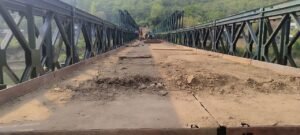
“Crossing the river by boat became a risky proposition whenever the water level rose. Several people lost their lives after boats capsized during floods,” Baite said.
According to him, the project was a community-driven effort, with local residents contributing manual labour while engineers volunteered to design and supervise the construction of the Bailey bridge.
Baite said the bridge has already transformed life for residents of Chandel by restoring access to neighbouring Churachandpur and Tengnoupal districts.
“For thousands of people, the bridge has reopened a vital lifeline. Residents can now travel more easily to Churachandpur and Tengnoupal for work, trade and essential purchases—something that had become extremely difficult after the existing routes were cut off,” he said.
In many ways, the project echoed the spirit of Dasrath Manjhi. Where Manjhi used hand tools to carve a road through a mountain because no government would, villagers in conflict-ridden Manipur pooled scarce resources to build the infrastructure they believed was essential for survival.
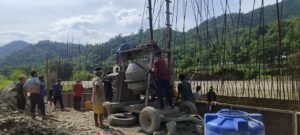
For residents, the bridge is not merely about connectivity. It is about ensuring that ambulances can reach hospitals, students can attend schools, farmers can transport produce and families can cross a river that has become increasingly dangerous.
The Kuki Inpi Manipur, the apex civil society organisation of the community, says at least eight people lost their lives while attempting to cross the river during medical emergencies and other crises after traditional routes were disrupted.
“The Khulmi Bridge stands as a testament to public sacrifice and government failure,” the organisation said in a statement. “It was built because our people died, the state remained silent, and the community chose to act.”
The inauguration drew village chiefs, community leaders, civil society representatives and MLAs Paolienlal Haokip and Chinlunthang Zou. The bridge was dedicated to those described by organisers as the Kuki-Zo “martyrs” of the post-May 2023 conflict, symbolising resilience and collective resolve.
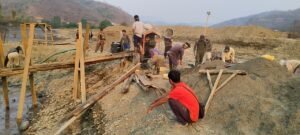
Yet even before celebrations ended, the bridge became the centre of a political and media storm.
Some media reports and commentators alleged that the structure could facilitate drug trafficking because of its proximity to routes leading towards India’s border with Myanmar and the wider Golden Triangle region.
The Kuki Inpi Manipur strongly rejected the allegations, accusing sections of the media of spreading misinformation and engaging in what it described as character assassination. The organisation argued that such claims ignored the humanitarian circumstances that led to the bridge’s construction.
It also pointed out that security forces maintain a presence roughly 100 metres from the bridge, making allegations that it was secretly built as a narcotics corridor implausible.
Former Coordination Committee on Manipur Integrity (COCOMI) leader Khuraijam Athouba, however, has maintained that concerns remain over infrastructure that could potentially improve access to areas linked to narcotics trafficking. He questioned whether the bridge was constructed through authorised procedures and argued that the development appeared inconsistent with the government’s stated policy of “zero tolerance” towards drugs and narco-terrorism.
Those competing narratives have transformed the Khulmi Bridge into more than a physical crossing. It now sits at the intersection of humanitarian need, ethnic politics, security concerns and competing visions of Manipur’s future.
History often remembers great engineering not for the steel or the concrete, but for the circumstances that gave birth to it.
Dasrath Manjhi’s mountain path was once dismissed as impossible before becoming a symbol of perseverance. Whether the Khulmi Bridge comes to be remembered as a monument to community resilience or remains overshadowed by political controversy may ultimately depend less on the bridge itself than on whether peace and trust can be rebuilt across the divides it was intended to overcome.