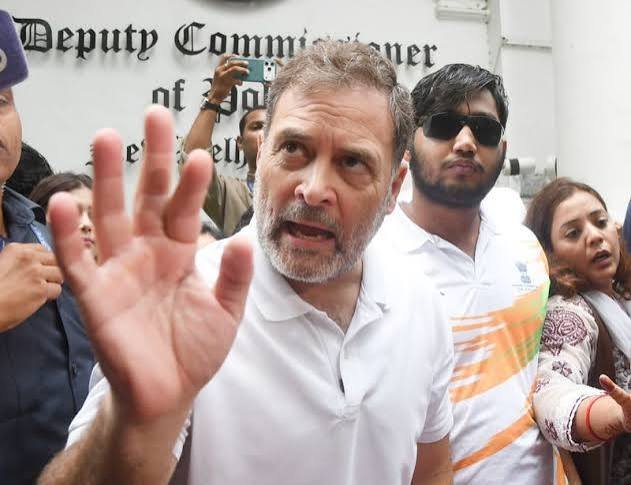
The reported FIR marks a major turn in the pellet-gun controversy, after Gandhi confronted Delhi Police over the alleged refusal to register Lochab’s complaint and vowed not to leave until action was taken.
BY PC Bureau
August 21, 2026: Delhi Police has registered an FIR over the alleged pellet-gun injuries suffered by 19-year-old student protester Sahil Lochab, shortly after Leader of the Opposition Rahul Gandhi staged a dharna at Parliament Street Police Station demanding that a case be filed, sources said on Friday.
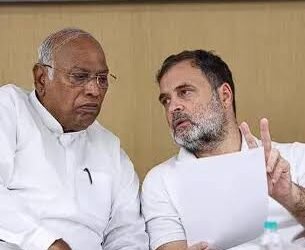
The development came after Gandhi arrived at the police station with Lochab and his mother and refused to leave until the complaint was formally registered. The Congress leader had accused Delhi Police of denying the student access to justice and alleged that officials were acting on “orders from the top”.
The reported registration of the FIR marks a significant turn in the confrontation that unfolded through the day. Gandhi had first accompanied Lochab to Mandir Marg Police Station and later to the Parliament Street police station, where he met senior officers including DCP Sachin Sharma. When the issue remained unresolved, Gandhi and Lochab began a sit-in outside the police station.
Rahul Gandhi refuses to leave
Gandhi had made it clear that he would remain at the police station until an FIR was registered.
“We won’t budge from here until an FIR is registered,” Gandhi told reporters, accusing the police of refusing to act on Lochab’s complaint.
He also questioned Delhi Police’s denial that its personnel had used pellet guns during the July 20 protest, asking who was responsible for the injuries if the police had not fired such weapons. Gandhi displayed pellets that he said had been recovered from Lochab’s body and cited medical reports concerning the teenager’s injuries.
Congress leaders, including Priyanka Gandhi Vadra, Jairam Ramesh, Salman Khurshid and Kumari Selja, later joined the protest as a large number of party workers gathered outside the police station. Rapid Action Force personnel were also deployed in the area.
How Sahil Lochab was injured
Lochab alleges that he was hit by pellets during the July 20 “Sansad Chalo” protest organised by activists associated with the Cockroach Janta Party at Jantar Mantar. The protest centred on alleged examination irregularities and paper leaks, including the NEET controversy.
The demonstration later moved towards Parliament and the situation turned confrontational, with security personnel deployed to control the crowd.
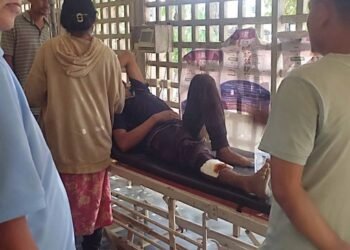
Lochab, a Delhi University student from Najafgarh, has said he was carrying the national flag when he was struck by pellets. He suffered injuries to several parts of his body and underwent treatment and surgery at the AIIMS Trauma Centre.
Gandhi has claimed, citing medical records, that more than 200 pellet fragments were found in Lochab’s body, including three in or around his injured eye. The Congress has also said some fragments were lodged in areas where they could not safely be removed.
The teenager has suffered serious damage to his right eye, with his family fearing permanent loss of vision.
Police deny firing pellet guns
Delhi Police has repeatedly denied using pellet guns during the July 20 operation. The denial has become a central point of the political dispute, with Gandhi arguing that an investigation is necessary precisely to establish who fired the projectiles that injured Lochab.
The July 20 violence is already the subject of wider investigations. Police have said complaints connected with the protest are being examined by the Crime Branch, while a Supreme Court-appointed High-Powered Expert Committee is examining allegations concerning excessive or disproportionate use of force during the protests.
The BJP has criticised Gandhi’s dharna, accusing him of engaging in “politics of anarchy”. BJP leader Ravi Shankar Prasad said police had informed Gandhi that an FIR had already been registered in connection with the incident and that it was under investigation.
The Congress, however, insisted that Lochab’s individual complaint required a formal FIR and an investigating officer.
Complaint had been pending
According to Congress sources, Lochab and his lawyers first submitted a written complaint to Delhi Police on August 14. They alleged that they were not given an acknowledgement or the details of an investigating officer.
The complaint was pursued again through email and telephone on August 17, but the Congress said there was still no clear response.
That prompted Gandhi to accompany Lochab to the police authorities on Friday. After the initial attempt at Mandir Marg Police Station did not produce the desired result, Gandhi moved to Parliament Street and met senior officers. The subsequent dharna transformed the dispute into a major political confrontation.
READ: Huge Drug Haul in Two Parts of Manipur Hills
Amit Shah comes under Gandhi’s attack
Gandhi also directly targeted Union Home Minister Amit Shah, whose ministry oversees Delhi Police.
In his public statements, Gandhi accused the government of failing to explain the alleged use of force against students and questioned why an FIR had not been registered when a young protester had suffered serious injuries.
He demanded a judicial inquiry and said those found responsible should face action, irrespective of their rank.
The Congress has portrayed the episode as a test of police accountability and the right of citizens to seek legal remedies after alleged excessive use of force.
साहिल की FIR दर्ज न होने देने का एक ही मतलब है –
नरेंद्र मोदी और अमित शाह के राज में शांतिपूर्ण प्रदर्शन कर रहे युवाओं पर खुलेआम पैलेट गन चलाई जा सकती है, मगर उन्हें इंसाफ नहीं मिल सकता।
जब तक FIR दर्ज नहीं होती, जब तक दोषियों पर कड़ी कार्रवाई का भरोसा नहीं मिलता – हम डटे… pic.twitter.com/iJ6ojC9mmA
— Rahul Gandhi (@RahulGandhi) August 21, 2026
FIR changes the political stakes
The reported registration of the FIR following Gandhi’s sit-in could now shift the controversy from a political confrontation over whether police would accept the complaint to a formal investigation into the circumstances surrounding Lochab’s injuries.
The key questions will be what weapon caused the injuries, who deployed it, under whose orders it was used and whether the force was justified under the circumstances of the July 20 protest.
The case also comes against the backdrop of broader judicial and police investigations into the clashes that day.
For Gandhi and the Congress, the FIR represents an initial victory after hours of confrontation outside the police station. For Delhi Police, the investigation will now have to establish the facts behind the alleged pellet injuries while also being examined against the wider inquiry into the July 20 violence.
The development could therefore give fresh momentum to the political battle over the use of force during the student protests and put renewed focus on accountability for serious injuries suffered by protesters.