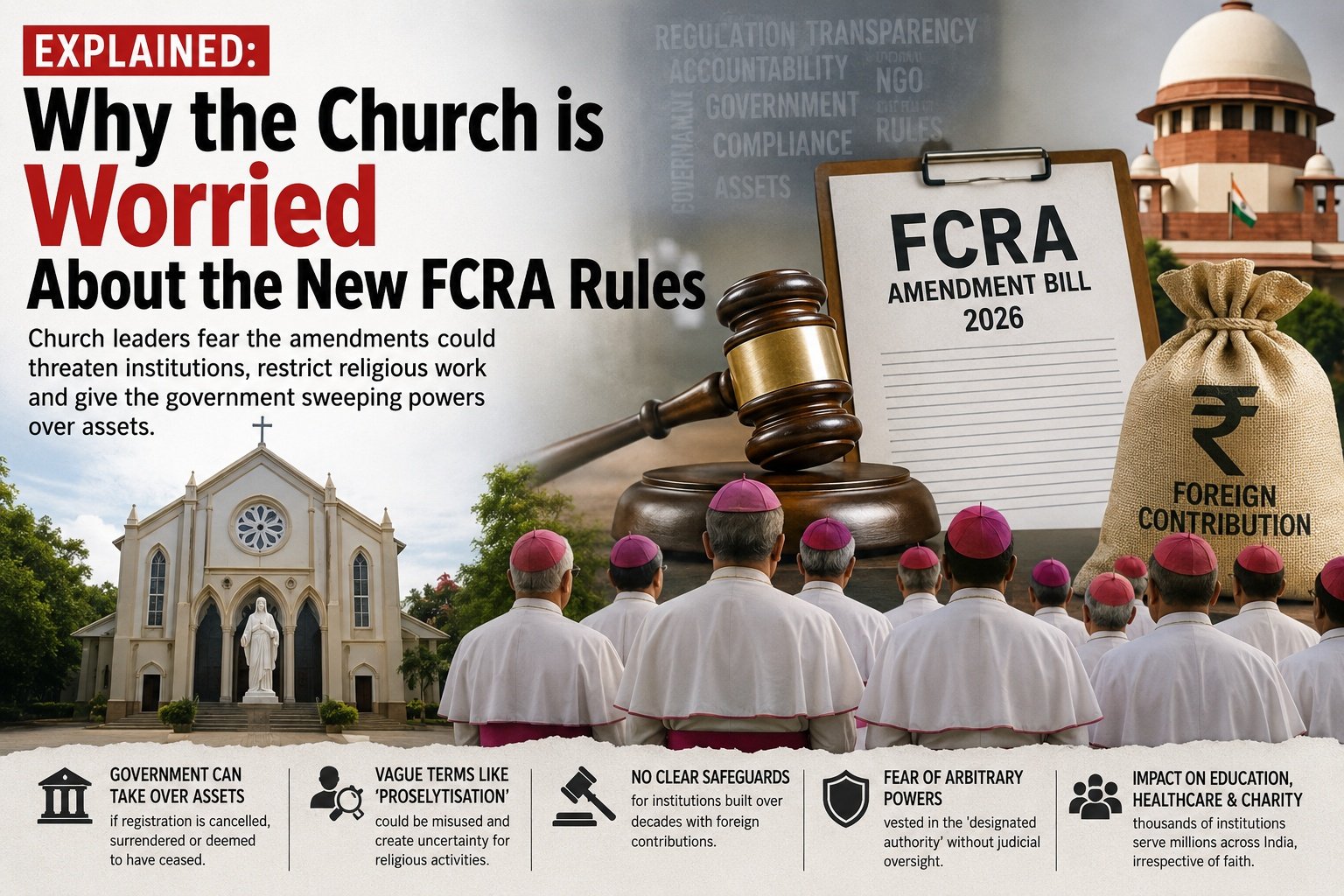
Church leaders say vague provisions on “proselytisation,” expanded government powers and the absence of safeguards for existing institutions could jeopardise schools, hospitals and social welfare programmes serving millions.
BY PC Bureau
New Delhi: The Catholic Bishops’ Conference of India (CBCI), the country’s apex Catholic body, has mounted one of its strongest interventions in recent years against proposed changes to the Foreign Contribution (Regulation) Act (FCRA), arguing that the amendments could fundamentally alter the relationship between the government and thousands of charitable institutions run by churches.
The concerns were serious enough for a high-level delegation led by CBCI President Cardinal Anthony Poola to meet Union Home Minister Amit Shah in New Delhi. The delegation sought assurances that the proposed law would not adversely affect educational institutions, hospitals, orphanages, tribal welfare programmes and humanitarian organisations that depend partly on foreign donations.
Although the Home Minister assured the delegation that the law would not operate retrospectively, the Church says several provisions continue to raise significant constitutional and operational concerns.
In typical BJP fashion, HM Amit Shah has lied to the CBCI about FCRA and is wrongly deflecting blame to hide his government’s culpability in weaponising the FCRA laws.
In reality, the Modi Government has been hell bent on using the FCRA to harass vocal civil society…
— K C Venugopal (@kcvenugopalmp) July 10, 2026
What is the FCRA?
The Foreign Contribution (Regulation) Act regulates foreign donations received by individuals, associations and non-governmental organisations (NGOs) in India.
Any organisation receiving foreign funds for educational, religious, cultural, social or economic activities must obtain FCRA registration from the Union Ministry of Home Affairs and comply with strict reporting and accounting requirements.
The government says the law is intended to ensure transparency, prevent money laundering and stop foreign funding from being used for activities that threaten India’s sovereignty or public order.
What Has Changed?
The proposed 2026 amendments, along with the recently notified FCRA Rules, introduce sweeping new powers for the Central government.
The most contentious provision allows the government to take over, manage or transfer assets created from foreign contributions if an organisation’s FCRA registration is cancelled, surrendered, expires or is deemed to have ceased.
The amendments also create a “designated authority” empowered to administer or dispose of those assets.
In addition, the new Rules require organisations to classify every activity under specific categories and prohibit “proselytisation” as an approved religious activity.
It is these provisions that have alarmed Christian institutions across the country.
My sincere thanks to Home Minister @AmitShah ji for patiently addressing the concerns raised by the CBCI leadership and explaining the FCRA amendments in detail.
As I have said from the very beginning, BJP/NDA and I have always been ready to facilitate dialogue with the… pic.twitter.com/KDZdBxh6Jc
— Rajeev Chandrasekhar 🇮🇳 (@RajeevRC_X) July 11, 2026
Why Is the Church Concerned?
1. Fear of Losing Institutions Built Over Decades
The Church’s biggest concern is not foreign funding itself but what happens to hospitals, schools, colleges, hostels, orphanages and community centres if an organisation loses its FCRA licence.
Many of these institutions have been built over decades through donations from overseas churches and charities.
Under the proposed law, these assets could potentially come under government control.
The CBCI argues that such institutions were established for charitable purposes and should continue serving those objectives rather than being transferred elsewhere.
2. Concerns Over Retrospective Application
Although Amit Shah reportedly assured Church leaders that the amendments would not apply retrospectively, the CBCI wants this protection explicitly written into law.
Without clear statutory safeguards, it fears uncertainty over properties legally acquired years before the amendments.
The Conference has therefore sought “saving clauses” and transitional provisions protecting vested rights and ongoing charitable work.
3. Broad Powers Given to the Government
The Church believes the proposed “designated authority” would exercise enormous powers over NGO assets.
It has suggested that any such authority should instead function under judicial supervision, preferably headed by a judicial officer answerable to a High Court.
According to the CBCI, independent oversight would reduce the possibility of arbitrary decisions.
4. The Undefined Word ‘Proselytisation’
Perhaps the most sensitive issue concerns the inclusion of the word “proselytisation” in the new Rules.
The Rules prohibit foreign funds from being used for proselytisation but do not define the term.
The Church argues that this ambiguity creates uncertainty because religious activities such as prayer meetings, Bible classes, retreats or pastoral work could potentially be interpreted differently by different authorities.
The CBCI has therefore requested that the term either be clearly defined or removed altogether.
5. Distinguishing Mistakes From Serious Violations
Church organisations also want the law to distinguish between procedural errors—such as delays in filing returns—and deliberate criminal violations.
They argue that minor administrative lapses should not result in severe penalties like cancellation of registration or loss of assets.
Why Does This Matter to the Church?
The Catholic Church is among India’s largest providers of non-government education and healthcare.
Its institutions operate thousands of schools, colleges, hospitals, dispensaries, orphanages, homes for the elderly and programmes for tribal and rural communities.
Many receive support from international Catholic charities and missionary organisations.
Church leaders argue that restrictions on foreign funding or uncertainty over institutional assets could affect services delivered to millions of Indians irrespective of religion.
READ: Manipur: How Kuki-Zo people Built a Bridge Against All Odds
What Is the Government’s Position?
The Union government has rejected suggestions that the amendments target Christians or any particular community.
According to those present at the meeting, Amit Shah told the delegation that Christian organisations receive only around ₹3,000 crore out of nearly ₹17,000 crore in total foreign contributions entering India annually.
He reportedly emphasised that the law seeks only to regulate foreign funding, improve transparency and prevent misuse.
The Home Minister also assured the delegation that organisations facing difficulties could approach the Ministry directly.
Wider Concerns Beyond FCRA
The CBCI also used the meeting to raise broader issues affecting the Christian community, including attacks on churches, anti-conversion laws in several states, the continuing humanitarian crisis in Manipur and the denial of Scheduled Caste status to Dalit Christians.
While these concerns extend beyond the FCRA debate, Church leaders say they contribute to a wider sense of insecurity among Christian institutions.
What Happens Next?
The proposed FCRA Amendment Bill was introduced in Parliament earlier this year but was not taken up after Opposition protests.
However, many of its provisions have since appeared in the notified FCRA Rules, prompting fresh criticism from church bodies and civil society organisations.
The CBCI has urged the government to withdraw both the proposed amendments and the Rules, undertake wider consultations with stakeholders and redraft the framework to balance transparency with constitutional protections for charitable institutions.
For the Church, the issue goes beyond regulatory compliance. It is about preserving institutions built over generations that provide education, healthcare and humanitarian assistance across India. For the government, the challenge is to reassure religious and charitable organisations that stronger oversight of foreign funding will not come at the cost of their autonomy or their ability to serve vulnerable communities.