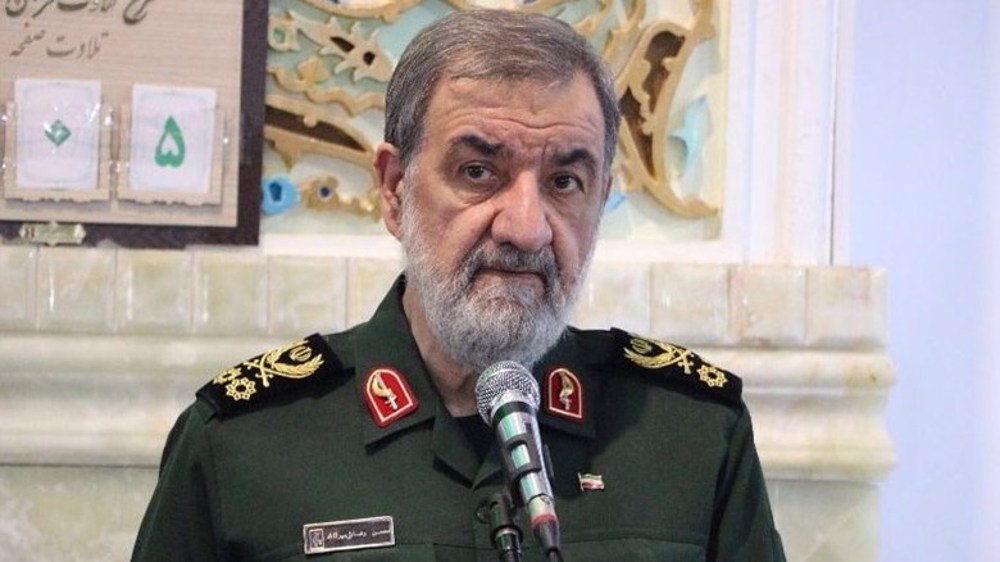
Iran has issued a stark warning to the United States, threatening to sink American naval vessels and capture troops if tensions in the Strait of Hormuz continue to escalate.
BY PC Bureau
April 30, 2026 — The already volatile confrontation between Iran, the United States, and Israel has entered a more dangerous phase, with Tehran issuing sweeping warnings of devastating retaliation, unveiling hints of new military capabilities, and tightening its grip over the strategically crucial Strait of Hormuz.
At the center of the latest escalation is Mohsen Rezaei, a senior figure in Iran’s political-military establishment and former chief of the Islamic Revolutionary Guard Corps (IRGC). Speaking on Wednesday, Rezaei warned that any renewed aggression by Washington would prove “catastrophic” for the United States, predicting heavy losses in both personnel and military assets.
“History will record that the Iranian nation sank the American superpower in the Persian Gulf and the Sea of Oman,” he said, adding that U.S. forces risk having vessels destroyed and troops captured if the conflict intensifies. He further claimed that even American military insiders have privately acknowledged the risks of continued confrontation.
Rezaei’s remarks were framed as a direct message tied to the leadership circle of Ayatollah Seyyed Mojtaba Khamenei, reinforcing Tehran’s position that it is prepared for a prolonged and potentially expanded conflict.
New Weapon Threat and Military Signaling
Adding to the tension, Iranian Navy Commander Shahram Irani recently revealed that Iran is on the verge of deploying a new, unspecified weapon system—one he described as something adversaries are “deeply afraid of.” In a pointed remark, he suggested the weapon is already positioned close to enemy forces, signaling both capability and intent.
While details remain undisclosed, analysts interpret the statement as part of a broader strategy of psychological deterrence—aimed at raising uncertainty within U.S. and Israeli military planning. Such rhetoric, combined with Iran’s demonstrated missile and naval capabilities, has heightened concerns about asymmetric warfare in confined waterways like the Strait of Hormuz.
Iran has also claimed it conducted multiple missile operations targeting the U.S. aircraft carrier USS Abraham Lincoln, allegedly disrupting flight operations—though these claims remain unverified by independent sources.
READ: NYC Mayor Urges King Charles to Return Koh-i-Noor to India
Retaliation Campaign and Regional Impact
According to Iranian officials, the country has carried out more than 100 retaliatory strikes across West Asia since the latest hostilities erupted. These operations, Tehran says, targeted sensitive U.S. and Israeli positions and demonstrated that Iran retains substantial military strength despite sustained attacks.
Rezaei warned that future escalation could include the capture of American forces, a move that would dramatically raise the stakes and potentially trigger a broader regional war.
He also emphasized that Iran remains committed to avenging its losses, framing the conflict not only as a geopolitical struggle but also as a matter of national honor and long-term resistance.
Hormuz: The Global Pressure Point
The Strait of Hormuz—through which nearly 20% of the world’s oil supply flows—has once again become the epicenter of the crisis. In response to what it calls illegal U.S. naval actions and the seizure of Iranian vessels, Tehran has imposed strict maritime controls.
While not fully closed, the strait now operates under heightened Iranian oversight, with ships required to coordinate with Iranian authorities for safe passage. Officials warn that any unauthorized approach by U.S. or allied vessels could trigger immediate military action.
The impact has been swift and global. Energy markets have reacted sharply, with oil prices surging amid fears of supply disruption. In the United States, rising fuel costs have added domestic pressure on the administration of Donald Trump, whose approval ratings have been affected by the economic fallout.
New round of war to be catastrophic for US: Leader’s advisor https://t.co/lwObvR3EmE
— Press TV 🔻 (@PressTV) April 29, 2026
Trump’s Strategy and Diplomatic Gridlock
President Trump has maintained a hardline approach, rejecting Iran’s proposal to reopen the strait in exchange for lifting the blockade and postponing nuclear negotiations. He has argued that economic pressure—particularly the naval blockade on Iranian oil exports—is more effective than direct military engagement.
“They can’t have a nuclear weapon,” Trump reiterated, underscoring Washington’s central demand.
Although a temporary lull in attacks was announced earlier this month and later extended, the continued blockade has effectively undermined ceasefire conditions, leaving diplomatic channels stalled.
Rezaei suggested that internal U.S. politics could shape the next phase of the crisis, arguing that Trump may shift responsibility onto Congress depending on whether lawmakers back continued military action.
Iran’s Conditions and Strategic Messaging
Tehran has laid out a series of conditions for de-escalation, including a complete cessation of hostilities, removal of sanctions, and compensation for damages. Rezaei described these terms as the “least costly option” for Washington.
At the same time, he dismissed speculation about instability within Iran’s leadership, asserting that the country remains firmly governed and capable of managing the conflict.
He also pointed to broader geopolitical shifts, claiming that European allies are increasingly distancing themselves from U.S. policy and questioning Washington’s ability to ensure their security.
A Precarious Moment
With threats of advanced weaponry, warnings of naval confrontation, and mounting economic consequences, the standoff is rapidly approaching a critical juncture. The combination of military posturing and diplomatic deadlock has created a highly combustible environment in and around the Strait of Hormuz.
Security analysts warn that even a minor miscalculation—whether at sea or through misinterpreted signals—could trigger a broader conflict with far-reaching global implications.
For now, the world watches as one of the most strategically sensitive regions teeters on the brink, with both sides showing little sign of backing down.