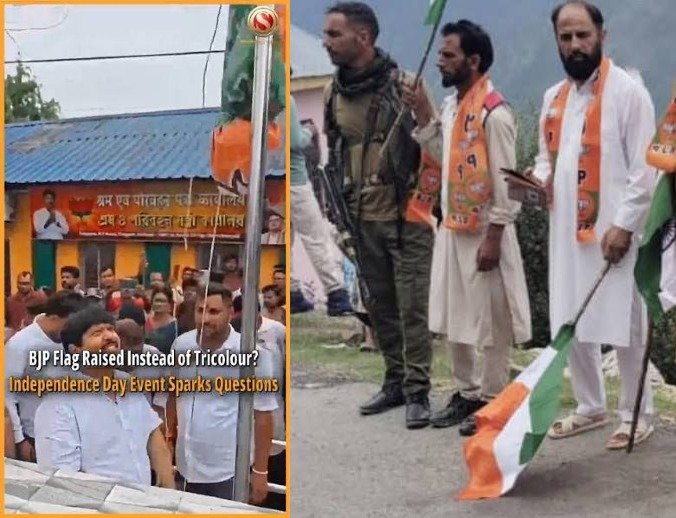
From party flags allegedly replacing the Tiranga to claims of improper handling of the national flag, the controversies highlight the need for equal standards, verified facts and respect for India’s national symbol.
BY Navin Upadhyay
August 16, 2026: The Tiranga occupies a unique place in India’s public life. It is a national symbol, an object of deep emotional attachment and, increasingly, a fixture in political theatre. Every Independence Day, millions of Indians hoist the national flag with pride. Yet, alongside those celebrations, images and videos often emerge showing the Tricolour being mishandled, misused or treated as though it were simply another piece of political or decorative material.
Independence Day 2026 was no different.
Videos and reports from different parts of the country highlighted several alleged instances of disrespect to the national flag—from a political party flag reportedly being hoisted instead of the Tricolour to the national flag being displayed upside down, left on the ground or allegedly used for personal purposes.
Some of these incidents warrant further verification, particularly when the claims originate on social media. Others have been reported by news organisations. But taken together, they raise a larger question:
Why does respect for the national flag so often become a matter of political convenience, rather than a basic civic responsibility?
One Union Minister of State uses Tiranga as a piece of cloth to wipe off sweat.
One Police officer uses Tiranga to wipe off nise and throws it.
One uses it as a piece of clothing.
But only one will be persecuted in New India 🤦 pic.twitter.com/nCihv0u5BV
— D (@Deb_livnletliv) August 15, 2026
When a party flag replaces the national flag
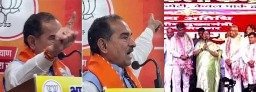
Among the most politically contentious incidents were videos from Chhattisgarh and West Bengal that purportedly showed BJP workers hoisting the party’s saffron flag in place of the national Tricolour during Independence Day-related events.
If the footage accurately represents what happened, there is little justification for it.
Independence Day is not a BJP occasion, a Congress occasion, a TMC occasion or an event belonging to any political organisation. It is a national celebration.
A party flag represents a political organisation. The Tiranga represents the Republic.
The distinction should be obvious.
The irony becomes greater when such an incident allegedly occurs in a state governed by the same political party. But the principle is universal. If a Congress, TMC, AAP, Left or any other party’s flag were substituted for the national flag during an official Independence Day ceremony, the criticism should be equally strong.
The Tiranga does not become more sacred when someone from our political camp is holding it.
The controversy involving Bandi Sanjay
Another controversy centred on Union Minister of State for Home Affairs Bandi Sanjay, who appeared in a video to wipe his face with a tricolour-coloured cloth during an event connected with Independence Day activities.
The footage triggered criticism from political opponents, who accused him of disrespecting the national flag. His defenders argued that the material was a traditional kanduva or scarf in the national colours rather than the official national flag.
That distinction is important.
Not every piece of orange, white and green fabric constitutes the national flag. The Tiranga has prescribed colours, proportions and the Ashoka Chakra.
Yet the episode raises a broader question of public judgment.
BJP leaders start hoisting their party flag instead of the Tiranga, will anyone even dare to question it?
The national flag is not optional. Respect for the Tricolor is non-negotiable, party symbols come second.
Or has the idea of “nation first” already been replaced by “party… pic.twitter.com/ePh41nQoVv— Aaradhya Pandey (@AaradhyaViews) August 15, 2026
When something closely resembles the national flag, why use it for wiping one’s face?
Public figures, particularly ministers, carry an additional responsibility. Even conduct that may not technically amount to an offence can be needlessly insensitive when it involves a symbol held in such high regard by millions.
READ: Former Bengal Deputy Speaker Found Hanging at TMC Office
The viral video involving a woman
Another widely circulated video allegedly showed a woman using what appeared to be the national flag as an undergarment.
This case demonstrates another danger: the speed with which social media turns an allegation into a verdict.
A viral video is not automatically proof of identity, intention, authenticity or context. Footage can be edited, recycled from previous years or accompanied by misleading captions.
If the material genuinely depicts the national flag being used as clothing below the waist, the matter deserves scrutiny under the applicable rules. But identifying an individual from an unverified social-media post, circulating her personal information and demanding punishment before the facts are established is not responsible citizenship.
Respect for the national flag should not become an excuse for abandoning due process.
The quieter forms of disrespect
Some of the incidents reported around Independence Day were less politically dramatic but perhaps more revealing.
In Korba, Chhattisgarh, a Tricolour was reportedly hoisted upside down at an Anganwadi centre.
In Ambikapur, a video reportedly showed a cleaner sweeping over a national flag lying on the floor.
In Agra, discarded national flags were reportedly found among garbage, prompting concerns over the way flags are distributed and disposed of after Independence Day celebrations.
These incidents expose a problem that cannot be solved simply by accusing someone of being anti-national.
Sometimes disrespect is deliberate.
Sometimes it is ignorance.
Sometimes it is negligence.
And sometimes it results from treating the national flag as a disposable Independence Day accessory.
The danger of selective outrage
Perhaps the most troubling aspect of these controversies is not any single incident but the political response to them.
When someone associated with an opposing political camp mishandles the Tiranga, the incident can quickly become evidence of anti-nationalism.
When someone from our own political camp is accused of doing the same thing, explanations suddenly appear.
It was not the national flag.
It was a scarf.
It was accidental.
The video was edited.
The person did not mean it.
The opposition is politicising the issue.
This pattern cuts across India’s political spectrum.
But national symbols cannot be subject to partisan standards.
The Tiranga stands above the BJP, Congress, TMC, Left and every other political organisation. It stands above governments and opposition parties alike.
That is precisely what makes it a national symbol.
The law matters—but so does education
The Flag Code of India establishes rules governing the display of the national flag, while the Prevention of Insults to National Honour Act, 1971, provides penalties for certain acts involving intentional insult to the national flag and other national symbols.
Where there is credible evidence of a deliberate violation, authorities should investigate and take action in accordance with the law.
But punishment alone will not solve the problem.
Children should be taught why the national flag is treated differently from an ordinary piece of cloth. Schools, government offices and public institutions should understand the rules governing its display and disposal. Political parties should ensure their workers know that Independence Day and Republic Day are national occasions—not opportunities for partisan symbolism.
And citizens should understand that there is a difference between an accidental mistake, ignorance, negligence and a deliberate insult.
That distinction is essential for a democracy governed by law.
A different picture from Bastar
There was also another set of images from Chhattisgarh this Independence Day—ones that carried a very different symbolism.
The Tricolour was reportedly hoisted for the first time in parts of Bastar that had once been considered strongholds of Left-wing extremism, including areas around the Karreguttalu Hills and several villages.
Whatever one’s political affiliation, those images carried considerable symbolic weight.
A national flag flying peacefully in an area where the Indian state once struggled to maintain a sustained presence represents the expansion of state institutions and civic participation.
That is fundamentally different from replacing the national flag with a political party flag during an Independence Day celebration.
One reinforces the idea of a common nation.
The other risks reducing a national occasion to partisan spectacle.
Don’t turn the Tiranga into a political weapon
There is a larger lesson here.
Patriotism is not demonstrated by shouting the loudest about who is or isn’t patriotic. Nor is it established by selectively condemning people whose politics we dislike.
The correct response to an alleged insult to the national flag is straightforward:
Verify the facts. Establish intent. Apply the law. Educate the public. And apply the same standard to everyone.
If a BJP worker deliberately disrespects the Tiranga, condemn it.
If a TMC worker does so, condemn it.
If a minister does it, condemn it.
If an ordinary citizen deliberately violates the law, the same legal standards should apply.
And if somebody is falsely accused because an unverified social-media post went viral, the law should protect that person too.
Because the Tiranga belongs to none of them.
It belongs to all of us.
And perhaps the best way to honour it is not to use it as a political weapon, but to remember what it actually represents: India.