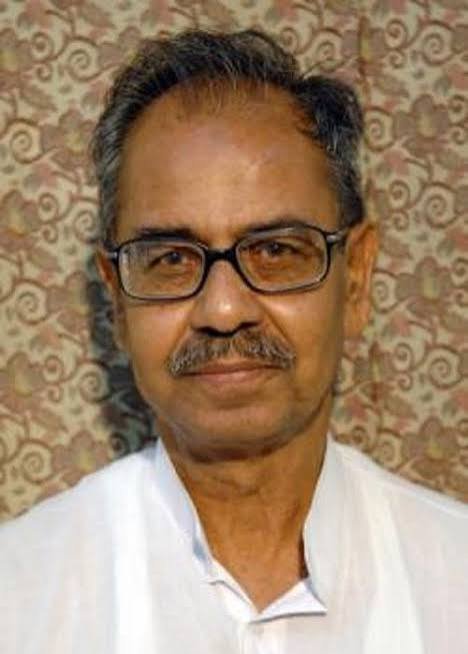
Veteran TMC leader Asish Banerjee, a close associate of Mamata Banerjee, was found hanging inside a Trinamool Congress office in Birbhum. Police have sent his body for postmortem and begun an investigation.
BY PC Bureau
Kolkata/ August 16, 2026: Former West Bengal deputy speaker and five-time Trinamool Congress MLA Asish Banerjee was found hanging inside a TMC office adjoining his residence in Rampurhat, Birbhum, on Sunday morning, police said. The 74-year-old veteran leader’s body was sent for postmortem examination.
The discovery triggered a rush of party workers, supporters and local residents to the area around Banerjee’s residence and the TMC office. Police have begun an investigation and further details are awaited.
A quarter-century as Rampurhat’s TMC face
Banerjee’s political career was closely intertwined with the rise and consolidation of the Trinamool Congress in Birbhum.
A former associate professor of Bengali at Rampurhat College, Banerjee entered electoral politics after an earlier association with the Congress and unsuccessfully contested the Rampurhat Assembly seat three times before winning it for the first time on a TMC ticket in 2001. He subsequently retained the constituency in 2006, 2011, 2016 and 2021, making him a five-time MLA.
His victories reflected the strength of the TMC organisation in Rampurhat. In 2016, Banerjee defeated Congress candidate Syed Siraj Jimmi by more than 21,000 votes. In 2021, he again retained the seat, defeating BJP candidate Subhasis Choudhury by 8,472 votes.
He subsequently rose within the state government, handling ministerial responsibilities including Ayurveda, Yoga and related systems, Biotechnology and Statistics and Programme Monitoring before becoming Agriculture Minister in 2017. He served as Agriculture Minister until 2021.
In July 2021, Banerjee was elected Deputy Speaker of the West Bengal Assembly, a post he held until the end of the previous Assembly’s term in May 2026.
The 2026 election changed his political fortunes
The Assembly election held earlier this year marked a dramatic break in Banerjee’s political record.
After winning Rampurhat in five successive elections, he was defeated by BJP candidate Dhruba Saha in 2026. Election data shows Saha polled 111,920 votes against Banerjee’s 87,687, defeating the veteran TMC leader by 24,233 votes.
The defeat was particularly significant because Rampurhat had remained a TMC stronghold for a quarter of a century. Banerjee’s first victory came in 2001, and the party had retained the constituency through successive elections even as the BJP gradually expanded its presence in the region.
Banerjee’s defeat was also part of a much larger political reversal in Birbhum.
Birbhum’s political map was redrawn
The 2026 election dramatically weakened the TMC’s once formidable hold over Birbhum. The BJP won six of the district’s 11 Assembly constituencies, while the TMC retained five. In the 2021 election, the TMC had won all 11 seats in the district.
Banerjee himself acknowledged the scale of the setback when he resigned in June as chairman of the Birbhum district TMC core committee and district chairman. He said the core committee had become non-functional and that he would thereafter remain an ordinary member of the party.
The change was stark. The BJP retained or captured several constituencies in a district that had long been regarded as a major TMC bastion. Overall, the BJP’s breakthrough in Birbhum was part of its broader advance across southern West Bengal.
The electoral reversal also carried symbolic weight because Birbhum had been one of the districts where the TMC’s organisational machinery had traditionally been considered particularly strong.
From Mamata loyalist to a leader at the centre of Bengal’s political transition
Banerjee’s career mirrored several stages of the TMC’s evolution—from its expansion as an opposition force to its transformation into West Bengal’s dominant political party and, later, the emergence of the BJP as its principal challenger.
He was regarded as a trusted figure within the party and had occupied important governmental and legislative positions without becoming one of the most nationally visible faces of the TMC. His political base remained firmly rooted in Rampurhat and Birbhum.
His association with the party leadership also placed him at the centre of several episodes involving the TMC’s internal politics in Birbhum. In 2022, he drew attention during a period of factional tensions following the Bogtui violence, when questions were raised about competing power centres within the district organisation. The episode underscored the increasingly complex factional politics of Birbhum.
Yet Banerjee’s political longevity was notable. He survived changes in the party’s internal hierarchy, shifts in electoral alliances and the BJP’s rapid rise in Bengal, remaining the TMC’s candidate in Rampurhat for five consecutive victories before his defeat this year.
READ: Facing CJP Fury, BCI Chief Apologises to NALSAR Students
The 2026 Bengal verdict: a historic BJP breakthrough
Banerjee’s defeat has to be viewed against the backdrop of one of the most dramatic electoral reversals in recent West Bengal politics.
According to Election Commission results, the BJP won 207 of the 294 Assembly seats, while the TMC was reduced to 80. Congress won two seats, while the Aam Janata Unnayan Party won two; the CPI(M) and All India Secular Front won one each.
The result represented a fundamental shift from the 2021 election, when the TMC had won 215 seats and the BJP emerged as the principal opposition force.
The BJP’s gains were particularly striking in southern Bengal, where the TMC had historically enjoyed a much stronger organisational network. Birbhum was among the districts where that change was visible: the BJP went from having no Assembly seat in the district in 2021 to winning six in 2026.
The shift also explains the significance of Banerjee’s personal defeat. His loss was not simply the fall of a veteran legislator; it symbolised the collapse of a political arrangement that had kept Rampurhat and much of Birbhum firmly within the TMC camp for years.
A political career that ended abruptly
Banerjee’s exit from electoral politics had already been accompanied by a gradual withdrawal from organisational responsibilities. His June resignation from the Birbhum core committee came after the TMC’s unprecedented losses in the district. At the time, he said he would continue as an ordinary party member.
His death now comes against that backdrop of political upheaval.
For a leader who had spent a quarter of a century representing Rampurhat, the sequence of events has been striking: defeat in a constituency he had won five times, withdrawal from a key organisational position and, less than three months later, death inside a party office close to his home.
The immediate focus, however, remains on the police investigation. With the postmortem examination pending and investigators examining the circumstances surrounding the discovery of his body and the purported note, the precise circumstances of Banerjee’s death remain to be established.