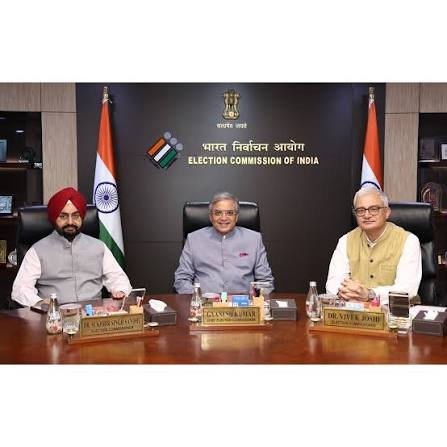
While the ECI says differing views, written notes and internal checks are a normal part of decision-making, its clarification does not specifically address questions over the alteration of Form 6, West Bengal appeals, ERONet access and key decisions allegedly not placed before the full Commission.
BY Navibn Upadhyay
September 23, 2026: The Election Commission’s clarification, issued after an Indian Express report highlighted multiple objections recorded by Election Commissioners Vivek Joshi and Sukhbir Singh Sandhu over the past 10 months, seeks to portray the differences as normal internal checks and balances. But the eight-point response does not specifically address several questions raised by the two commissioners — whether statutory Form 6 was altered without due authority, who authorised the filing of mass appeals in West Bengal, why some field officers said they lacked full access to the electoral-roll database, and whether key administrative and technical decisions were placed before the full three-member Commission.
The note, ECI/PN/119/2026, signed by Deputy Director P. Pawan, says written notes, observations and “internal checks-and-balances” are normal features of institutional deliberation. Differences, it says, are part of the process before a final decision is taken. It also argues that highlighting selected notes from a 10-month period gives only “one part of the picture”, pointing instead to a larger body of unanimous decisions and “around 40 new initiatives”.
VIDEO | Delhi: Former Chief Election Commissioner SY Quraishi says, “Supreme Court in one judgment in 1995, TN Seshan versus the government, had very clearly said that Commission is not one person. The CEC Commission is three members and the act which was passed made it very… pic.twitter.com/naksQu3CEa
— Press Trust of India (@PTI_News) September 23, 2026
On data systems, the Commission says ECINet operates under strict security protocols and that Electoral Registration Officers (EROs) and District Election Officers (DEOs) continue to exercise their statutory powers. The note concludes by reaffirming the Commission’s commitment to electoral integrity.
Those broad assurances, however, do not directly address the substance of the objections recorded by Joshi and Sandhu.
Form 6: Was the statutory form altered without authority?
Form 6 is prescribed under the Registration of Electors Rules, 1960. Changes to the statutory form require the prescribed legal process; they cannot simply be introduced through an SIR guideline or an alteration to an election-technology platform.
On May 16, 2026, Vivek Joshi recorded that the Special Intensive Revision was a one-time revision under Section 21(3) of the Representation of the People Act, 1950. He noted that the enumeration forms used for the exercise were non-statutory, but Form 6 and Form 8 were statutory forms and could not be rewritten through an SIR order. He said any proposal for changing them should be sent to the government and a draft placed before the full Commission.
READ: ‘Impeach Him, Prosecute Him’: Opposition Steps Up Attack on Gyanesh Kumar
READ: Opinion: Why SC Hearing on CEC Immunity Needs Urgency
Sandhu concurred three days later.
The online Form 6 on ECINet was nevertheless subsequently altered. Applicants were required to answer whether their own name, or that of a parent or grandparent, appeared in the previous SIR roll, or whether none did. Although the additional section was not labelled mandatory, the form could not be submitted without an answer.
After the change was reported in July, Sandhu wrote on August 13 that the alteration was “unauthorised/illegal” and should be removed immediately. He argued that the additional requirement could create an obstacle for first-time voters whose families were absent from earlier electoral rolls.
The September 23 press note does not mention Form 6. It does not say whether the additional questions were approved by the full Commission, whether the prescribed statutory process was followed, or whether the alteration was subsequently withdrawn.
Describing the commissioners’ objections as “suggestions for further improving the electoral processes” or “inputs raised during draft stages” does not, by itself, resolve a specific written objection concerning an alteration that had already been implemented.
Official Press Note pic.twitter.com/xIQvXHqMSt
— Election Commission of India (@ECISVEEP) September 23, 2026
West Bengal appeals: Who authorised them?
A second unresolved issue concerns appeals arising from the electoral-roll exercise in West Bengal.
Following Supreme Court intervention, judicial officers examined voters identified through the exercise for “logical discrepancies”, and the Commission deleted about 27 lakh electors. Retired High Court judges were subsequently appointed to hear appeals. The Commission informed the court that around 38 lakh appeals were pending, including approximately 16.10 lakh against voters whom the judicial officers had included.
Sandhu subsequently asked who had authorised the Commission to file those appeals, who had filed them and under what procedure. He recorded that neither he nor Joshi, nor the then West Bengal Chief Electoral Officer, had been informed of the basis or procedure.
The issue therefore went beyond the merits of individual appeals. It raised a question about institutional authority: who was acting in the Commission’s name, and whether such action had been placed before all three members.
The September 23 press note is silent on those questions. It refers instead to the successful conduct of major elections, including West Bengal, and to “many Commission approvals and instructions”.
That does not identify the authority that approved the appeals, explain the filing process, or address the recorded assertion that two commissioners and the state Chief Electoral Officer were not informed of the basis for them.
Database control, ERONet access and the proposed audit
The statutory framework places preparation and maintenance of electoral rolls, and decisions on claims and objections, within the election machinery headed by EROs, DEOs and Chief Electoral Officers.
Internal notes by Sandhu and Joshi raised concerns that changes to the information-technology system were increasingly concentrating control over the electoral-roll database.
In November 2025 and January 2026, Deputy Election Commissioner Sanjay Kumar, acting on Sandhu’s directions, instructed that software should not override statutory functions or restrict the discretion of EROs.
On April 16, Sandhu recorded that several new modules and portals had been developed without being shown to him or to the Commission, with some information reaching him through the media.
On May 29, Joshi warned of “gradual centralisation of the electoral roll database” and proposed an independent audit, including examination by an IIT expert, to establish whether only statutory officers possessed credentials to alter the database. Sandhu endorsed the proposal in July.
On August 14, Sandhu recorded that he still did not know what action had been taken. He also said several CEOs, DEOs and EROs had told him they lacked “proper and complete access” to ERONet. He said the Director General of IT, Seema Khanna, had no authority to restrict such access and directed that it be restored.
The press note says ECINet operates under “strict data security protocols” and that IT security checks and audit controls are standard. It also states that EROs and DEOs continue to function according to their statutory powers.
But it does not say whether the proposed independent audit was conducted, whether field officers now have full access, or why new modules were introduced without being placed before the two commissioners who subsequently raised objections.
Work allocation and the Cabinet Secretary letters
Another unresolved episode concerns the Election Commission’s internal work allocation.
Until late July, Sanjay Kumar oversaw the IT division and routed its files to the three-member Commission. On July 28, Senior Deputy Election Commissioner Maneesh Garg, holding additional charge of administration, issued an order removing Kumar from that role.
Sandhu and Joshi objected separately the following day in letters to Cabinet Secretary T.V. Somanathan, describing the order as a “clear violation” of the law governing the Commission.
On July 30, the two commissioners jointly set the order aside, describing it as having been issued “without any reason and justification”, and directed that the earlier arrangement continue until consensus was reached. The note was copied to CEC Gyanesh Kumar.
The September 23 press note does not mention the work-allocation order, the letters to the Cabinet Secretary or the subsequent action by the two commissioners.
Its assertion that official orders and administrative directions carry full legal sanction and follow established statutory procedures does not address why two members of the Commission separately told the country’s top civil servant that a particular order violated the law.
Goa: 97 eligible voters and a software problem
The Goa episode raises another question about the relationship between statutory authority and the technology used to implement it.
Following a January 29 Supreme Court order, EROs in Goa examined voters flagged for “logical discrepancies”. They found 97 people eligible.
Between February 11 and 17, the Goa Chief Electoral Officer’s office reportedly wrote eight times to Senior Deputy Election Commissioner Gyanesh Bharti, with IT Director General Seema Khanna copied, seeking a rollback facility so that the EROs’ decisions could be entered into the system.
The requests were not acted upon in time. Because the software lacked a mechanism to record the restorations, the 97 names remained off the final roll.
The September 23 press note contains no reference to Goa or to a software limitation that allegedly prevented statutory officers from recording their own findings.
What does “unanimous” mean?
The Representation of the People Act and the framework governing the Commission contemplate collective decision-making, with differences resolved according to the prescribed procedure.
Sandhu and Joshi’s notes raise a more basic question: whether some of the disputed decisions were actually placed before the full three-member Commission.
The two commissioners reportedly did not have a full meeting with CEC Gyanesh Kumar for four months. The first such meeting during that period was held on September 9, after their letters to the Cabinet Secretary.
Yet the September 23 press note says that “all these decisions are an outcome of the unanimous decisions of the full Commission in the past one year”.
It also says that every officer, and not only the three commissioners, is entitled to offer suggestions.
That framing does not explain the distinction between ordinary suggestions and formal objections recorded by commissioners—some describing an action as “unauthorised/illegal”, some asking who had acted in the Commission’s name, and others being sent directly to the Cabinet Secretary.
Nor does it explain how the claim of year-long unanimity should be understood alongside the four-month gap in full meetings and contemporaneous notes alleging inadequate information or consultation.
Previous public disagreements within the Election Commission, including the Gopalaswami-Chawla dispute in 2009 and Election Commissioner Ashok Lavasa’s minority views on the Model Code, emerged from deliberations within the Commission. The current documents raise a different procedural question: whether some disputed decisions reached that deliberative stage at all.
The Commission’s final point reaffirms its commitment to integrity.
That commitment is important, but it does not answer the narrower questions now on the record: Was Form 6 lawfully altered? Who authorised the West Bengal appeals? Did statutory field officers have the access required to perform their functions? Were the proposed database audits carried out? And how were decisions taken in the Commission’s name when two of its members say they were not adequately informed or consulted?
Those are the specific questions raised by the commissioners’ own records. The September 23 press note does not, so far, provide specific answers to them.